Crude Oil, Refined Products
October 23, 2025
INTERVIEW: ONGC plans to set up crude, products trading unit, joining global oil majors

HIGHLIGHTS
Aiming to go live with the trading unit in March 2026
Unit will trade in both crude oil and refined products
India's Oil and Natural Gas Corp. Ltd. is aiming to create a crude and refined products trading unit, a move that would help diversify the company's business and help capture arbitrage opportunities in a global market flush with cargoes, a top ONGC official told Platts, part of S&P Global Energy, Oct. 23.
The move will not only help the state-run company to align with many of the global oil majors which have their own trading units, but it will also help all the group companies under ONGC -- Hindustan Petroleum Corp. Ltd., Mangalore Refinery and Petrochemicals Ltd, and ONGC Petro Additions Ltd. -- to approach the global market as a single, unified face, in a coordinated manner, both for exports of products as well as for crude imports, Satyan Kumar, executive director at ONGC, said in an exclusive interview.
"A lot of global oil companies are making sizable contributions to their top line as well as their bottom line by establishing trading arms in their organizations. Therefore, we think ONGC and its group companies are very well placed to start this trading unit. It will have the potential to unlock $1 billion in value for ONGC annually, primarily by enhancing our commercial agility to optimize our existing assets, diversify our revenue streams, and eliminate value leakage," Kumar, who is also the former head of corporate strategy, said.
ONGC is looking at both India and overseas locations to set up its trading unit, but has not yet reached a decision on the exact location, Kumar said, adding that the company was looking to go live with the trading entity by March 2026, a milestone that will be preceded by a period of capability building and knowledge transfer. Following this, the company expects to commence full trading activities in the subsequent quarters.
Capturing global opportunities
"The trading unit can import crude to meet the requirements for all the group companies. This means not only importing to meet our requirements but also proactively sourcing more advantageous 'opportunity crudes' from the global market. At the same time, we also produce crude and if exports are allowed in the future, we can look at exporting when there are good arbitrage opportunities and then importing back the equivalent replacement volumes when the time is right," Kumar said.
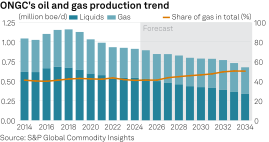
In FY 2024-25 (April-March), ONGC's crude output rose 0.8% year over year to 18.56 million mt, while its gas output fell 1.6% year over year to 19.65 Bcm, according to company officials.
Initially, the new trading entity of ONGC would aim to source crude only for its group refineries but would be open to the possibility to undertake similar trading and sourcing operations for other state-run oil refiners if opportunities arise, Kumar said.
In the products segment, the trading entity would create opportunities from the group companies to offer products in a more systematic manner. "Instead of competing with each other for capturing business for refined products and petrochemicals, this trading entity can help to go to the market in a more united way. By leveraging our collective infrastructure and increasing our operational optionality, they can draw a lot of strength from that," Kumar said.
Business diversification
In a recent interview with Platts, HPCL Chairman and Managing Director Vikas Kaushal said that HPCL was moving towards a crude sourcing model that optimizes the term and spot contracts, as refinery technology upgrades and expansions are creating bandwidth to process a wider array of feedstocks and take advantage of a market flush with supplies.
As new shipping and trade flow lanes open, the move is part of a strategy among India's state-run refiners to rebalance their imports to ensure flexible supplies, optimize refining margins, and cater to upgraded refineries that can handle more of the heavier crudes, he added.
HPCL's overall refining capacity -- including joint venture refineries -- is set to expand to 45 million mt/year from the current 36 million mt/year, with the execution of the HPCL Rajasthan Refinery Ltd. (HRRL) project. MRPL has a refining capacity of 15 million mt/year. HPCL is a subsidiary of ONGC.
"There are a lot of scenarios on how far we want to go. We will have to take a lot of precautions as trading comes with its own set of risks, which is why the foundation of this entity will be a sophisticated one, with an independent risk management framework from day one. But we are very optimistic about the fact that the creation of a trading entity will help diversify ONGC's business even further, given all the new initiatives that we are taking to create an integrated energy company," Kumar said.
ONGC CEO Arun Kumar Singh said in a recent interview that the company plans to invest in new reserves and continue to push upstream growth as oil and gas will remain its core business over the next two decades. But renewables, low-carbon technologies, and new energy services would gradually grow their share in ONGC's portfolio.

Editor: