Energy Transition, Crude Oil, Refined Products, Electric Power, Emissions, Gasoline, Diesel-Gasoil, Renewables
October 20, 2026
Democrats may gain platform but lack power to shift EV, fuels policy: analysts

Editor:
HIGHLIGHTS
EV adoption stalls amid policy rollback
Full hybrids surge as gas prices climb
Democratic control of Congress after the November US midterm elections would give the party a larger platform to promote electric vehicles and challenge President Donald Trump's energy policies, but it is unlikely to meaningfully accelerate US EV adoption or a broader fuel transition before the 2028 presidential election.
Congressional Democrats could hold hearings, investigate administration decisions and argue that greater reliance on oil will become increasingly costly. But restoring federal EV incentives or reversing the rollback of vehicle-efficiency rules would require legislation acceptable to Trump or enough congressional support to override his veto, analysts said.
Neither outcome is expected under the likely configurations of the next Congress. S&P Global Energy CERA analysts in a September report expect neither party to secure the 60 Senate votes generally required to end a filibuster or the two-thirds majorities in both chambers needed to override a veto. Even if Democrats win both chambers, major legislation would still require Trump's signature.
The election could therefore change Washington's debate over transportation policy but not substantially change the policies shaping vehicle purchases, experts said.
Republicans' 2025 budget reconciliation legislation ended federal clean-vehicle tax credits and reduced penalties for automakers' noncompliance with Corporate Average Fuel Economy (CAFE) standards to zero. The Trump administration also repealed federal greenhouse gas standards for vehicles and finalized weaker CAFE requirements through model year 2031.
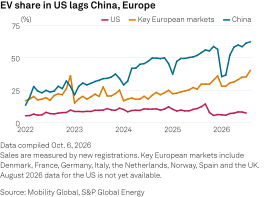
The new CAFE rule requires estimated industrywide light-vehicle fuel economy of 34.9 miles/gallon in model year 2031, up only modestly from an estimated requirement of 32.2 miles/gal in 2026. The previous Biden-era rule targeted 50.4 miles/gal in 2031, although other differences between the regulations make an exact comparison difficult. Those policy changes had already slowed the US' EV transition momentum before the US-Israel war on Iran lifted global fuel prices, reducing the impact of the new price environment on the US market.
According to a S&P Global Energy CERA analysis published Oct. 15, US gasoline demand has marginally declined since the beginning of 2026, averaging 94,000 barrels per day below the 2023-2025 average. But demand is projected to rise in the rest of the year, to 8.9 million b/d.
Meanwhile, "there's little, if any, support" at the federal level for EVs or more fuel-efficient vehicles generally, Jeff Meyer, CERA's director of mobility and energy, said in an interview.
Even under a Democratic Congress, "there would still be the challenge of a veto and then overcoming that veto, which is a very, very high hurdle," Meyer said.
US trails on EV adoption
The US has already lost momentum relative to China, Europe and several other markets following the withdrawal of federal policy support, S&P Global analyses have found.
US battery-electric and plug-in hybrid sales growth has recently stalled, and consumers have increasingly selected full hybrids that do not need to be plugged in, according to a July 29 CERA report. Europe continues to apply stronger policy support through subsidies in some countries and a greenhouse gas framework that encourages automakers to introduce and competitively price more EV models.
Markets open to competitively priced Chinese EVs have also benefited from a broader selection of vehicles and downward price pressure, Meyer said. The US remains relatively insulated from that supply-side effect.
The US also has a different energy-security calculation. Its large domestic oil supply makes the case for replacing petroleum imports with electricity less urgent than in Europe and some Asian economies, Meyer said. Those differences have persisted despite the 2026 increase in oil and gasoline prices.
CERA found that US retail gasoline prices increased by more than 40% between February and June, based on a simple average across the five main US Petroleum Administration for Defense Districts. Yet the US entered the year with little or no momentum toward EV adoption and, despite increased gasoline and diesel costs, has seen fewer EV sales as a percentage of all light vehicles than in 2025, despite the US-Israel war on Iran.
China, the UK, Turkey and several Southeast Asian markets combined higher gasoline prices with stronger existing momentum, positioning fuel costs to accelerate a transition already underway.
"Increased pump prices or retail gasoline or diesel prices are a tailwind, all else equal, including electricity prices," Meyer said. But fuel prices, government support, vehicle availability and other market forces are difficult to disentangle. "It's easier to make an energy security argument from a European perspective, or among some markets in Asia."
In the US, the clearest response to higher gasoline prices has occurred in full hybrids rather than plug-in vehicles.
EV market share bottomed after federal incentives were removed, and has shown only a limited rebound, Meyer said. Full hybrids have gained more visibility, reflecting their smaller price premium over conventional vehicles and their ability to improve fuel economy without requiring drivers to charge. CERA said some consumers now choosing hybrids might have selected battery EVs or plug-in hybrids under a more supportive federal policy environment.
Slower transition
The reduced federal role is not expected to halt US EV adoption altogether.
CERA has lowered its medium-term EV outlook but still expects adoption to increase. The transition is projected to proceed more slowly through at least 2028, supported principally by organic demand, home-charging access and the introduction of compelling models rather than federal incentives, Meyer said.
Nor could a future administration immediately reverse that path. Automakers work on multiyear product-planning cycles, limiting how quickly another change in federal policy could alter the vehicles available to consumers.
A Democratic Congress could put those choices under greater scrutiny and keep EV policy prominent in Washington. But with Trump retaining the veto and control of the executive branch, the US transition would remain driven more by markets and product decisions than by Congress.
Chinese automakers have aggressively pursued increased global market share, but are broadly unable to access the US market. European and Asian countries are "pressing automakers to bring forward more models and price them attractively in order to sell them," Meyer said. "We don't have that kind of stick or carrot in the United States right now."
Oversight rather than legislation
Democrats could use control of congressional committees to press the Trump administration over those policies and make an economic case for shifting transportation and energy consumption away from oil, Robert Glicksman, a professor of environmental law at George Washington University Law School, said.
Debate over the American Affordability and Jobs Act, a permitting reform bill introduced Sept. 30 by Senators Shelden Whitehouse (Democrat-Rhode Island), Martin Heinrich (Democrat-New Mexico), Shelley Moore Capito (Republican-West Virginia) and Mike Lee (Republican-Utah), could increase the salience of renewable energy versus fossil fuel projects in the upcoming Congress. Democrats could seek to demonstrate through debate on that bill and in hearings that renewable energy is becoming cheaper than continued reliance on oil and gas amid high prices and supply disruptions in the Middle East, and argue that additional fossil-fuel leasing risks locking the US into higher-cost energy consumption.
"The only thing I can think of would be putting pressure to slow that [fossil fuel project pipeline] down is by coming up with facts that substantiate that renewable energy production is cheaper than continued reliance on oil and gas," Glicksman said. "If they can basically make the argument that we're heading down the wrong path here, we ought to be slowing this down and facilitating cheaper renewable production, maybe that'll have some traction."
Energy costs have emerged as a "key voter issue," CERA's midterms forecast said, but the opportunity for meaningful legislation until 2028 is limited.
"Voters have raised significant concerns that energy prices will continue to rise due to several geopolitical and internal factors," CERA analysts Anna Mosby, Matt Williams, Tony Lenoir and Monica Hlinka wrote. "However, the outcome of the election is expected to only minimally impact federal climate- and energy-related policy over the next two years.
"Over the past two decades, federal policymaking in the energy and environmental spaces has been dominated by executive branch action, as the legislative branch has faced immense difficulty in passing major legislation due to increasing political polarization and institutional constraints within the Senate," they said.
