28 Sep 2021 | 12:03 UTC
INTERVIEW: Just resigned Libyan deputy oil minister says foreign support critical to reviving output
By Eklavya Gupte and Herman Wang
Highlights
Abbar resigns amid continued strife between ministry factions
Libya aims to boost oil production to 1.6 mil b/d in 2022
Upgrades to storage facilities and ports needed
Libya's energy industry has seen no end to political upheaval, with deputy oil minister Refaat al-Abbar's abrupt Sept. 28 resignation the latest turmoil.
Abbar cited "special circumstances" in his resignation letter to Prime Minister Abdul Hamid Dbeibah and appears to be a casualty of the protracted struggle between the Benghazi-based Libyan National Army and the Tripoli-based Government of National Unity to control the country.
Abbar, who hails from Libya's east and has maintained close ties with the LNA, found the infighting within the ministry and with the state-owned National Oil Corporation to be untenable, sources working in the country said.
"He was the glue holding it together and managing interests of LNA and GNU," one said on condition of anonymity.
Just prior to his resignation, Abbar agreed to answer written questions from S&P Global Platts about the ministry's work to rebuild its beleaguered industry.
He said Libya, which has the largest oil reserves in Africa, would redouble its efforts to attract international financing to boost crude and gas production that has suffered in recent years from war, sabotage and underinvestment.
Libya is currently pumping about 1.2 million b/d of crude, Abbar said, and the ministry is aiming to hit 1.4 million b/d by December and 1.6 million b/d in 2022, depending on how much government funding NOC receives from the still unpassed national budget.
Even if that target is hit, it would still be well below Libya's peak crude production of about 1.75 million b/d in 2008.
"Despite the lack of budgets for years and the consequent shortage of spare parts and supplies to ensure stable production rates, there are serious efforts being made by the Ministry of Oil and the NOC," said Abbar, who had been appointed to his position in May.
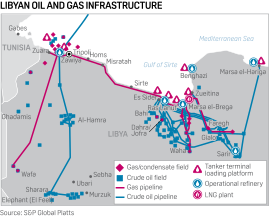
Crude exports from three major Libyan oil terminals -- Es Sider, Ras Lanuf and Marsa el-Hariga -- resumed earlier in September after short-lived protests that have become a regular feature plaguing the country's reliability to supply key markets in Europe.
But as Abbar's resignation underlines, stability is elusive in Libyan politics, and the planned Dec. 24 election could be another flashpoint.
Meanwhile, tensions are still simmering between oil minister Mohamed Oun and NOC Chairman Mustafa Sanalla, in a power struggle over Libya's energy policy, leaving Libya's oil flows vulnerable to disruption.
Abbar, who formerly held high-level positions with Benghazi-based NOC subsidiary Arabian Gulf Oil Co., said the Oun and Sanalla camps must set aside their rivalry to improve Libya's investment environment.
Below is a transcript of Abbar's responses to Platts' questions, lightly edited for clarity.
PLATTS: How does Libya plan to raise its production capacity in the coming years?
ABBAR: Despite the lack of budgets for years and the consequent shortage of spare parts and supplies to ensure stable production rates, there are serious efforts by the Ministry of Oil and the NOC.
Projects to increase storage and upgrade ports are strategic projects that support our call to raise exports to 2.2 million b/d, but it is tough currently because of the lack of adoption of the budget allocated to the oil and gas sector.
NOC and its companies continue their efforts to rehabilitate some of the storage facilities in the fields and Sidra port, Sirte Basin and Ghadames Basin, which have been destroyed in previous years.
PLATTS: What steps is the ministry taking to rehabilitate the country's oil and gas infrastructure?
ABBAR: We are working to achieve the plans of the Government of National Unity to support the only source of income in Libya, the oil and gas sector, by bringing investments and implementing strategic projects that are stalled due to the lack of funding and weak investments, which will be reflected positively in the development of surface equipment, construction works and the development of crude oil.
PLATTS: How are relations between the ministry and NOC progressing, and what has your role as deputy oil minister been during this difficult period?
ABBAR: We are working hard to raise the level of coordination between the higher authorities and between the NOC and the ministry in order to create harmony, ... implement strategic projects, and provide the necessary requirements to maintain the flow of production of oil and gas. We are working impartially to reconcile all the people of Libya without any political orientation, in order to serve the success of the NOC and the recovery of the national economy.
PLATTS: What is the latest on the stalled budget and allocating funding for Libya's oil and gas sector?
ABBAR: Production currently continues with the efforts of oil sector workers despite technical difficulties. To achieve our targets to raise the production of oil and gas, we need about $12 billion to carry out comprehensive rehabilitation operations. Efforts and cooperation continue with the unity government to find urgent solutions to funding problems.
PLATTS: Does the ministry have plans for reforming the country's downstream sector?
ABBAR: With regards to refining, the Ministry of Oil and Gas is considering a number of investment offers from foreign partners, as well as working to bring investors in coordination with the government and the NOC... to establish refineries in several areas that will promote fuel abundance and support development.
We also care about clean and renewable energy programs that support our environmental conservation priorities.
PLATTS: What steps is the ministry taking to attract foreign investment?
ABBAR: During October, we aspire to visit Germany, France, the UK and Russia in order to assess investment opportunities in oil and gas and the petrochemical industry, as well as open the prospects of cooperation that contribute to the development of reserves and enable new exploration in promising oil areas.
PLATTS: The US has been very involved in engaging with Libya on rebuilding the country. What role is the US playing in Libya's infrastructure rehabilitation?
ABBAR: The United States is a long-standing partner of Libya and we are working through oil conferences in Tripoli and Houston to encourage investment from major companies from the United States that have modern technologies, so that we can keep up with the developments in this industry. These will be an opportunity to share knowledge and strengthen the economic relations between the two countries.
PLATTS: Has the ministry spoken to OPEC about a potential production quota for Libya in 2022?
ABBAR: Libya is part of OPEC and has always endeavored to cooperate with member states to ensure the stability of oil and gas markets. Libya is exempt from the production cut policy adopted by OPEC+ due to its production disruptions and frequent closures. Maintaining Libya's exempt status depends on what will happen to the oil market in the future, and we need today to make up for market share previously lost and to exploit the recovery in prices.