Crude Oil
September 09, 2025
APPEC: Oil prices stable despite geopolitical, economic risks as markets adapt
HIGHLIGHTS
OPEC's structured output decisions curb significant volatility
China's Russian crude imports steady despite sanctions
Platts Cash Dubai rangebound at $67-$77/b since June
In a landscape characterized by geopolitical tensions and economic uncertainties, oil market participants are demonstrating notable resilience, thanks to a complex interplay of factors balancing upside and downside risks. This dynamic has allowed benchmark crude prices to maintain relative stability, according to industry executives at the APPEC 2025 conference in Singapore Sept. 9.
Despite numerous challenges facing the oil market, prices have shown remarkable resilience, fluctuating within a stable range in recent months, as producers and end-users navigate both supply and demand-side risks, according to Emma Mazhari, CEO of Maersk Oil Trading, Saad Rahim, Chief Economist at Trafigura, Li Xinhua, Head of Trading at Rongsheng Petrochemical, and Taghi Taghi-Zada, Acting CTO at Socar, during a panel discussion at the APPEC, hosted by S&P Global Energy.

In a landscape characterized by geopolitical tensions and economic uncertainties, oil market participants are demonstrating notable resilience, thanks to a complex interplay of factors balancing upside and downside risks. This dynamic has allowed benchmark crude prices to maintain relative stability, according to industry executives at the APPEC 2025 conference in Singapore Sept. 9.
Despite numerous challenges facing the oil market, prices have shown remarkable resilience, fluctuating within a stable range in recent months, as producers and end-users navigate both supply and demand-side risks, according to Emma Mazhari, CEO of Maersk Oil Trading, Saad Rahim, Chief Economist at Trafigura, Li Xinhua, Head of Trading at Rongsheng Petrochemical, and Taghi Taghi-Zada, Acting CTO at Socar, during a panel discussion at the APPEC, hosted by S&P Global Energy.
Industry participants are adapting to geopolitical tensions and regulatory changes by securing alternative supply routes and optimizing inventory management. These proactive strategies have helped maintain the stability of benchmark crude prices, allowing the market to withstand external pressures while ensuring a steady flow of oil, the executives said.
While sanctions targeting Russian and Iranian oil supplies, alongside ongoing geopolitical tensions, present upward pressure on prices, Mazhari said "the reason why we haven't seen that much volatility in the markets is because we had a record-high supply in the US and additional barrels coming from Brazil."
This stability is further reinforced by the adaptability of trading patterns, as traders adjust to shifting dynamics, Mazhari added.
Rahim echoed this sentiment, noting that while the market is currently policy-driven, OPEC's structured production decisions have helped avoid significant volatility. Accordingly, oil prices have managed to maintain a steady corridor, reflecting the market's ability to navigate through uncertainties while effectively balancing supply and demand.
Despite various geopolitical and economic pressures impacting the market, "oil prices have been relatively within the $60-$70/b range ... we haven't blown out $100/b plus for an extended period of time," Rahim said.
Platts, part of Energy, assessed the international physical sour crude benchmark Cash Dubai at an average of $70.18/b to date in the second half of 2025, compared with the H1 average of $71.87/b. Since June 12, the Platts sour crude benchmark has been locked within the $67/b-$77/b range.
Additionally, Mazhari and Rahim said higher US tariffs have had a limited impact on oil demand.
While US tariffs are designed to protect domestic industries, they ultimately create ripple effects that could influence consumer spending. However, the current resilience of oil prices indicates that demand has remained relatively stable. As producers and end-users adapt to the evolving landscape, including securing alternative supply routes, the immediate impact of tariffs on oil consumption appears muted, allowing the market to maintain its balance amid external pressures, according to Rahim.
Adapting to sanctions
Regarding China's crude trading and imports, Li said sanctions on Russian and Iranian oil have had little impact on China's crude trading dynamics.
"Despite the sanctions and tariffs, our trade flow with Russia remains unaffected... this demonstrates that geopolitical tensions have not deterred China from securing its energy needs," Li said.
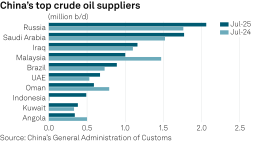
China raised Russian crude imports by about 18,000 b/d from June to 2.06 million b/d (8.71 million mt) in July, the highest since the 2.12 million b/d seen in March.
Moreover, the impact of China's stockpiling strategies on the recent stability of oil prices cannot be overlooked.
"China's strategic stockpiling is crucial in maintaining a steady demand for crude oil, even amid the backdrop of sanctions," Li said, highlighting that this stability in demand from Asia's biggest crude buyer serves to counterbalance the fluctuations caused by geopolitical and economic pressures elsewhere.
Meanwhile, the oil market is navigating a dual threat of geopolitical instability and economic pressures.
On one hand, sanctions on Russian and Iranian oil exports have created a sense of urgency among buyers seeking alternative supplies, according to Taghi-Zada. This has led to a scramble for crude oil, particularly from regions less affected by these sanctions.
Still, Taghi-Zada warned that the implications of these sanctions could be critical to oil prices, raising concerns about how these tensions could disrupt traditional pricing mechanisms in the oil market.
"The comfort of geopolitical issues will lead to a decoupling of pricing for most of the years, affecting the crude price," Taghi-Zada said.
