Crude Oil, NGLs, Refined Products
September 08, 2025
US exporters vie for greater share in global light sweet crude trade

By Binish Azhar
HIGHLIGHTS
US exported 3.8 million b/d light sweet crude in August
Latin American producers competing for market share
Trade deals abound, but questions persist on feasibility
This feature is part of a series exploring the major developments impacting the near-term US upstream and midstream sectors.
In a global market flush with light sweet crude, the Trump Administration has made a pointed effort to get international trading partners to buy more US barrels, along with other energy products, as part of the White House's "Energy Dominance" agenda.
The Trump Administration has cut regulations and opened up more offshore acreage to oil drilling, but has also pushed for lower prices, which some market watchers think could bolster mergers and acquisitions.
With domestic refining demand for light sweet crude barrels limited, producers need to turn to international markets, where demand growth remains questionable, considering the uncertainty stemming in part from Trump's use of tariffs in trade negotiations.
S&P Global Energy forecasts global oil demand to grow by just 700,000 b/d in 2025 and 780,000 b/d in 2026, marking the weakest growth since 2001, except for the financial crisis and COVID-19 pandemic.
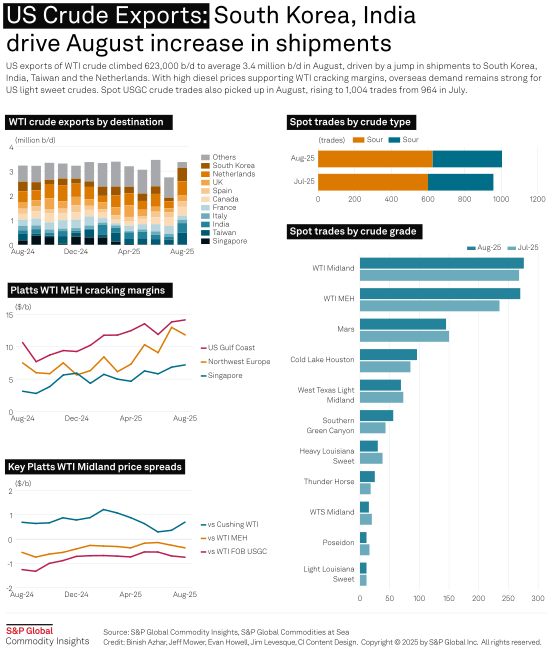
US crude exports climbed to an average 3.8 million b/d in August from 3.1 million b/d in July, S&P Global Commodities at Sea data showed. The bulk of those exports -- 3.4 million b/d -- were WTI light sweet crude. While exports climbed in August, they remained in a well-worn range and down from a record high of 4.4 million b/d in December 2023.
"US exports are facing the headwinds of an expected decline in domestic production in 2026 as oil prices weaken," Energy analysts said in a report. "US refinery runs are expected to decline on average in 2026, which will create an offset by freeing up more domestic crude for export."
US producers also face competition from Latin America, where output is growing from Guyana, Argentina, and Brazil, much of it light, sweet crude. Guyana's first light, sweet crude, Golden Arrowhead, is scheduled for nine 1-million-barrel cargoes loading in October, more than Liza and Unity Gold.
Looking for buyers
Since taking office, Trump has announced several energy deals with trading partners. Most notably, in February, Trump said that India would be buying more US crude and natural gas.
US crude exports to India climbed 284,000 b/d in August to 381,000 b/d. Exports to India have averaged 221,000 b/d so far in 2025, up from 160,000 b/d in 2024, according to CAS data.
But the increase in exports could be due to strong refining margins, which have been boosted largely by tight diesel supplies. The WTI MEH cracking margin in Singapore, for instance, averaged $7.19/b in August, up from $3.13/b in August 2024, according to data from Platts, part of Energy.
Trump has also increased tariffs on India in an attempt to get the country to stop buying discounted Russian crude.
With WTI MEH delivered into India priced at roughly $4/b above Russian Urals delivered to India, it's not surprising that India continues to purchase Russian crude despite the tariffs. Russian crude now accounts for nearly 40% of India's total oil purchases.
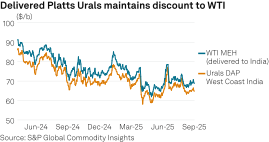
India's energy security concerns, combined with its position as a major refining hub, complicate any rapid transition away from discounted Russian crude toward higher-priced US barrels.
Trump's energy strategy extends well beyond India. In January, during Indonesian President Prabowo Subianto's visit to Washington, Trump announced a preliminary $15 billion deal for US energy commodities as part of a broader trade package.
The agreement encompasses liquefied natural gas shipments, crude oil exports, and refined products. Indonesian officials are committed to increasing energy imports from the US by 300% over five years.
Indonesia's oil consumption has risen 15% since 2020 to approximately 1.7 million b/d, while domestic production has declined, making the country increasingly dependent on imports. CAS data shows Indonesia imported 650,000 b/d of crude oil in 2024, primarily from Middle Eastern suppliers.
Perhaps the most ambitious proposal involves Europe, with Trump announcing a $750 billion energy and technology deal with the EU during a March summit in Brussels.
However, energy experts have dismissed the European arrangement as unrealistic given the EU's commitment to achieving net zero emissions by 2050 and its accelerated renewable energy deployment following Russia's invasion of Ukraine.
US export capacity
Any major increase in US crude exports will eventually require expansions to crude export capacity.
Export capacity is due to be expanded through Enterprise's Sea Port Oil Terminal, or SPOT, alongside Sentinel Midstream's Texas GulfLink deepwater terminal.
The projects are the only two to make regulatory progress out of a string of proposed terminals that didn't make the permitting cut, including the stalled Blue Marlin offshore port and Bluewater Texas terminal.
But the timeline to coming on stream remains unclear even for SPOT and Texas GulfLink. In February, Enterprise CEO Jim Teague was quoted as saying that the terminal had not received enough customer interest to commercialize the project.
Texas GulfLink, meanwhile, only received its Record of Decision from the US Maritime Administration in February. Multiple critical licenses are still necessary before construction.