Crude Oil, LNG, NGLs, Natural Gas
September 05, 2025
INTERVIEW: LNG taking larger slice of Woodside's portfolio as new projects ramp up: CEO

By Sheky Espejo
HIGHLIGHTS
LNG to account for over 50% of business by 2030
European LNG break-evens at Henry Hub plus $5
Woodside hoping to grow presence in US Gulf, Mexico
Woodside Energy expects LNG to account for a growing share of its portfolio by the end of the decade as new projects ramp up and mature assets continue to decline, according to CEO Meg O'Neill.
The Australian company currently produces about 50% LNG, 30% crude and condensate and 20% pipeline gas, with 70% of output from Australia and 30% from international operations. O'Neill said the mix will begin to shift as Senegal's Sangomar oil field, which started up in 2024, is followed by the Scarborough LNG project in Western Australia in 2026, Mexico's Trion oil project in 2028, and three trains of the Louisiana LNG project between 2029 and 2031.
"Longer term, I think we're pretty comfortable with the orientation of being 50%-plus LNG weighted, but as Louisiana LNG comes online, Woodside will start to skew up higher in terms of LNG as a percentage of our business," O'Neill told Platts, part of S&P Global Energy, on Sept. 4.
Woodside sees LNG as the most resilient part of its mix, supported by forecasts for global demand to rise by 50% to 600 million mt/year by the mid-2030s.
"We've got strong conviction around LNG demand and that's underpinning the investments we're making," O'Neill said.
In the US, an abundant natural gas supply has kept prices relatively stable despite rising exports, but Woodside expects continued volatility in European and Asian LNG markets, she added.
European LNG prices must stay at least $5/MMBtu above Henry Hub for new export projects to deliver targeted returns, O'Neill said, underscoring the region's dependence on imported supply.
"To get our projects to the 12% rate of return that we are looking for, we need European prices to be $5 above Henry Hub," she said, noting that the industry has similar break-evens.
"Anything lower than that, you will see US LNG players shut in," O'Neill said. European domestic production has been curtailed over the years, and the market now relies on LNG and pipelines from mature sources, she added.
On Sept. 4, the spread between the Platts DES Northwest Europe marker for October and Henry Hub prices was assessed at $7.38/MMBtu.
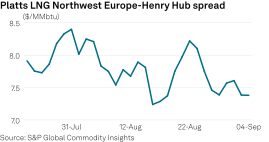
O'Neill said this spread, along with forecasts for a 50% rise in global LNG demand over the next decade, underpins Woodside's investments in its Scarborough and Louisiana LNG projects.
US Gulf leasing
The Trump administration is advancing offshore oil and gas lease sales, reversing policies implemented under the previous Biden administration. The schedule follows directives from the One Big Beautiful Bill Act and several related executive orders.
O'Neill welcomed the planned restart of Gulf of Mexico lease sales, offering that Woodside already has an interest in the region and sees "untapped potential" that could be developed in upcoming bid rounds.
"It's very good news for us," she said. "We have production in the Gulf already, we've got exploration acreage today, so we look forward to seeing those next bid rounds and hopefully participating."
O'Neill's remarks underscore the company's interest in expanding its US Gulf footprint, aligning with broader industry expectations for a more predictable leasing schedule under the new federal program.
A US appeals court has recently cleared the Department of the Interior to proceed with the 2024-2029 Gulf of Mexico leasing program, rejecting environmental groups' claims that it failed to assess impacts on coastal communities.
The court decision follows earlier rulings that had questioned Interior's environmental impact statements, prompting updates to emissions modeling. The leasing program, which had no sales in 2024, for the first time since 1966, will now be replaced by a "robust" schedule under the One Big Beautiful Bill Act. The legislation mandates 30 lease sales over the next decade, with the first, "Big Beautiful Gulf 1," planned for Dec. 10 of this year.
The updated Interior Department environmental impact statement acknowledges moderate adverse impacts but concludes production benefits outweigh environmental risks.
Derisking strategy
Woodside has a strategy of sharing the risk of projects by bringing in partners in a staged approach, a strategy used successfully at Scarborough and planned for Louisiana LNG, O'Neill said.
For Louisiana LNG, Woodside has structured the project into an infrastructure-focused venture and a commodity-focused company that sources and markets the gas. At the infrastructure level, it has already brought in Stonepeak Investments, which has acquired a 40% stake and will cover 75% of the capital investments in 2025 and 2026. O'Neill said Woodside plans to sell down 20%-30% of the parent, mirroring the approach at Scarborough, where Woodside has sold stakes. The company has said it is in talks with Saudi Aramco and others for that stake.
In 2024, Woodside sold a 25.1% stake in the offshore Scarborough Field to Japanese companies: 15.1% to JERA and 10% to LNG Japan.
O'Neill said Woodside remains focused on building projects that are competitive even in low-price environments when asked about the prospect of a downturn in oil markets. President Donald Trump has pushed for lower oil prices in his narrative and recently said prices could "break" below $60/b soon.
"We don't control prices; what we control are the decisions we make around which assets we develop and how we run our business, so we focus on high-quality assets," O'Neill said. It is hard to be competitive with small, low-quality assets when prices are low, she added.
"So, so we're very focused on obtaining the highest quality assets with large resources, very competitive development costs and very competitive operating costs," she said.
Woodside's cash unit production cost is $7.70/boe, according to its second-quarter earnings report.
More Mexico exposure
Despite uncertainty over Mexico's 2024 energy reform, Woodside sees an opportunity to grow beyond its flagship Trion project.
"We do have a desire to grow in Mexico, and we need to work with the government and understand what options are available and what resources are available," O'Neill said. "But I think it would be valuable for us, and I think it'd be an opportunity to build on our relationships that we have in the country if we were able to continue growing in Mexico."
Mexico has recently laid out a bold 10-year strategic plan to improve the operations and finances of state oil and gas company Pemex, centered on financial self-sufficiency by 2027.
According to multiple sources, the government is currently negotiating with private companies to form ventures to develop at least six upstream projects. However, it has said it intends to sign deals for 21 projects before the end of the year.
A key pillar of its plans is the development of major offshore projects like Trion to revive Mexico's declining oil output.
"Trion is a high-quality asset, it's a very large asset, and we think it will be a very valuable part of our business going forward," O'Neill said. "We're pleased with the quality of the working relationship with the Mexican government, but just having one asset in a country means we've got all of the overheads."
