Crude Oil, Refined Products
September 05, 2025
INDIA CEO SERIES: Oil India sees bright upstream outlook as transition goals turn realistic

HIGHLIGHTS
Energy security a key priority for governments amid tariffs, sanctions
Industry witnessing roadmap reversal to pursue practical transition approach
Numaligarh expansion on track; Arab Heavy and Arab Light crudes in focus
The India CEO Series by S&P Global Energy is a compilation of exclusive interviews by Asia Energy Editor Sambit Mohanty with some of the leaders of the biggest energy companies in India.
India's upstream sector is poised for increased global partnerships and investment as energy majors and policymakers reshape their strategies to achieve realistic transition goals while ensuring energy security amid turbulent geopolitics and trade policies, Oil India's Chairman and Managing Director Ranjit Rath said.
In addition, the recently announced National Deepwater Mission as well as reforms to the Oilfields (Regulation and Development) Act -- which address long-standing challenges related to regulatory clarity and procedural timelines -- had set the stage for exploration successes, he told Platts, part of S&P Global Energy, in an exclusive interview.
"The global upstream landscape is getting reshaped and realigned against the backdrop of socio-economic and geopolitical development while at the same time addressing climate concerns, transition to cleaner energy, the Russia–Ukraine conflict and tariff imposition by the US," Rath said.
"As a result, we observe a reversal of the earlier outlook that believed in a forced transition to cleaner fuel, to a more healthy and practical transition approach, prioritizing energy security and growth for all. Therefore, we do not see much challenge in the upstream oil and gas industry, driven by sustainable growth and net-zero commitment that address the need for both the developed and developing economies," he added.
He said that tariffs and sanctions could potentially impact commodity prices and services, but India has a huge indigenous demand. "We are geared up to deal with such a situation, with in-house expertise and other resources at our disposal. In line with the government's initiative, our focus will be more on indigenous resource utilization," Rath added.
Evaluating global successes
As part of the National Deepwater Mission announced by Prime Minister Narendra Modi in August, Oil India was evaluating global upstream success stories and undertaking basinal analyses to establish commonalities, in an effort to target deepwater and ultra deepwater exploration acreages, Rath said.
Sharing an update on the progress made across India following the government's decision to release approximately 1 million sq km of no-go areas in the Eastern Coast, Western Coast and the Andaman basin, 56,894 sq km has been already awarded, 97,919 sq km would be awarded under the tenth round of the Open Acreage Licensing Policy, or OALP-X, and 845,187 sq km would be awarded in future.
"Further, the government, to accelerate the exploration endeavors for hydrocarbon in frontier offshore regions, has mandated Oil India and Oil and Natural Gas Corp. to drill four stratigraphic wells to obtain critical data for robust modelling of petroleum system elements in Category-II and III sedimentary basins," Rath said.
He said Oil India had expanded its domestic acreages from about 9,300 sq. km. in 2017-18 to present 1,08,000 sq. km. -- a more than 12-fold increase in acreage -- spreading across Assam Shelf, Assam Arakan fold belt, Rajasthan basin, Mahanadi basin, Cambay Basin, offshore areas in Andaman and Nicobar basin, Kerala Konkan basin and Krishna Godavari basin.
"The exploration blocks, which had been awarded during initial OALP bid rounds, are under the drilling phase. We completed one offshore well and the second well is under drilling in the Andaman and Nicobar Basin. Our drilling campaign in OALP acreages in the Assam Shelf, Rajasthan basin and Mahanadi basin is under progress," Rath said.
According to Energy, exploration and appraisal activity in India had returned to pre–COVID-19 levels, both onshore and offshore. Exploratory drilling campaigns in the OALP blocks are expected to significantly increase in the near future.
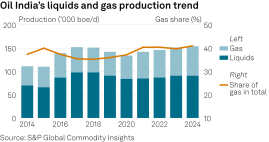
While a series of recent upstream policy reforms had set the stage for growth, several further initiatives were under active consideration, Rath said.
He said that the country's federal government system divides powers between the central and state governments, requiring both to approve E&P activities. Land is a state subject, leading to state governments regulating land use and granting permits for E&P activities. While the federal government sets broad environmental policies, states have the authority to manage land use and enforce environmental laws, necessitating multiple approvals from different regulatory bodies.
"With oil and gas being a central subject, the federal government may like to consider a single window approach for all oil and gas operations across territories," Rath said.
Downstream expansion
On the company's downstream operations, Rath said Oil India's Numaligarh Refinery Ltd.'s capacity expansion from 3 million mt/year to 9 million mt/year was on schedule. The company had finalized a collaborative agreement with Bharat Petroleum Corp. Ltd., under which BPCL will annually import up to 6 million mt of crude oil for the refinery.
"The commissioning of all the primary units is going to begin very soon, with a target to complete it latest by the January-March 2026 quarter. The expanding refinery will have a very wide crude slate, but Arab Heavy and Arab Light will be the main ones," Rath said.
NRL currently uses mainly domestic crude as feedstock, with a capacity utilization of more than 100%. The NRL expansion road map also includes setting up a crude oil import terminal at the Paradip port and laying about 1,640 km of pipelines to transport imported crude oil, Rath said.
"BPCL will source the crude oil for us both on spot and term basis and the crude oil shall be imported through Paradip Port in Odisha utilizing Indian Oil Corp.'s single point mooring facilities," he said.
Rath added that its bio-ethanol plant at Numaligarh was also in the advanced stages of completion.
