Agriculture, Energy Transition, Crude Oil, Biofuel, Renewables
September 03, 2025
Ethanol industry asks US to fight Brazil's 'unfair' trade practices

HIGHLIGHTS
US ethanol producers urge action to open Brazil's market
Want USTR to investigate Brazil's renewable fuels program
Investigation follows Trump's July threat of 50% tariffs
Representatives of the US ethanol industry urged the United States Trade Representative to continue its investigation into what they called Brazil's "unfair" trade practices on Sept. 3, asking the USTR to push Brazil to open its market to US ethanol exports.
Testifying before a public hearing at the US International Trade Commission in Washington, Renewable Fuels Association CEO Geoff Cooper said the US ethanol industry "strongly believes" the USTR's Section 301 investigation of Brazil's trade policy was "justified and necessary." Cooper said he was confident the government would find the South American nation's ethanol market barriers "prejudicial and unreasonable," designed to favor Brazil's domestic ethanol industry and block US products from reaching a formerly crucial foreign market.
"These barriers have been highly effective in achieving the outcomes desired by Brazil," Cooper testified. "Brazil was once the world's largest importer of US ethanol, but the market has disintegrated."
In 2018, the US exported 489 million gallons of ethanol to Brazil, worth $761 million. According to the RFA, that number had dwindled to 28 million gallons, worth $53 million, by 2024.
Since 2020, Brazil has imposed an 18% tariff on imports of corn-based ethanol from the US. The US imposes a 2.5% on ethanol imports from Brazil, prompting ethanol groups to argue that Brazil enjoys disproportionate access to US ethanol customers.
"It adds insult to injury," Cooper said. "In fact, policies like the Renewable Fuel Standard and state low-carbon fuel programs actually give preferential treatment to Brazilian imports over US grain-based ethanol."
US producers are eager for new overseas markets. Domestic regulatory restraints on higher blends and consumers' increasing adoption of more fuel-efficient and electric vehicles have spurred demand concerns. The US produces more ethanol than any other country, and legal blending requirements can lead to oversupply. In 2023, the US exported a total of 92,000 b/d of ethanol, according to the US Energy Information Administration.
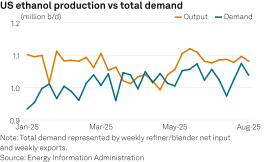
After an Aug. 15 US Department of Agriculture report predicted US farmers would produce a record $16.7 billion bushels of corn this fall, the National Corn Growers Association and other farm groups have urged US lawmakers to swiftly increase demand for corn and corn products -- both by boosting domestic ethanol availability and via increased overseas trade.
"We have exceptional yields this year," US Grains & Bioproducts Council Multilateral Ethanol Policy Manager Linda Schmid testified. "We really need your help to restore robust trade with Brazil."
Not just tariffs
Chris Bliley, Senior Vice President of Regulatory Affairs at Growth Energy, another large ethanol trade group, said that in addition to negotiating a lower tariff on US ethanol, the administration should probe Brazil's methods of calculating lifecycle greenhouse gas emissions for its own biofuels, which he argued are less rigorous and accurate than the US GREET model and "artificially" prevent the US from being the "ethanol supplier of choice around the world." The groups also criticized Brazil's model for failing to account for the potential impacts of deforestation.
Bliley, like Cooper and NCGA President Kenneth Hartman, also asked the trade representative to examine RenovaBio, Brazil's domestic biofuels program. RenovaBio incentivizes low-carbon fuel production and manages a carbon credit market designed to offset fossil fuel emissions. US producers have complained that they are systematically prevented from taking part.
"We have patiently waited and worked for years," Bliley said. "But Brazil has acquiesced to their domestic industry's demands to functionally keep US ethanol from effectively, fairly, and widely participating in their program."
"This is a clear discrimination against US producers," Hartman testified. "US companies have been allowed to submit applications -- but none of them have been approved."
Andrea Almeida, of the Brazilian Corn Ethanol Association, pushed back on the US producers' claims, noting that Brazil's 18% tariff on ethanol imports applied to all countries equally, and that the levy was far less than US President Donald Trump's newly proposed tariffs on swathes of Brazilian products. Almeida argued that Brazil's growing domestic sugarcane ethanol industry leaves the nation with minimal demand for imports, much as the US has little need for Brazilian exports, which Cooper later said was "false."
Welber Barral, of União da Indústria de Cana-de-Açúcar e Bioenergia, or UNICA, said both US and EU regulators have acknowledged that sugarcane ethanol is lower in emissions than its corn-based counterpart, and that Brazil's greenhouse impacts model is "aligned with the spirit of the Renewable Fuel Standard" administered by the US Environmental Protection Agency. He asked the trade representative to terminate the investigation and instead work with Brazil to form a working group that could help coordinate future initiatives, including on increased production of Sustainable Aviation Fuel, or SAF.
"The world is going to need a lot of SAF," Barral said. "The US and Brazil can be the lead producers."
Wide-ranging dispute
The ethanol testimony was just one segment of the day-long hearing, which gathered intellectual property and information technology experts, pharmaceutical industry representatives, and coffee, beef, wood and paper products producers from both countries. On July 16, when US Trade Representative Jameison Greer announced the Section 301 investigation, he cited potential retaliation against US social media companies "for failing to censor political speech" and poor anti-corruption enforcement, intellectual property protections and illegal deforestation as among the reasons for the probe.
On July 11, in a letter posted to Truth Social, Trump proposed an increased tariff rate of 50% on Brazilian imports, an increase from the 10% rate he proposed in April. Trump said the two countries had a "longstanding, and very unfair" trade relationship and criticized the Brazilian government for prosecuting former Brazilian president and Trump supporter Jair Bolsonaro, who is charged with attempting to overturn his 2022 election loss.
Brazilian President Luiz Inácio Lula da Silva responded that Brazil was a "sovereign nation with independent institutions and will not accept any form of tutelage." He noted that the US has run a $410 billion trade surplus with Brazil in the past 15 years.
At the hearing on Sept. 3, Roberto Azevedo, a Brazilian diplomat and former Director-General of the World Trade Organization, called on both sides to de-escalate.
"We are the two largest democracies in this hemisphere," Azevedo testified. "We should be talking to each other -- not fighting each other."
