Crude Oil
September 02, 2025
US oil producers hope Trump deregulations will help lower costs
By Ashok Dutta and Eamonn Brennan
HIGHLIGHTS
OBBB Act could help reduce costs by $1/boe to $2/boe
ConocoPhillips, EOG, Permian Resources see benefits
Room for more regulatory relief for offshore producers
This feature is part of a series exploring the major developments impacting the near-term US upstream and midstream sectors.
The Trump administration is banking on a wave of deregulation to bolster the competitiveness of US crude in the global market.
Producers are hopeful that these measures will help lower breakeven costs, especially considering Trump's push for lower oil prices. However, other market forces will need to align for a meaningful increase in US production in the near term.
In early July, the One Big Beautiful Bill Act was signed into law, lowering royalty rates from 12.25% to 16.75% and creating a new fast-track permitting process under the National Environmental Policy Act, allowing developers to pay a fee to opt in to accelerated environmental reviews of pending projects.
The bill also directed the Department of the Interior to approve applications for the commingling of two or more production sources in federal or non-federal lands and waters. This would allow operators to produce from multiple reservoirs with greater pressure differences if certain safety measures are met.
S&P Global Energy analyst Andrew Byrne said that as a starting point, producers would see a lowering of their cash taxes, which would boost their balance sheets.
Cash tax is the amount any producer pays as income tax for its business activities.
"The biggest thing companies were talking about in Q2 releases regarding the OBBB [One Big Beautiful Bill] was that it will lower cash taxes," Byrne said. "It should help, but we don't expect it to be terribly material - $1/boe to $2/boe."
He said the federal government could also help push some gas pipelines through the regulatory process, along with other infrastructure projects that should help improve economics and boost demand.
The 2025 weighted average US barrel breaks even at WTI $54.09/b, according to Energy.
The marginal barrel breaks even just under WTI $61/b when accounting for a 30% cash flow diversion to investors, and in the Wolfcamp area of the Permian Basin, more than 80% of volumes break even at under WTI $55/b.
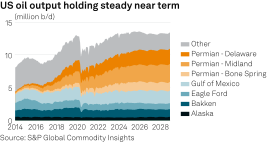
US crude production is expected to decline from 13.5 million b/d in September to 13.1 million b/d in September 2026, and then rebound by the end of 2028, according to the most recent Energy forecast.
Production could move higher if prices rise enough to encourage higher cost output, or if breakevens are slashed.
Producers stated during their second quarter 2025 earnings calls that the new deregulations will provide a "balance sheet" relief, while others hope the new measures will mitigate an anticipated increase in the price of steel and input costs due to the ongoing tariff disputes.
Benefits of bonus depreciation, research costs
The oil and gas industry should receive some further balance sheet relief in the form of OBBBA's 100% bonus depreciation provision, which allows firms to quickly write off the full cost of new equipment placed in service after Jan. 20, 2025, ConocoPhillips' CFO Andy O'Brien said on an earnings call on Aug. 7, noting his company was expecting a $500 million impact from the bill "primarily due just simply to the bonus depreciation rate going from 40% to 100%."
Bonus depreciation allows a producer to deduct the capital cost of assets in service.
Fellow producer EOG Resources expects to benefit from the act, which additionally restores 100% deductibility of the research and experimental cost permanently, CEO Ezra Yacob said on an Aug. 8 earnings call.
Yacob said the bill for EOG will impact 2025 by about $200 million, and that amount is expected to be a recurring benefit in future years.
Yet another producer, Permian Resources, sees the tax provision as incentivizing investment in domestic shale production and reducing the company's taxes over the coming years, Co-CEO James Walter said on Aug. 8.
"We expect current cash taxes to be less than $5 million in 2025 and less than $50 million cumulatively in 2026 and 2027," Walter said, adding the tax and regulatory benefits will help mitigate the "modest" impact the company anticipates on steel and other input costs due to the tariffs.
Byrne said the focus for US shale producers is firmly on efficiency gains, with a new E&P (exploration and production) business model focusing on cash flows and return of capital to shareholders.
"No one is chasing volume growth as their primary business objective. But all in all, it is better to have the support of the government," Byrne said.
'Idle Iron Act' still a hurdle
In the offshore Gulf of Mexico, at least one producer is looking to change regulations related to the costs of plugging and abandoning idle oil wells.
"There's a lot of things that the Department of Interior is looking at," CEO of W&T Offshore Tracy Krohn said on an earnings call on Aug. 5. "There is the so-called Idle Iron act, which is kind of nonsensical to me and our company. Why do you need to prematurely abandon these wells when none of the rest of the wells on the platform have been abandoned?"
Under current Bureau of Safety and Environmental Enforcement guidelines, offshore wells that have not been used for five years are classified as "idle iron," and operators typically have three additional years to permanently plug and abandon them, said Rishabh Sharma, an analyst with Energy.
However, decommissioning each well after it stops can be costly, and it is often more effective to retire all wells and facilities on a platform together once the entire platform ceases production, Sharma said.
"We demand fairness and transparency for all oil and natural gas producers, and we'll continue to pursue the pending litigation," Krohn said.
W&T Offshore is currently fighting collateral demands from insurance companies in court. The demands are related to a Biden-era ruling that increased the amount of financial assurance required to cover decommissioning costs.
The Interior Department said on May 2 that it would revise the Bureau of Ocean Energy Management's ruling and finalize it in 2025.
