Crude Oil
September 02, 2025
North Sea boss defends transition against claim industry being ‘strangled’

By Nick Coleman
HIGHLIGHTS
Conservative leader launches onslaught in industry’s Scottish heartland
Regulator defends need for industry to keep curbing emissions
Industry chiefs stress stability needed for long-term investment
The UK's Conservative opposition leader on Sept. 2 launched a rhetorical assault on the country's energy policies and upstream regulator, saying she would tear up "absurd" requirements for oil platforms to become zero emissions facilities, and warning the government was "sabotaging" the country and its energy security.
The comments by Kemi Badenoch at the Offshore Europe conference in Aberdeen prompted a warning from top regulator Stuart Payne -- CEO of the North Sea Transition Authority -- that the industry could not ignore societal concern about global warming, and companies needed a body to "mark their homework" in reducing emissions from rigs and platforms.
He noted these had fallen by a third since 2018, and such know-how could be exported around the world.
Badenoch, who aims to lead the Conservatives into general elections due by August 2029, said she would remove the word "transition" from the title of the regulatory body, and went on to take aim at the Energy Profits Levy, introduced as a "windfall" tax by a previous Conservative administration, and subsequently increased by the current Labour government.
The UK's headline upstream tax rate is now 78%, with some companies arguing they are paying more than this due to decommissioning obligations.
Badenoch, whose party has long struggled to win votes in Scotland, pointed to increasing European imports of Russian LNG as evidence of the need for North Sea production.
"This is not a managed transition. This is collapse," Badenoch told the event. "Right now the regulatory system is strangling the North Sea. We will judge oil and gas operators on one metric alone -- how much oil and gas they produce. Every extra barrel that we produce will underpin sterling and strengthen our balance of payments."
"Who is looking after our industry here? The North Sea is not a wasteland, it is a cornerstone of Britain's future. Oil and gas still meets three-quarters of the UK's energy needs, yet our oil fields are not being wound down over decades to come -- they are at risk of vanishing in just a few years because of Labour's ideological approach," she said.
"This windfall [tax] is a policy that punishes success, and accelerates decline. Last year more than 40% of our [oil and gas] needs were met by imports -- that is not security, and certainly not strength -- it is weakness by choice, and it does not have to be this way," she told the conference in what is considered the UK's energy capital.
Industry response
The comments by Badenoch won loud applause at the event, while industry leaders went on to warn it was the instability of UK policy and tax that was the main deterrent to investment.
Shell UK vice president Simon Roddy said it was still possible to implement long-awaited plans for UK oil platforms to be supplied with low-carbon electricity -- for example by cable from low-carbon sources -- but that the stability of the regime was the key.
"To be successful, we in this industry need long-term stability. That long-term consensus is extraordinarily important to be able to invest for the long term and invest in the future both for the North Sea and to develop low-carbon energy," Roddy said.
Meanwhile the NSTA's Payne insisted there was a continued need for the industry to curb its emissions, and noted his authority had 12 upstream oil and gas projects currently moving toward regulatory approval.
"When you recognize that there are people in this society who are terrified about the climate crisis -- that's a very real and legitimate fear for lots and lots of people -- if you're going to talk about having oil and gas for decades to come, it's got to be cleaner," Payne said. "Somebody has to hold industry to account, and the good companies want us to do that, they want us to mark their homework."
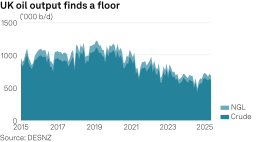
UK fields are a constituent in the Platts Dated Brent crude oil benchmark used around the world, although UK oil production is now a third of levels in nearby Norway. Dated Brent was last assessed by Platts at $68.91/b on Sept. 1
