24 Aug 2020 | 19:51 UTC — Houston
NYMEX RBOB jumps ahead of Gulf Coast storms

By Jordan Blum
Highlights
NYMEX RBOB jumps by 6.5%
More than 80% of Gulf oil output taken offline
Marco weakens, but TS Laura looms
RBOB futures prices rose more sharply than crude oil on Aug. 24 as two large storms trekked through the Gulf of Mexico, posing a threat to major refineries.
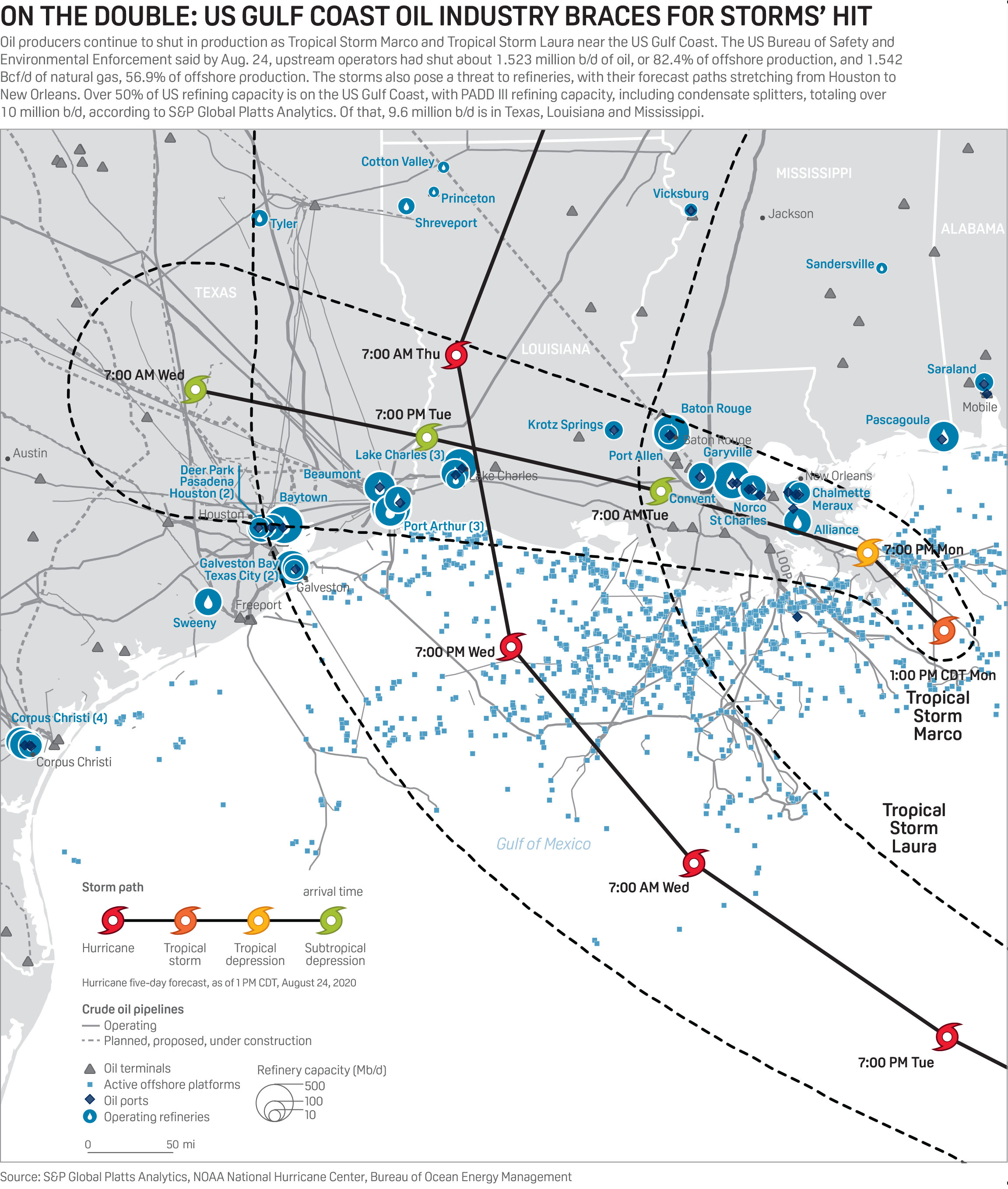
Tropical Storm Marco was downgraded from a hurricane before making a Louisiana landfall, but the more ominous Tropical Storm Laura is expected to strengthen into a powerful hurricane. Laura is projected to move across the oil-producing US Gulf of Mexico and head toward the nation's refining epicenter near the Texas-Louisiana border, although its path could still shift, according to the National Hurricane Center.
NYMEX September RBOB spiked by 8.3 cents to $1.3671/gal and NYMEX September ULSD gained 3.96 cents to trade around $1.2476/gal.
The largest refinery in the US, Motiva's Port Arthur Refinery in Texas, is reportedly considering closing down this week and others could follow suit, said Patrick De Haan, head of petroleum analysis for GasBuddy. Falling US stockpiles of gasoline also could factor into the prices.
Click here for full-size image

"I'm hearing that Motiva is considering doing just that and, of course, that's a monster refinery," De Haan said. "Though the storm is forecast to be a Category 2 or so on landfall, two storms in such proximity may make it difficult to sustain normal operations until both clear. Power, wind and rain are concerns."
Motiva did not respond to a request for comment about its 607,000 b/d refinery, but within a few miles also are ExxonMobil's Beaumont refinery, and Valero's and Total's Port Arthur refineries. Then a little farther west is the large Houston refining corridor that treks from Houston to Galveston.
In nearby southwestern Louisiana are the Phillips 66 and Citgo's Lake Charles refineries, as well as some other smaller refining complexes.
The major refiners, including ExxonMobil, Valero and Phillips 66, said they're preparing for the storms but that operations remain normal for now.
More than 50% of US refining capacity is on the coast, with PADD III refining capacity, including condensate splitters, totaling over 10 million b/d, according to S&P Global Platts Analytics. Of that, 9.6 million b/d is in Texas, Louisiana and Mississippi.
Separate from the storms, refiners already were cutting refinery runs because of weak demand owing to the coronavirus. PADD III refinery runs averaged 7.8 million b/d the week ended Aug. 14, according to the US Energy Information Administration, 1.4 million b/d below the five-year average.
And with more than 80% of the US Gulf's offshore oil production temporarily taken offline ahead of the storms, front-month NYMEX WTI settled 28 cents higher on the day at $42.62/b while ICE October Brent was 78 cents higher at $45.13/b.
The region was producing about 1.8 million b/d of oil and more than 1.5 million b/d is shut in, according to the US Bureau of Safety and Environmental Enforcement.
COVID-19 weighs heavily
Following a larger-than-expected gasoline inventories draw for the week that ended Aug. 14, there's also growing optimism that gasoline stockpiles will continue to decline, said Edward Moya, senior market analyst with OANDA.
"Reopening momentum in the US seems to be heading the right direction, albeit at a must slower pace that initially expected," Moya said. "Gradual reopenings in the US should continue in September and that should strongly help gasoline prices."
Still, with global crude demand remaining depressed and US activity beginning to pick up now that drilling rigs are ramping up again, hurricanes in the Gulf of Mexico don't seem to have the same impact on commodities that they once did.
"Normally, such a weather phenomena could have an even wider impact on prices, but COVID-19 concerns are making price moves a bit more careful," said Bjornar Tonhaugen, Rystad Energy's head of oil markets.
Demand recovery -- and not production -- remains the key element, he said.
"Rising beyond the $40-$45/b price range will be very difficult for oil this year," Tonhaugen added. "It would take either a significant change in production or an unlikely collapse of the pandemic."
So markets remain more focused on potential breakthroughs in coronavirus vaccines and treatments, which are making progress but haven't crossed any finish lines yet.
Editor: