Crude Oil, LNG
August 20, 2025
Japan's US crude imports surge 19-fold as diversification push gains pace
By Takeo Kumagai and Gawoon Vahn
HIGHLIGHTS
US crude import share at 4%; Middle East remains at 93%
Favorable US crude economics also support imports
Records Russian oil imports for 2nd straight month since Jan 2023
Japan's crude oil imports from the US surged more than 19-fold in July as the country's refiners accelerate efforts to diversify away from heavy reliance on Middle Eastern supplies amid mounting geopolitical risks in the region.
The dramatic shift reflects growing concerns about energy security following recent tensions between Israel and Iran.
Japanese imports of US crude jumped to 480,000 kiloliters, or 97,390 b/d, in July, representing a 1,820.4% increase year over year, according to preliminary data released Aug. 20 by the Ministry of Finance.
The surge brought US crude's share of Japan's total crude imports to 4.2% of the 11.473 million kiloliters imported that month, marking a significant shift in the country's traditional supply patterns.
Meanwhile, Japan imported 10.685 million kiloliters of crude from the Middle East in July, up 6.3% year over year, accounting for 93% of the country's total crude imports, MOF data showed.
In the first half of the year, Japan imported 2.299 million b/d of crude from Middle Eastern suppliers, accounting for over 95% of its total refinery feedstock imports of 2.415 million b/d, according to the latest data from the Ministry of Economy, Trade and Industry.
Diversification efforts
The heightened geopolitical tensions and missile exchanges between Israel and Iran in June serve as a stark reminder for the industry of the importance of diversifying supply sources to safeguard energy security against unforeseen events, a trade flow analyst at a Japanese integrated trading company said.
An inventory management source at Taiyo Oil previously told Platts, part of S&P Global Energy, that although a rapid transition to a new feedstock mix is difficult, Japan should aim to reduce its reliance on Middle Eastern crude imports to about 90%.
A feedstock manager at Japan's top refiner, ENEOS, stressed that diversifying crude supply is not only about ensuring immediate availability but also about building resilience against unforeseen geopolitical disruptions that could threaten energy security.
Additionally, light sweet US crude grades have appeared highly attractive in recent trading cycles, with WTI Midland's premium over light and medium sour Middle Eastern grades trending sharply lower, traders and refinery feedstock managers said.
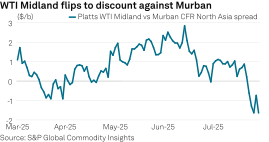
Platts assessed the spread between WTI Midland and Murban on a CFR North Asia basis at minus $1.17/b on Aug. 19, down from the year-to-date high of $2.51/b on June 4.
Sakhalin Blend
In July, Japan also recorded Russian crude oil imports for the second consecutive month, with customs-cleared volumes appearing to reflect the balance of a 600,000-barrel cargo taken by Taiyo Oil in June, first reported by Platts.
In June, Japan also imported 70,000 kiloliters, or 440,286 barrels, of Russian crude, MOF data showed.
Taiyo Oil's intake of Sakhalin Blend crude marked Japan's first import of Russian crude since January 2023, when the country received 747,706 barrels of the grade, METI data showed.
It was Taiyo Oil that took the Sakhalin Blend crude in January 2023, as part of the remaining crude volume from its 2022 term contract, according to S&P Global Commodities at Sea.
Sakhalin Blend is a light, sweet crude produced as a byproduct of LNG production at the Sakhalin 2 project. Exports of the grade to Japan are exempt from the G7's Russian oil "price cap" due to its critical role in ensuring stable LNG production from the project.
Sakhalin Energy is majority-owned by Russia's state-owned Gazprom, with minority stakes held by Japan's Mitsui & Co. and Mitsubishi Corp.
