Crude Oil
August 20, 2025
INTERVIEW: UK producer Ithaca boosts performance as Rosebank progresses

By Nick Coleman
HIGHLIGHTS
Enlarged company reports higher output, cost reductions
Costs being cut at core heavy oil asset Captain
Energy security arguments supporting tax debate
INTERVIEW: UK producer Ithaca boosts performance as Rosebank progresses
UK oil and gas producer Ithaca Energy is on track for startup of the Rosebank oil project in 2026-27 after a regulatory overhaul and is hopeful of a softening of the country's controversial tax regime, executive chairman Yaniv Friedman said on Aug. 20 as the company reported higher first-half output.
Ithaca, which incorporated the UK oil and gas assets of Italy's Eni last year, raised its production guidance as it released first-half 2025 results that showed it more than doubled its production from a year earlier, to 124,000 boe/d.
It forecast year-end output of 140,000 b/d of oil equivalent, confirming it as one of the UK's top producers, and highlighted efficiency improvements at core assets. The company bought an additional stake in the newly producing BP-operated Seagull field earlier in the year – a contributor to the Forties grade used by Platts in its Dated Brent price assessments. And it is in the process of more than doubling its stake in the Cygnus gas field with a purchase of an extra 46.25% from Spirit Energy, majority owned by Centrica. Meanwhile, Ithaca's operating costs fell by almost $10 per barrel in the first half of the year compared with a year earlier, to $17.50/boe. The company has Israel's Delek and Eni as its largest shareholders.
Ithaca had "excellent first-half performance" and is "performing well both on organic and inorganic growth strategies," Friedman said, the latter a reference to the recent acquisitions.
West of Shetland
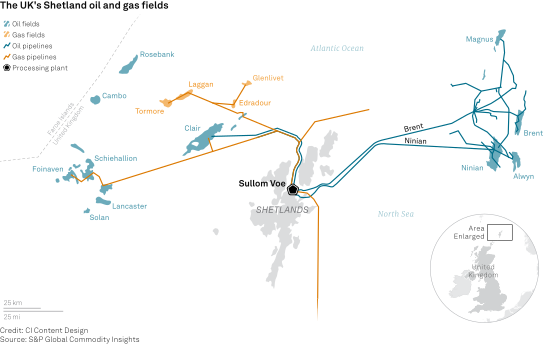
On Rosebank, in which it is a partner with Norway's Equinor, Friedman said the two were stepping up spending as the refurbishment of the floating production storage and vessel nears completion in Dubai, prior to its return to the North Sea at the end of the year.
Equinor will provide an update at year-end, but the projected startup date of 2026-27 still stands, he said.
Rosebank has proved one of the UK's most controversial oil projects as its approval flew in the face of environmental opposition, and campaigners overturned the regulatory process in the courts -- after approval had been given and a final investment decision taken.
Following new regulatory guidance in June, the partners are rewriting their application for environmental approval while continuing with the work, Friedman confirmed. Rosebank is "progressing on all work fronts," he said.
Meanwhile, Ithaca is working on plans for an additional West of Shetland investment to the north of Rosebank focused on gas and with an estimated 70 million barrels of oil equivalent, dubbed Tornado.
With a preliminary "no objection" granted by the authorities, the project could work on a standalone basis or in conjunction with a prospective nearby gas field known as Tobermory, where Shell is operator, Friedman said. "We've made significant progress on what we call our West of Shetland strategy," he said, noting also recent work to "refresh" plans for the proposed Cambo project, which Shell pulled out of in 2021 citing issues with project economics and potential delays.
Heavy oil
Friedman said Ithaca had also reduced costs at its Captain heavy oil field, which is the company's highest producing asset, and the focus of a major enhanced oil recovery project involving polymer injection, initiated by former owner Chevron.
Heavy crudes such as Captain have attracted greater interest in a region known for light sweet grades. Norway's Grane, for example, was assessed by Platts at a $1.35/b premium to Dated Brent on Aug. 19. Captain is among the heaviest crudes produced in the North Sea, with an API gravity of 19-21.
Friedman declined to comment on pricing for Captain, but said the field is "a core asset in our portfolio and will continue to be a core asset in our portfolio. There's improvement cost-wise -- overall, our costs came down. We can't have the largest producing asset in our portfolio being an outlier," he said.
Tax row
As for the North Sea overall, he said the government was demonstrating "constructive engagement" over the industry's objections to the tax regime and the Energy Profits Levy, which has lifted the headline rate to 78%. Comments by US President Donald Trump on a recent visit to Scotland may have helped, he conceded. The EPL is due to be withdrawn in 2030, and government consultations have been underway on a replacement, with the industry lobbying for more rapid termination.
"We think there is a change, definitely in rhetoric," Friedman said, noting there were other ways to modify the regime, such as investment allowances. "We believe the government understands the need to support the North Sea, not for us, but for UK energy security. It's becoming more evident and more critical," he said. "For us, UK energy security is definitely something we're a part of, and if Trump did anything to help, that's great, but we're relying on data, facts and hard work."
