Crude Oil
August 18, 2025
Trump meeting with European leaders leaves secondary oil sanctions in play

HIGHLIGHTS
No agreement at White House talks
India trade flows continue
US Senate sanctions bill ready
US President Donald Trump's meeting with a coterie of European leaders, including Ukraine President Volodymyr Zelenskyy, did not yield any immediate progress on peace in the Russia-Ukraine conflict on Aug. 18, with the prospect of potential secondary sanctions on crude purchases from Russia undecided and Republicans in the US Senate still pushing a harsh sanctions bill on buyers of Russian crude.
Trump has repeatedly threatened the largest buyers of Russian crude with sanctions if a deal to end the war in Ukraine is not reached. On Aug. 6, Trump issued an executive order raising tariffs on US imports from India from 25% to 50%, in response to what Trump described on Truth Social as India's "massive" purchases of Russian crude.
After the White House meetings, US Senate Majority Leader John Thune, Republican-South Dakota, wrote in a social media post that the Senate would pass its own sanctions package if the talks fail to lead to an agreement.
"As peace talks continue today in Washington, the US Senate stands ready to provide President Trump any economic leverage needed to keep Russia at the table to negotiate a just and lasting peace in Ukraine," Thune said.
The bipartisan Senate bill, the Sanctioning Russia Act of 2025, would impose a 500% duty on all goods or services imported by the US from any country that "knowingly sells, supplies, transfers, or purchases oil, uranium, petroleum products, or petrochemical products that originated in the Russian Federation."
Still, as long as negotiations continue, the US is unlikely to levy harsher penalties on Russia's crude buyers, Rachel Ziemba, Senior Advisor at Horizon Engage, said.
"While negotiations are in play, there is no prospect of new sanctions from the US that might reduce supplies of Russian energy," Ziemba said. "This was signaled by Trump after the Alaska meeting. Trump is unlikely to use either tariffs or sanctions until he believes that Putin is blocking an agreement."
India flow continues
India remains the largest buyer of Russian crude. On Aug. 18, India's state-run refiner India Oil Corp. said in an earnings call that it had continued its purchases despite sanctions and narrowing discounts for heavy Urals supply.
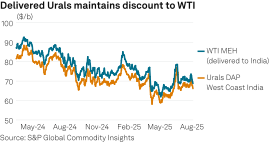
Between April and June, IOC used Russian crude to satisfy a quarter of its feedstock needs. "We are continuing to buy Russian crude in the ongoing quarter," IOC Director of Finance Anuj Jain said on the call. In 2026, the EU will impose an import ban on products made from Russian crude oil.
Platts, part of S&P Global Energy, assessed Urals crude at a $2.74/b discount to the Dubai benchmark on Aug. 15, reflecting a 76-cent wider discount for the grade than the previous week. However, the delta remains far below recent levels of over $5/b in January.
India, China and Turkey are the largest importers of Russian crude. In July, India received 1.7 million b/d, China received around 1 million b/d and Turkey received around 400,000 b/d, according to S&P Global Commodities at Sea data. Trump's additional tariffs on Indian goods, effective Aug. 27, combined with new EU policies targeting refined products made from Russian crude, are already impacting flows, CAS said on Aug. 14 in its Weekly Crude Oil Report.
On Aug. 18, White House trade advisor Peter Navarro wrote that India was "cozying up to both Russia and China," and said if "India wants to be treated as a strategic partner of the US, it needs to start acting like one."
"An outcome which would see a ratcheting down of tensions and remove threats of secondary tariffs or sanctions would see oil drift lower toward our $58/b average target," TD Securities Head of Commodity Strategy Bart Melek said. "In sharp contrast, a result which would see the US apply pressure on Russia in the form of broader secondary tariffs against Russia's oil customers (as those now faced by India) would no doubt move crude to the highs seen a few weeks ago.
No agreement
The tone of Trump's meeting with Zelenskyy marked a contrast from their previous meeting in March, when an Oval Office press conference descended into an argument. The two met for several hours in the East Room of the White House on Aug. 18, per reports, after Trump's meeting with Russian President Vladimir Putin in Alaska on Aug. 15. Both pressed for a trilateral meeting of the US, Ukraine and Russia.
Trump continued to push back against reporters' questions that he had given Putin a diplomatic victory by hosting the Russian President in Alaska, while pledging support for Ukraine without specific defense guarantees. While Trump insisted Europe would be the first line of defense against further Russian aggression, the US would "help them out," Trump said.
"There'll be a lot of help when it comes to security," Trump said.
The crude futures market settled slightly higher on the day. NYMEX September WTI settled 62 cents higher at $63.42/b, and ICE October Brent climbed 75 cents to $66.60/b.
No agreement was reached, and the prospect of sanctions remained unknown.
"It's too early to talk substantially about sanctions relief, but I wouldn't see much more fuel production coming from Russia any time soon," Ziemba said. "Sanctions did more to cap new production than to reduce current volumes, although Ukrainian drone attacks on refineries have reduced some volumes. Overall, there are many questions whether sanctions will just be suspended or lifted in the case of any longer-lasting agreement."
