Crude Oil, Refined Products, Maritime & Shipping
August 18, 2025
Drone attacks halt Russian oil flows to Central Europe, hit Socar depot in Ukraine
HIGHLIGHTS
Ukrainian attack hits Druzhba pumping station, halts flows
Russian drones set fire to Azeri-owned depot in Odesa
Attacks have hit refineries with around 25% of Russian capacity
Russia and Ukraine continued to batter each other's energy infrastructure with drones ahead of Aug. 18 peace talks in Washington, causing a suspension of oil flows to Hungary and Slovakia through the Druzhba pipeline system and hitting an Azeri-owned fuel depot in the Black Sea port of Odesa.
In a statement on X, Hungarian Foreign Minister Peter Szijjarto wrote that back-to-back attacks on Russia's crude oil pipeline system had halted flows to Central Europe, with little clarity over when a damaged transformer station would be repaired.
Experts were working to restore operations on a damaged transformer station, he said, admonishing the offensive as "outrageous and unacceptable." After speaking with Russian Deputy Energy Minister Pavel Sorokin, there was no clear timeline for when deliveries would resume, he said.
In a thinly-veiled threat to retaliate against further sabotage activity, he issued a warning to Kyiv. "A reminder to Ukrainian decision-makers: Electricity from Hungary plays a vital role in powering your country," Szijjarto said.
The minister had previously expected oil flows to be restored within the day on Aug. 14 after attacks hit a pumping station in Unecha, southwest of Moscow.
The station is part of the Druzhba pipeline system, which has the capacity to pump up to 1.5 million b/d through its two branches into Central and Eastern Europe and north to the Ust-Luga oil export terminal on the Gulf of Finland.
Russian pipeline operator Transneft was not available for comment.
A spokesperson for Hungarian refiner MOL confirmed that crude deliveries had been suspended pending technical work on the pipeline. The company can also source feedstock from the Croatian port of Omisalj via its alternative crude connection, Adria, but has previously said it wouldn't be capable of running without Russian oil until at least 2026.
Nevertheless, the spokesperson downplayed the impact of the incident, assuring that "security of supply for the region remains guaranteed".
A statement from Slovakian pipeline operator Transpetrol also confirmed that pipeline supplies had been interrupted, without providing detail on the cause of the outage.
With almost 290,000 b/d of refining capacity domestically and in Slovakia, MOL is one of the largest refiners to still rely on crude delivered through Russia's Druzhba pipeline system. In Belarus, two refineries still process Russian oil, while Germany continues to import some KEBCO-branded Kazakh supply through the Druzhba connection.
Other former Russian oil buyers, including Poland and the Czech Republic, have suspended imports through the pipeline, partly due to energy security concerns as fighting has dragged on. In March, a drone attack temporarily suspended flows through the southern branch of the Druzhba network, accelerating a pivot from the Czech Republic.
Socar depot
In a separate incident, Russian drones struck and set fire to an oil terminal owned by Azerbaijan's state oil company Socar in Ukraine's Odesa region.
Ukraine's President Volodymyr Zelensky called the incident a significant escalation from Russia, calling it "an attack not only on us but on our relations and energy security."
Azerbaijan's APA news reported that a major fire at the site damaged 17 fuel tanks, a pumping station building, and administrative buildings, as well as weighing points at the depot, the Azeri news outlet said.
The Socar facility, located on the Black Sea coastline, was estimated to have held over 16,000 mt of fuel.
On Aug. 10, Azerbaijan's President Ilham Aliyev condemned previous Russian attacks on Azerbaijani energy infrastructure facilities in Ukraine, including the Socar oil depot near Odesa.
Both countries assured that they would work on "expanding joint capabilities" to preserve their energy security, contributing to souring relations between Baku and Moscow.

Refineries under fire
Ukraine's domestically-produced drones have taken on growing prominence for its military since 2024, when it began picking off some of Russia's largest refining facilities with high-precision strikes.
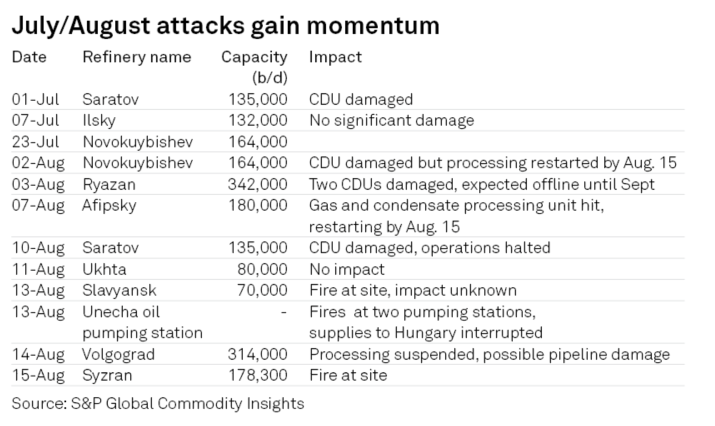
In the week to Aug. 14 alone, it struck five Russian refineries, including the major 314,000 b/d Volgograd complex and other large-scale facilities Syzran, Afipsky, and Saratov.
The war of attrition on Russia's oil infrastructure has left refineries with a combined total of some 1.5 million b/d capacity -- or roughly a quarter of the country's total -- impacted by drone damage, putting pressure on export revenues and requiring costly repairs.
On Aug. 11, drones stretched a record 2,000 km distance into Russian territory to hit a refinery in the Komi Republic, while plants such as Novokuybishev have been subject to repeated strikes. According to statistics from Ukraine's defense forces, refineries have been the target of 42% of its drone attacks in 2025.
Increasingly, however, new strikes have expanded in focus to target crude pipelines and export infrastructure, demonstrating a show of force at a critical juncture for the peacemaking process.
After receiving Russian President Vladimir Putin in Alaska last week, US President Donald Trump will meet Zelensky and European leaders Aug. 18 to discuss ending the three-year conflict. However, the Ukrainian leader is expected to resist the maximalist demands of his Russian adversary and has previously rejected the idea of making territorial concessions.