Crude Oil
August 18, 2025
Bruised by Trump’s tariffs, India, Brazil look to strengthen oil ties
HIGHLIGHTS
Brazilian crude flows rise 75% YOY in H1: CAS
Modi, Lula speak to boost cooperation on energy, other areas
Logistical hurdles, high freight some of the key challenges
Sky-high US tariffs are prompting India and Brazil to explore opportunities to boost oil trade, as New Delhi looks for alternatives to Russian oil, while Brazil scouts for newer markets for its growing crude output, analysts and refining sources said.
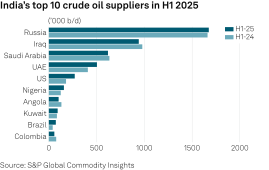
Russian oil flows to India continue, but Indian refiners are preparing for the worst by continuing to diversify their sources, a move that could lead to Brazilian crude flows to India -- which posted the highest growth among all suppliers in H1 2025 -- rising even further in H2.
While freight, arbitrage opportunities, and availability of spare cargoes would determine the commercial viability of Brazilian crude among Indian refiners, analysts and refining sources said growing diplomatic efforts between the governments of India and Brazil would yield positive results.
"Brazilian crude exports to India will be closely watched in the coming months, particularly as both countries navigate the impact of US tariffs related to Russian oil imports," said Benjamin Tang, head of liquid bulk at S&P Global Commodities at Sea.
Crude inflows from Brazil posted the sharpest growth in the six-month period, rising about 75% year over year to 72,000 b/d from 41,000 b/d, CAS data showed, signaling a growing affinity of its refiners for non-OPEC crudes.
This year, shipments, primarily from Petrobras, consisted mainly of the medium-sweet crudes -- such as Lula/Tupi grades -- accounting for about 43% of the flows, followed by Sepia at 28%, and Atapu and Peregrino grades, each at 14%.
Indian Oil Corp. and Reliance Industries have been the primary buyers of Brazilian crude. The latest CAS data indicates that most medium-sweet grades, including Lula/Tupi, Sepia, and Atapu, were discharged at IOCL's Paradip terminal in 2025, while the heavy-sour Peregrino grade was offloaded at Reliance's Sikka terminal.
The most recent Brazilian discharge took place almost three months ago on May 18 from the VLCC Donoussa at Paradip, totaling 1.9 million barrels of Sepia and Atapu.
Diplomatic efforts intensify
Both Prime Minister Narendra Modi and Petroleum Minister Hardeep Singh Puri recently visited Brazil to discuss how India can increase crude oil imports from the South American country and explore opportunities for collaboration on offshore deep and ultra-deepwater exploration and production projects.
US President Donald Trump's move to impose an additional 25% tariff on US imports from India -- raising the overall duty to 50% -- as a penalty for Russian oil purchases has led Indian policymakers to weigh the economic consequences and trade-offs of paying additional tariffs on various other commodities.
Immediately after Washington announced additional tariffs, Modi spoke with Brazilian President Luiz Inacio Lula da Silva.
"We are committed to deepening our strategic partnership, including in trade, energy, technology, defense, health, and more. A strong, people-centric partnership between global south nations benefits everyone," Modi said.
Even Brazil, which also faces a 50% tariff on exports to the US, said it plans to rally global opposition to Trump's tariff policy, which now includes duties on coffee, beef, and petrochemicals. Lula has also said he would reach out to India to expand trade.
It currently costs about $4-$6/mt and takes around a week to ship crude oil from some Middle Eastern destinations, while it costs $15-$20/mt and takes about a month to import crude oil from Brazil, market sources and analysts said.
"India has been trying for a long time to source crude oil from Brazil. It's a good development if the government-to-government relationship can catalyze this process. There are a lot of synergies for Indo-Brazilian energy trade in terms of crude oil and biofuels," said DLN Sastri, director for oil refining and marketing at the Federation of Indian Petroleum Industry.
Upstream ties offer hope
India is also seeking to strengthen ties in the upstream sector. Recently, Oil India Ltd. signed a deal with Petrobras to collaborate on exploring and producing hydrocarbon resources in India's offshore regions.
According to Energy, 2000-2015 could be classified as a period of aggressive internationalization by upstream companies globally. Brazil's deepwater has been one of the most attractive emerging areas and has seen huge participation in bidding by global oil majors, including Indian companies.
However, with a few exceptions, Brazil then did not end up being a focus area for Indian companies. This can be attributed to attention being paid elsewhere back then -- Russia and Venezuela, according to Energy.
However, the tide is turning, and Indian upstream companies are now becoming more open to overseas investments and exploring new locations, he and other sources said. Indian companies still have exposure in Brazil with ONGC's Campos Basin BC-10 and BPCL's stake in five offshore blocks.
While entitlement production for Indian companies from Brazil is minimal, new projects coming online starting in 2024 will increase production to about 40,000 boe/d by 2028. These include SEAP 1 and Wahoo for BPCL and SEAP 2 for Oil and Natural Gas Corp.
"India stands to gain by expanding the scope of its oil trade with Brazil -- both in upstream and downstream sectors. We have been seeing the results in some of the recent data. We are going to see more of it," said a senior Indian oil industry source.
