Refined Products, Crude Oil, Maritime & Shipping
August 15, 2025
Thailand's PTT sets up ‘War Room’ to manage global economic, geopolitical risks

By Gawoon Vahn
HIGHLIGHTS
'War Room' monitors macroeconomic, geopolitical changes
H1 net profit falls over 30% amid volatile oil prices
PTT expects Dubai crude to average between $65/b and $75/b in H2
Thailand's state-run oil and gas giant PTT has established a special brainstorming and analysis division to navigate global economic and geopolitical risks, following a over 30% drop in earnings for the first half of 2025 amid volatile oil prices.
PTT is proactively adapting its strategies to enhance competitiveness and manage global trade, economic, geopolitical, and price volatility risks. The state-run Thai energy giant has established a special division called the "War Room" to address global economic uncertainties, company officials and its refining division sources said over Aug. 13-15.
The special "War Room" division will constantly monitor macroeconomic changes stemming from US reciprocal tax policies and key geopolitical issues, especially the Iran-Israel confrontation and Thailand–Cambodia border dispute, assess the potential impacts on the country and PTT Group, and formulate appropriate response plans, a company official said.
"Regular monthly meetings are held to report progress, flag issues, identify opportunities and threats, and prepare mitigation plans to address those issues," PTT said in a statement.
When asked about specific cost optimization strategies, a feedstock strategist at PTT said the "War Room" decision makers and analysts would regularly assess Middle Eastern sour crude prices and Persian Gulf-Asia tanker logistical costs amid geopolitical tensions in that region, while the company's trading desk in Singapore would constantly assess arbitrage economics for US and West African crude for spot purchases.
In addition to the global energy market risk management, the special "War Room" division would also focus on key initiatives such as domestic production management and digital transformation, as part of PTT's efforts to drive operational efficiency and cost optimization, the state-run oil company said.
Meanwhile, PTT's net profit in H1 fell 30.4% from a year earlier to Baht 44,848 million, or around $1.385 billion, although refining margins and oil product sales volume improved in the second quarter, the company said in a statement Aug. 13.
In Q2, the Gross Refining Margin (GRM) rose to $4.6/b from $3/b a year earlier. Oil product sales volume increased due to improved refinery utilization rates, which climbed from 103.8% in Q2 2024 to 105.0% in Q2 2025, according to a company official.
However, a sharp decline in oil prices during H1 negatively impacted various segments, leading PTT to post an inventory valuation loss of approximately Baht 5,800 million ($179 million), compared to a gain of Baht 5,400 million ($166 million) in H1 2024.
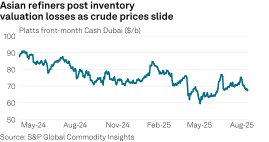
Lower average selling prices for refined products, resulting from a decrease in benchmark crude and oil product prices, significantly affected sales revenue in the Petrochemical and Refining business. H1 sales revenue totaled Baht 611,373 million ($18.9 billion), reflecting a 12.5% year-over-year decline.
PTT indicated that the average Dubai crude oil price fell sharply to $71.9/b in the first six months, down from $83.3/b in H1 2024. This decline was influenced by global economic concerns, including US tariff hikes.
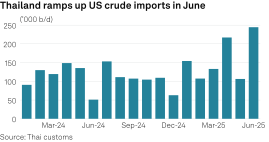
In June, Thailand's US crude oil imports hit a record 7.3 million barrels, enhancing the country's energy security and crude supply source diversification amid ongoing geopolitical tensions in the Middle East. Industry sources advised against relying heavily on Middle Eastern supplies due to the risks posed by conflicts such as the Israel-Iran situation.
Oil price, margin, sales outlook
Looking ahead, PTT anticipates continued volatility in oil prices, but the downtrend may slow with the average price of Dubai crude oil expected to range between $65/b and $75/b for the remainder of 2025.
Platts assessed Middle Eastern sour crude outright benchmark Cash Dubai at an average of $70.45/b to date in Q3.
"The oil market is likely to face oversupply pressures due to increased production from both OPEC+ and non-OPEC+ producers," PTT said.
PTT expects that sales volumes could improve in H2, particularly if global economic conditions stabilize and US tariff uncertainties fade. It expects global oil demand to increase modestly, with forecasts indicating growth of 600,000 b/d in 2025.
"This growth is expected to support overall sales, although it may still be tempered by trade uncertainties and geopolitical tensions," PTT said in the statement.
