Refined Products, Crude Oil, NGLs, Jet Fuel
August 13, 2025
IEA cuts oil demand growth estimates in ‘ever more bloated market’

By Nick Coleman
HIGHLIGHTS
Oil stocks seen at 46-month high, led by China, US NGLs, floating storage
Raises non-OPEC+ supply growth estimate for 2026 on Americas boom
China's weak demand growth highly petrochemical dependent
The International Energy Agency trimmed its 2025 and 2026 oil demand growth estimates for a third month in a row on Aug. 13, citing flat year-over-year OECD demand and lower-than-expected emerging market growth in the second quarter.
The Paris-based organization lowered its demand growth estimates for the two years to 680,000 b/d and 700,000 b/d, respectively, in light of Q2 weakness, noting Japan's demand had hit multidecade lows, alongside lower-than-expected growth in China, Brazil, India and Egypt.
Within the overall picture, OECD oil demand is showing greater price "elasticity," with lower international prices having a weaker link to oil demand in emerging markets due to the greater prevalence of price controls and subsidies, the IEA said. Retail prices had remained essentially unchanged for several years in some Middle Eastern countries, it noted.
In China, oil demand rose by 230,000 b/d year over year in June, but this was the first such increase since February, the IEA said. Recent weakness will be offset by stronger demand in the second half of the year, resulting in an annual demand growth rate for China of 90,000 b/d in 2025, rising to 160,000 b/d in 2026, it forecast. However, such rates are still "far below typical historical levels" and remain highly dependent on the petrochemical sector, the IEA said. It also noted a reduction in the distances traveled for domestic tourism, as well as the uptake of electric vehicles as factors suppressing demand in China.
Oil glut
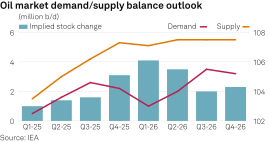
Meanwhile global "observed" oil inventories reached a 46-month high in June, rising by 28.1 million barrels month over month to 7.8 billion barrels, underpinned by growing volumes of oil at sea and rising stocks of Chinese crude and US NGLs, the IEA said. OECD industry stocks by contrast were close to decade-low levels, down 88 million barrels year over year at 2.8 billion barrels, it said.
One bullish factor remains the recent spate of EU and US sanctions announcements against Russia and Iran, the agency noted. "While oil market balances look ever more bloated as forecast supply far eclipses demand towards year-end and in 2026, additional sanctions on Russia and Iran may curb supplies from the world's third and fifth largest producers," it said.
"It is clear that something will have to give for the market to balance," it added, noting a recent easing of US restrictions on Venezuelan oil production.
On the supply side, the IEA lowered its growth estimate for non-OPEC+ producers in 2025 by 100,000 b/d to 1.3 million b/d, but raised it by 60,000 b/d for 2026.
Despite a run of announcements by OPEC+ raising the producer group's output plans, "non-OPEC+ producers will continue to lead growth ... bolstered by rising output of US NGLs, Canadian crude, and US, Brazilian and Guyanese offshore oil," the IEA said.
By contrast to the IEA, the generally more bullish OPEC monthly report kept the Vienna-based organization's 2025 demand growth estimate unchanged at 1.3 million b/d, and raised its estimate of 2026 demand growth by 100,000 b/d to 1.4 million b/d.
Analysts at S&P Global Energy substantially cut their 2025 oil demand growth estimate on July 29 to just 635,000 b/d, reflecting Q2 data, although they forecast somewhat firmer growth of 785,000 b/d in 2026.
Jetting off
Within the overall muted picture, the IEA noted summer jet fuel demand had reached record highs in Europe and the US, but said globally, jet fuel demand remained below pre-pandemic 2019 levels.
"Global jet/kerosene demand is on track to increase by 2.1% this year, the strongest of any product. However, at 7.7 million b/d in 2025 it will still be 180,000 b/d below the 2019 pre-COVID level," it said.
The Platts Dated Brent crude benchmark from Energy fell 20% year over year in Q2 to $67.88/b.
