Maritime & Shipping, Crude Oil, Natural Gas, Refined Products
August 08, 2025
CNR closing last North Sea facilities as costs soar above revenue

By Nick Coleman
HIGHLIGHTS
Operators report on challenges of mature basin, tax regime
Ninian area closures weakening Brent blend supply
Government guidance on fiscal plans expected in autumn
Canadian Natural Resources has closed two North Sea fields near its Ninian hub, which feeds Brent oil volumes, after production costs soared to $179/b of oil equivalent in the second quarter, it said Aug. 8, underscoring wider difficulties in the sector.
The Calgary-based company reaffirmed its decommissioning plans as a number of operators reiterated their diminishing expectations for the high-tax, and mature North Sea oil basin.
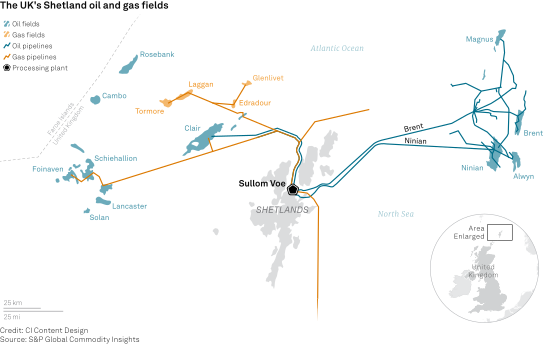
The Ninian hub is one of a few remaining sources for Brent blend crude loaded in the Shetland Islands after the closure of several other feeder fields, including the Brent field itself in 2021. Loadings of the blend have mostly been in the 20,000-30,000 b/d range in recent months. In September, they are set to fall to 22,580 b/d, according to a copy of the program seen by Platts July 30.
Brent blend is a constituent in the Platts Dated Brent benchmark, but has long been supplemented with other grades from around the region as well as US WTI Midland crude.
CNR has now ceased production at two feeder facilities, the Ninian South platform, on June 30, and the Lyell subsea facility, in mid-April, a company spokesperson said in emailed comments.
The hub is also significant as a conduit for crude produced at other fields, including EnQuest's Magnus, and sent by pipeline to Sullom Voe in the Shetland Islands. A bypass solution is expected for such flows, industry sources have said.
Following successive oil field closures, Brent blend is now sent to Sullom Voe only via the Ninian pipeline, with the second route, the Brent pipeline, no longer functioning, a source close to the situation previously told Platts.
CNR's Q2 production expenses, at $179/boe on average in the North Sea, are before the imposition of any taxes, and reflect "reduced volumes following the permanent cessation of production at Lyell and Ninian South and a planned maintenance turnaround at Ninian Central," the spokesperson said.
Production continues for the time being from CNR's Ninian Central hub, and the smaller Tiffany facility further to the south.
Job losses
Meanwhile, Harbour Energy reaffirmed Aug. 7 its determination to move away from the North Sea, where it is still a sizeable operator, with Q2 production of 161,000 b/d oil equivalent, including gas.
The UK North Sea saw an interruption in its long-standing output decline in the earlier part of 2025, with crude output rising 5% year over year in January-May, according to preliminary official figures published July 31.
Harbour said the greater part of its 2025 maintenance would be in the second half of the year, resulting in less production. In the first half, it benefited from new production coming on stream in the Greater Britannia and J-Areas, which feed the Ekofisk and Forties blends, respectively.
However, "we are again reducing our Aberdeen workforce. This is to align with lower levels of UK investment going forward, given the ongoing challenging fiscal and regulatory environment," Harbour CEO Linda Cook said in a call with investors. "What we've done is make the most of what has been a challenging situation, and our team has done a great job driving down unit costs, executing the high payback or high-return quick payback opportunities we had," Cook added.
Similar sentiments were expressed by US producer APA Corp, formerly Apache, which said it expected to move to a non-tax-paying position in the UK, reflecting production decline, probably in 2026. "At some point, with production continuing to decline without investment in the asset in the future, it will be at a tax loss position and at strip pricing and at current investment levels, we think that that's likely going to happen in 2026," APA's chief financial officer Ben Rodgers said in an Aug. 7 call with investors.
Dated Brent was last assessed by Platts, part of S&P Global Energy, at $67.73/b on Aug. 8.
The UK is expected to unveil plans for long-term changes to its North Sea tax regime probably in the autumn, with producers calling for these to be implemented more urgently.

Editor: