Crude Oil, Refined Products, Natural Gas
August 07, 2025
INTERVIEW: Disgruntled with foreign firms, Gabon’s state oil company forges ahead

HIGHLIGHTS
GOC CEO acknowledges industry's 'fear' following Assala pre-emption
Has repaid $160 mil to Gunvor, increased output while inking new deals
State firm establishes 'new system' after pleading with IOCs to explore
Gabon's state oil firm had little choice but to buy London-based Assala Energy in mid-2024, and to continue its spate of acquisitions since, after two decades of struggles to convince foreign operators to carry out exploration, its CEO told Platts.
In an interview to mark the first anniversary of the contentious pre-emption deal, which scooped Assala's 48,000 b/d oil assets from under the nose of would-be buyer Maurel & Prom, Marcellin Simba Ngabi said the deal -- designed to boost Gabon's energy sovereignty, revenues and long-term production -- was already bearing fruit.
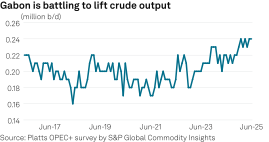
"We have proven our ability to manage a company of this scale with discipline and stability," he said at Assala's London offices. "Today, production remains steady at around 50,000 b/d, we continue to repay the loan contracted with Gunvor, and no operational issues have been encountered."
The $1 billion deal, financed with $800 million from trader Gunvor, shocked the industry and prompted fears over Gabon's investment climate. One of the biggest deals ever by an African national oil company, it followed a military coup in August 2023 by Brice Oligui Nguema, who secured a thumping presidential election victory in April after putting the Assala deal at the heart of his campaign.
Since then, GOC has continued to flex its muscles in a sector traditionally dominated by IOCs, acquiring Tullow's 10,000 b/d business with another $220 million loan from Gunvor, and taking over the Tsiengui-Obangue fields after Chinese company Addax's license expired.
GOC could also finalize its acquisition of drilling firm SMP Afrique this month and is planning to construct new oil and fuel depots, Ngabi said.
Meanwhile, the state firm has already repaid $160 million to Gunvor -- which has marketing rights for Assala's crude -- and the Assala and Tullow loans should be fully paid in four years.
"There is a fear of what is new, a fear of the unknown. But we are not changing anything," Ngabi said of the industry reaction. "For us, sovereignty is not refusing to work with foreign partners. It means having the capacity to decide for ourselves."
Assala takeover
According to industry sources familiar with the takeover, who spoke on condition of anonymity due its sensitivity, the pre-emption was initially turbulent.
Months of work with France's Maurel & Prom, which had agreed to buy the company from US private equity firm Carlyle, was torn up. Along with Assala's management team, some in the finance and trading departments left, while others worried about the pre-emption's implications amid intense media coverage, sources said.
However, Edgar Mba Ognane, Assala's Libreville-based managing director, said the company was in good shape a year on.
"People-wise, organization-wise, we have really stabilized, and I think we are now moving on a more steady-state regime," he told Platts in a separate interview.
"We are self-financing now. We no longer take RBL backed loans," Ognane said, referring to reserve backed lending secured against oil and gas assets. "We are generating enough revenue to cover opex and capex, which is about $600 million a year, pay dividends to the state and honor our other commitments."
A new CFO is expected to be appointed in mid-August.
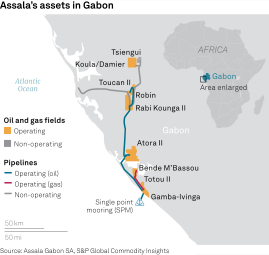
Crucially, the company has managed to nudge production towards 50,000 b/d through infill drilling and workovers on its well stock of 550 wells, and is analyzing more than 20 opportunities across three exploration blocks to fight its 15-20% natural decline, Ognane said.
Assala – which controls a significant share of Gabon's key medium sweet Rabi export grade popular in Europe and Asia – will bring the key N'Gongui oil field online next year as part of an effort to boost output by up to 30%.
"My main responsibility is to keep [output] above 50,000 b/d, bring N'Gongui -- the first new field under the fifth republic in Gabon -- to a plateau of at least 15,000 b/d within the next three years or so, and drive growth for the country," Ognane said. It will also drill an exploration well on its Mutamba-Iroru II block this year.
GOC runs Assala at arm's length, while the company pays taxes, royalties and dividends to the Gabonese state. Ognane said Assala also has an "excellent" relationship with Gunvor.
"The message that we push with GOC, and which has gone to the head of state, is that for this company to be profitable we need to have a healthy level of treasury to continue financing growth and operations. And we are very grateful that that is understood," he added.
Ngabi said Assala's knowledge base and access to international talent could be deployed across the wider portfolio, which is producing a combined 80,000 b/d of crude.
"In the past, Assala UK worked exclusively for Assala," he said. "Today, our objective is for it to also support the activities of GOC, of Tullow, and operations for [fields formerly operated by] Addax."
For instance, GOC is set to ship crude from its 5,000 b/d Tsiengui-Obangue fields to Assala's southern export terminal, according to Gabonese sources, ending its reliance on Perenco's Cap Lopez hub.
GOC strategy
Ngabi said the Assala acquisition was required due to the "lack of long-term vision" and risk-taking by foreign operators, and the need to boost state revenues for national development.
"For the past 20 years, companies have been urged to resume exploration. Few have taken the step," he said. "It is therefore a sovereign decision by the state of Gabon to engage directly in exploration."
Asked if the government was swapping its reliance on IOCs for dependency on commodity trader Gunvor, Ngabi said GOC was "part of the global banking system," which is "not incompatible with sovereignty." GOC had sought to diversify its financing sources to buy Tullow's assets, he said, but only Gunvor made a suitable offer "at the very last moment."
The GOC boss also shrugged off concerns that the acquisitions would dent investor confidence.
Platts reported in May that GOC's new approach had left foreign operators cautious, with one seasoned oil executive wondering if acquisitions in Gabon were even possible.
Ngabi said foreign companies were free to engage in exploration, and that GOC only buys assets that are up for sale, but he conceded that producing assets are likely to be purchased by the state.
"That does not mean we intend to acquire all fields and assets. We have a clear strategy," he said, noting that GOC had not pre-empted a recent marginal field acquisition by private Gabonese player Koreg.
Officials note that over 70% of Gabon's sedimentary basin is still available to investors, with Chinese players reportedly more interested in exploration than Western firms.
One Gabonese source familiar with the government’s thinking said the state would acquire only the very best assets. "There is the perception that, yes, of course, the state will try to pre-empt the juiciest assets. If it is an existing producing block that is being relinquished because there is no extension option the state will take it," the source said.
"But the state at the moment is not capable of embarking by itself on large exploration of empty blocks and starting development from them, so they are waiting on investors."
Although its base in London makes Assala somewhat unique, the pre-emption has raised the prospect that Gabon's approach could be replicated by other African NOCs keen to exert sovereignty over their energy sectors.
"We have established a system," said Ngabi. "If other countries believe this model aligns with their own strategy, we will not stand in their way."
Editor: