Refined Products, Crude Oil
August 07, 2025
India's oil diplomacy faces litmus test as Trump targets non-oil trade for Russian flows

HIGHLIGHTS
US announces additional tariffs on US imports from India
India pledges to act keeping country's energy security in mind
Russian oil will continue to flow to India for now: Energy
India's oil diplomacy is facing its biggest test in years as the US looks to penalize non-oil trade instead of directly targeting imports of Russian oil, but New Delhi is unlikely to step down from its stance on purchases from the biggest non-OPEC supplier yet, analysts, refiners and government sources said Aug. 7.
US President Donald Trump's move to impose an additional 25% tariff on US imports from India -- raising the overall duty to 50% -- as a penalty for Russian oil purchases has prompted Indian policymakers to weigh the economic fallout and trade-off of paying additional tariffs on various other commodities, while continuing with Russian oil purchases.
"This will certainly lower India's economic growth forecast, and the impact might be seen in demand growth. But on the Russian crude front, we still believe that Russian oil will continue to come to India, although an increase in Middle Eastern crude inflows cannot be overruled," said Abhishek Ranjan, South Asia oil research lead at S&P Global Energy.
An executive order released by the White House Aug. 6 said the new tariffs on US imports from India would be in addition to the country's existing 25% rate and would follow the same exemptions under the two countries' current trade policy, including exemptions for most refined products.
India has immediately responded to the US move, calling it unfair.
"We have already made clear our position on these issues, including the fact that our imports are based on market factors and done with the overall objective of ensuring the energy security of 1.4 billion people of India," India's foreign ministry said.
"It is therefore extremely unfortunate that the US should choose to impose additional tariffs on India for actions that several other countries are also taking in their own national interest. India will take all actions necessary to protect its national interests," it added.
Weighing various options
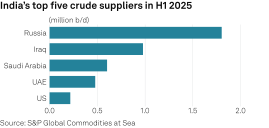
According to data from S&P Global Commodities at Sea, India was the largest importer of Russian crude, with inflows reaching 1.80 million b/d in 2024. China followed at 1.24 million b/d, while Turkey was in third place at 0.3 million b/d. India's imports of oil from Russia in the first half of 2025 have also maintained a similar trend. In July, India received 1.6 million b/d, China received nearly 1 million b/d, and Turkey received around 500,000 b/d.
"The trade-off is between India paying additional tariffs on many products heading to the US and continuing to buy Russian oil, one of the biggest items on India's import bills. I don't think India will alter its position, as inflows to India are not under sanctions, as long as they are keeping the price cap in mind," said a senior Indian refining source.
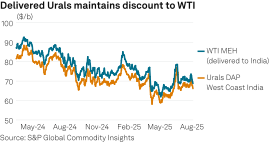
Russian crude has been trading near the $60/b G7 price cap for much of the year. Platts, part of S&P Global Energy, assessed Urals crude on an FOB basis at Primorsk at $57.41/b Aug. 6.
"A 50% US tariff may effectively freeze trade in labor-intensive goods like textiles and gems, and jewelry. There is an economic case for seeking tariff relief from Washington. But Trump administration's unpredictable trade tactics and India's long-standing strategic ties with Moscow make the decision complicated," said Priyanka Kishore, director and principal economist at Asia Decoded, a Singapore-based research consultancy.
Economic fallout, margins
Although the additional 25% tariff raises US duty on Indian goods to a steep 50%, the overall macro exposure is moderate, given the limited share of US export revenues in India's GDP, some analysts said. If the matter is resolved through bilateral discussions, and if India relents to certain concessions, GDP growth may only see a modest slowdown -- 0.3-0.4 percentage point. But a prolonged tariff regime would pose a more serious risk, particularly to labor-intensive sectors.
"If US pressure forces India to reduce or, in an extreme case, cease Russian imports, Indian refiners would be forced to revert to costlier Middle Eastern grades," said Rajat Kapoor, managing director for oil and gas at Synergy Consulting.
"This would significantly erode their gross refining margins, especially in the case of state-run refiners, which already operate on thin spreads and limited pricing flexibility. Such a scenario could directly increase the government's fiscal burden, particularly if it has to support public sector refiners for under recoveries or extend fuel subsidies to shield retail consumers from high prices," he added.
Energy expects that inventories will rise sharply later this year. As a result, Dated Brent could drop below $60/b as the most likely outcome later in 2025.
"We expect oil demand growth -- particularly for key refined products -- to slow down, especially in Q4 2025 and Q1 2026. More supply will come from OPEC+ members. There could be some reduction in output from US producers, but it may not be enough to offset the overall surplus. Once inventories show an increasing trend, there will be downward pressure on oil prices," said Premasish Das, executive director, oil research and analysis at Energy.
Editor: