Chemicals, Refined Products, Crude Oil, Natural Gas
August 05, 2025
Mexico unveils Pemex rescue plan; targets 1.8 mil b/d crude output, supplier relief

By Sheky Espejo
HIGHLIGHTS
Seeks to increase company's crude oil production to 1.8 million b/d
Pemex plans to focus on Zama, Trion, existing fields with potential
Aims to revive petchems industry to boost ammonia, urea production
Targets improved fuel output through refinery optimization
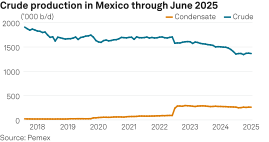
Mexican President Claudia Sheinbaum on Aug. 5 unveiled her administration's strategy to improve the finances and operation of state oil and gas company Pemex so it can raise crude production to 1.8 million b/d.
The goal is to "rescue and transform Pemex" while restoring its central role in Mexico's energy system so that by 2027, it can face its own financial commitments without government support, Sheinbaum said during her daily press conference.
To increase oil production, Pemex will concentrate on the offshore projects Zama, Trion and existing fields with potential, Pemex CEO Victor Padilla said during the conference.
Pemex will prioritize the fields where it gets its base production, Padilla said during a subsequent conference. Pemex obtains over 50% of its production from a handful of projects that include Maloob, Zaap, Quesqui, Tupilco Profundo, Ixachi and Balam, official data shows.
Padilla also mentioned the company will attend to fields that do not currently produce enough given financial constraints like Arenque, Tlaltitoc, Agua Fría, Miquetla and Macuil. Pemex will develop those fields through the newly created contracts called "mixed contracts" as they involve a partnership with the private industry. Padilla said there will be 21 such contracts. Offers are being received and companies are visiting the fields being offered, he said.
Padilla also mentioned the possibility of developing new fields with "geological complexity," which might refer to unconventional deposits. Roughly 60% of Mexico's 100 billion barrels of oil in reserves are located in unconventional deposits.
Pemex produced 1.366 million b/d of crude in June and 263,232 b/d of condensates, according to the latest official data.
Pemex will also focus on improving fuel output and reviving the company's petrochemical business, including the processing plants Independencia, Cosoleacaque, Morelos, Cangrejera and Escolín.
At Cosoleacaque, the goal is to increase the production of ammonia; at Cangrejera and Morelos, it is to produce ethylene; at Cangrejera, the company will produce aromatics; and at Escolín, it will aim to produce more urea, Padilla said.
The plan includes increasing domestic fuel production through refinery optimization and completing the delayed coker units at the Tula and Salina Cruz refineries. It also includes rehabilitating Pemex's aging logistics infrastructure and completing the natural gas infrastructure projects known as Interoceánico, Maya and Coatzacoalcos II, located in the southeast of the country.
In addition to operational upgrades, Sheinbaum announced the creation of a new financial vehicle that will manage Peso 250 billion ($12.8 billion) to help Pemex pay down its significant backlog of supplier debt. The move is intended to ease pressure on Pemex's contractors and restore confidence in the company's commercial relationships.
Development bank Banobras will provide 50% of the funds, while private banks and other investors will provide the rest, said Jorge Mendoza, Banobras president.
"The funds are enough given the investment program that was presented to us by Pemex," Mendoza said.
"This is responsible public stewardship," Sheinbaum said, emphasizing that the government will continue to support Pemex as a state-owned enterprise in 2025 and 2026. By 2027, Pemex will be able to face its financial commitments on its own, she said.
Pemex has a financial debt of roughly $100 billion, plus around $20 billion in debt to suppliers.
The company has struggled in recent years to maintain production, modernize infrastructure and meet payment obligations to suppliers and partners.
Editor: