Crude Oil, Maritime & Shipping
August 04, 2025
OPEC+ bets on market tightness with another aggressive quota hike
By Charlie Mitchell and Rosemary Griffin
HIGHLIGHTS
Would complete 2.5 million b/d hike 12 months early
OPEC insists market is tight, despite demand fears, tariffs
Analysts expect Q4 supply surplus of 2 million b/d
For two years, OPEC+ ministers, particularly Saudi Arabia's Prince Abdulaziz bin Salman, have insisted that the oil market is tighter than sentiment -- and speculators -- would suggest. With a final leap of faith on Aug. 3, the producer alliance has put that theory to the test.
Oil prices slid more than 2% on Aug. 4 after eight OPEC+ countries agreed to complete an almost 2.5 million b/d quota increase by October, with the fifth accelerated hike in September totaling 547,000 b/d.
The unwinding of 2.2 million b/d of voluntary cuts by the so-called Group of Eight -- Saudi Arabia, the UAE, Kuwait, Kazakhstan, Russia, Oman, Algeria and Iraq -- plus a separate long-argued-for 300,000 b/d hike for the UAE due to its elevated production capacity, were supposed to be implemented gradually over 18 months. Instead, they will take just six.
Although the market had largely priced in the September hike, it marks a decisive change in approach for OPEC+, which in recent years adopted a defensive crouch, holding a total of 5.8 million b/d off the market while production by rival producers, including the US, Canada and Guyana, soared.
Widely seen as an effort to reclaim market share, the hikes have surprised analysts and market participants, particularly coming in the wake of blanket US tariff announcements, which prompted fears of a global economic slowdown. In its statement Aug. 3, OPEC said the move was driven by a "steady global economic outlook" and "healthy market fundamentals."
Currently, a further supply boost cannot be ruled out, with 3.66 million b/d of further cuts still in effect from agreements in 2022 and 2023.
"The group retains full flexibility, by keeping all options on the table: From reversing the unwinding of the 2.2 million b/d voluntary cuts, to pausing the production increase, and/or even considering a further unwind of the next layer of production cuts of 1.65 million b/d," UBS analysts said in an Aug. 4 note.
Skip York, a non-resident fellow at the Center for Energy Studies at the Baker Institute for Public Policy, said he expected "a seasonal pause [over winter] because they can always add barrels if the market needs them."
It is also unclear what will become of the Group of Eight, which will continue holding meetings for now to review "market conditions, conformity and compensation," with the next scheduled for Sept. 7.
If the group disbands following the full unwinding, it could return more decision-making power to the wider 22-member alliance.
Extreme volatility
ICE Brent crude futures were down 2.1% to $68.21/b by 1326 GMT on Aug. 4, driven by the OPEC+ decision. The benchmark has hovered around $70/b in recent months, despite the quota hikes and tariffs, with conflicts in Europe and the Middle East supporting prices.
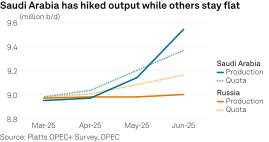
Analysts point out the OPEC+ output has so far not tracked the rising quotas, with key countries including Russia and Iraq holding production flat -- or even trimming it -- to compensate for previous overproduction.
In fact, only Saudi Arabia has significantly increased output since March, according to the Platts OPEC+ Survey from S&P Global Energy. The de facto OPEC leader hiked production by 590,000 b/d between March and June, the survey found, while others have increased by up to 40,000 b/d over that period.
Iraq, a serial overproducer, pumped 40,000 b/d less in June than in March, despite three successive quota increases.
"So far the oil market has been able to absorb the additional barrels coming from OPEC+ very well, as effective production increases have lagged the production increases," said the UBS analysts.
"With some countries in the group producing above the quota, as well as those that previously overproduced facing compensation cuts and some members likely maxed out in terms of capacity, the actual production increases are likely to be lower this and next month as well."
Payam Hashempour, an analyst at Energy, agrees, noting that "market focus will be on how much and how quickly key producers ramp up physical supply to meet higher quotas." But he noted that "this is all playing out at a time of fragile geopolitics, softening demand signals, and persistent sanctions pressure -- all of which could shift sentiment fast."
The OPEC+ alliance -- which says it comes into its own as the steward of the oil market in periods of extreme volatility -- will also be closely watching US sanctions on Russia.
US President Donald Trump has already sanctioned Russia's oil trade and key companies and could impose secondary tariffs on its crude buyers Aug. 8 in a bid to force the Kremlin's hand in Ukraine war negotiations.
It follows a new raft of European Union sanctions on Russian oil, including a ban on imports of refined products made from Russian crude oil. The bloc even targeted a Russian-owned refinery in India, a key exporter of refined products produced with Russian crude.
"In the medium term, oil prices will be shaped by a mix of tariffs and geopolitics," said PVM's Tamas Varga in a note, although he noted that "any price jump triggered by energy sanctions is expected to be ephemeral."
Supply overhang
Putting geopolitics aside, five months of aggressive quota hikes reflect a gamble by the OPEC+ alliance on the tightness of the crude market -- one that has given some members pause in recent months, sources within the alliance told Platts on condition of anonymity due to the sensitivity of the talks.
OPEC insiders point out that the market remains in backwardation through 2025 and that global inventories are low, while ministers -- particularly Prince Abdulaziz -- have long blamed speculators for price fluctuations in a market they say has too often become divorced from fundamentals.
Suhail al-Mazrouei, the UAE's energy minister, told journalists in Vienna last month that the market "needed" additional OPEC+ barrels, pointing to low stocks. And while non-OPEC+ production has risen in recent years, particularly in the Americas, it is the alliance's medium and heavy sour crudes that are in short supply today, analysts say.
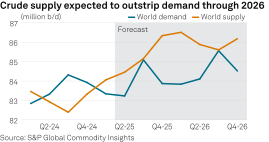
However, many analysts continue to expect a supply glut towards the end of 2025, after seasonal summer demand subsides, including those from Energy, who predict a 2 million b/d surplus in Q4 that could push Dated Brent as low as $58/b.
"The outlook for later in 2026 will hinge on the extent of production adjustments, such as potential reductions in US shale output," Energy analysts said in a note Aug. 3. "Should OPEC+ maintain output at Q4 2025 levels, prices are likely to remain under pressure throughout 2026."

Editor: