Crude Oil
August 01, 2025
Impact of Trump tariff threats uncertain as deadline for Russia looms

By Kate Winston
HIGHLIGHTS
Sub deployment may suggest maximalist approach
Strict measures could boost crude above $100/b
The impact of US President Donald Trump's threats of secondary sanctions and tariffs on countries that do business with Russia is uncertain as the Aug. 8 deadline for a peace deal looms, experts say.
The threats could be seen as largely a trade tactic, but Trump's decision to deploy nuclear submarines could also suggest a stronger response, experts say.
"Inaction at this point seems unlikely after the submarines, but a maximalist action with a long fuse or a moderate action with immediate impact both seem within the realm of possibility," Kevin Book, managing director at ClearView Partners, said in an interview.
Trump has threatened both secondary sanctions and secondary tariffs on entities and countries that do business with Russia if the Kremlin does not come to an agreement to end its war with Ukraine by Aug. 8.
On Aug. 1, Trump deployed nuclear submarines in response to "highly provocative statements" from a top Russian official. "I have ordered two nuclear submarines to be positioned in the appropriate regions, just in case these foolish and inflammatory statements are more than just that," Trump said in a post on his Truth Social media platform.
"Words are very important, and can often lead to unintended consequences, I hope this will not be one of those instances," Trump said.
Market impacts
If Trump imposes secondary sanctions or tariffs that stop Indian and Chinese purchases of Russian oil, it would remove 4 million b/d of oil from the market and send crude oil prices north of $100/b, said David Goldwyn, president of Goldwyn Global Strategies.
And even if it were imposed solely on India, since China continues to flout US sanctions, it would still raise prices between $28/b and $40/b, said Goldwyn, who is also the chairman of the Atlantic Council Global Energy Center's Energy Advisory Group.
"This would not be in the president's interest," Goldwyn said.
India, China and Turkey are the largest importers of Russian crude. In July, India received 1.6 million b/d, China received nearly 1 million b/d and Turkey received around 500,000 b/d, according to Commodities at Sea data to date.
Secondary tariffs could lead to price increases, particularly in the short term, said Ellen Wald, president of Transversal Consulting.
"All in all, if countries like India and Turkey take the threat of secondary tariff seriously, the prices for global oil benchmarks could increase temporarily as refiners in these countries drop purchases of Russian oil and express interest in purchasing oil from other countries," Wald said.
But prices will go back down as OPEC puts more oil on the market to satisfy these customers, Wald said. "OPEC countries would be happy to put more oil on the market," she said.
If a measure is announced, there's a good chance its implementation could be lagged, Ziemba said. However, there are signs that India is already tapering its purchases of Russian crude.
"This may reflect the narrowing of the discount of Russian oil products and some adjustments to EU sanctions, including plans to cut purchases of Indian refined products, many of which use Russian crude as a baseline fuel," Ziemba said.
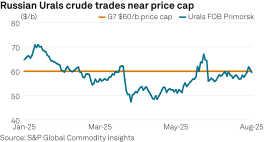
Russian crude has been trading near the $60/b G7 price cap for much of the year. Platts, a part of S&P Global Energy, assessed Urals crude on a FOB basis at Primorsk at $59.52/b on Aug. 1.
The EU has introduced a floating pricing mechanism for the Russian crude price cap with an initial threshold of $47.6/b, a unilateral move partially backed by the UK while other Western allies' stances remained uncertain.
Trade tactic
Trump has threatened to impose additional tariffs on India, on top of the announced 25% tariffs, as a penalty for its military and energy purchases from Russia.
But the vague nature of Trump's threats makes action seem less likely, said Rachel Ziemba, a senior adviser with Horizon Engage.
"The lack of detail, and Trump's own questioning whether economic pressure would lead to Russian policy change, makes me skeptical of big moves that would shake the oil markets," she said.
China should be the number one target for Trump's pressure, but it seems highly unlikely the administration will impose 100% tariffs on China while it is still negotiating the trade agreement, Goldwyn said.
"The president's focus on India, our ally and Quad partner, seems to be borne out of frustration with the pace of those negotiations," Goldywn said.
There are four dimensions that Trump can use to determine the strictness of any measures: the size of tariffs, the types of Russian fuel trade to be targeted, the number of countries targeted, and the timeline for any tariffs to be effective, Book said.
"We have been taking the view that a less strict set of options was more likely than a more strict set of options. However, deploying nuclear submarines is a strong statement," Book said. "It suggests the president is not interested in taking a moderate position."

Editor: