Crude Oil, LNG, Refined Products
July 31, 2025
Shell reports 7% dip in Q2 upstream output but eyes recovery next quarter

HIGHLIGHTS
Upstream output in Q2 dips 123,000 boe/d on lower gas production
Oil wins in Brazil, Nigeria but 'challenging' Q2 for chemicals, products
2025 capex guidance held at $20 bil-$22 bil despite weaker profits
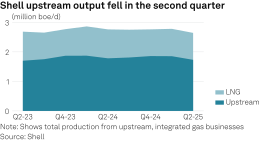
Shell saw upstream production dip 123,000 boe/d in the second quarter of 2025 on lower gas output but is eyeing a Q3 recovery, the British oil major said July 31, as it posted lower profits amid weak oil prices and a macro picture that was "challenging on multiple fronts."
The company pumped 1.732 million boe/d across its non-LNG-related upstream business, down from 1.855 million boe/d in the first quarter and 1.783 million boe/d in the same period in 2024. It marked the second successive quarterly production dip.
While upstream liquids production was broadly flat, Shell's upstream gas output fell in the quarter from 3.02 Bcf/d to 2.31 Bcf/d.
However, upstream production could recover in the third quarter, the company noted, with guidance set at 1.7 million-1.9 million boe/d. The second three months of the year are the highest maintenance quarter for Shell, its CEO Wael Sawan told an analyst call July 31.
Meanwhile, Shell's integrated gas business produced 913,000 boe/d of LNG in the second quarter, down slightly quarter over quarter and below the 980,000 boe/d recorded a year ago.
Despite significant volatility, lower profits and plans to continue its aggressive share buybacks, the company maintained its capital expenditures guidance at $20 billion-$22 billion for the year, it said.
"The macro continued to be challenging on multiple fronts," CEO Wael Sawan said in a video message. "Against a backdrop of geopolitical and economic uncertainty, we saw knock-on effects on both physical trade flows as well as commodity prices and margins more broadly."
Exploration reset
On the oil side, the quarter was characterized by successes in Brazil, including first oil from the Mero-4 FPSO in May and the increase of Shell's working interest in the offshore Gato do Mato project, Sawan said.
"In Nigeria, we deepened our interest in the Bonga field where we have been delivering top-quartile operational performance," he added, referring to a recent interest purchase from TotalEnergies.
The company completed its divestment from Nigeria's challenging onshore earlier this year -- selling its assets to Renaissance -- before shifting its focus to the more technical deepwater. It hopes to bring its 110,000 b/d Bonga North project online after 2027 and is edging toward FID on the Bonga Southwest expansion, which will require its own FPSO.
Sawan told analysts the company was focused on "basins where we have an advantaged position" in order to increase its cashflow per barrel, and that Shell's exploration program is "right size at the moment." Key basins where Shell has an established track record include the Gulf of Mexico, Malaysia and Gulf of Oman, he said.
"We went through a significant reset of our exploration department," Sawan said, looking ahead to "some exiting wells coming in the next six to 12 months."
On Namibia, where Shell this year wrote down $400 million on its huge Graff and Jonker discoveries in the Orange Basin, Sawan said Shell was "looking at what others are doing... and positioning ourselves in case something interesting comes up".
And in the Gulf of Mexico, the company achieved nameplate capacity at its Whale FPSO within five months of first oil in January, he said.
Shell also started production at its LNG Canada project in the quarter, which shipped its first cargo in June, and took final investment decisions on gas projects in Egypt and Trinidad and Tobago.
Downstream challenge
Despite continued efforts to "high grade" its downstream, renewables and energy solutions businesses, and the completion of its divestment of the Energy and Chemicals Park in Singapore, Shell's chemicals and products businesses "faced another challenging quarter, impacted by continued weak margins and unplanned downtime in Chemicals," CFO Sinead Gorman said in the recorded message.
Meanwhile, Sawan said the "the next level of measures" would be enacted to halt losses in chemicals, without elaborating.
However, with year-to-date oil products demand growth of 1 million b/d in spite of global headwinds and refining margins "moving to double digits", Sawan said the market looked "pretty robust". The diesel/gasoil market is fairly tight, Sawan said, with relatively low inventories, suggesting a stronger H2 is in store.
In the second quarter, Shell's refining margin edged up to $8.90/b, from $6.20/b in the first.
Sawan added that it would take some time to understand the full impact of US tariffs, OPEC+ supply policy this year and potential changes to US sanctions on Russia.
While the company continues to keep an eye on non-organic growth opportunities, Sawan said he is "not being dogmatic about trying to get to a certain target" and that any deals would need to compete with the company's share buybacks.
'Robust results'
Shell reported adjusted earnings of $4.26 billion in the second quarter, down year over year from $6.3 billion, due to significant drops in upstream, integrated gas and chemicals and products earnings. That compares to $5.58 billion in Q1.
However, profits in the second quarter beat the $3.7 billion predicted by analysts in a poll provided by Shell following an update earlier this month.
The dip came amid weaker oil prices -- Shell reported a realized liquids price of just $64/b, down from $71/b in the first quarter -- as well as declines in realized gas prices, chemicals sales, and refinery processing intake.
The Brent benchmark averaged $68/b in the second quarter amid US tariff-induced demand fears and a push by OPEC+ to accelerate the return of 2.2 million b/d of crude to the market.
Nevertheless, cash flow from operations was $11.9 billion, up from $9.28 billion in Q1, supported by strong operational performance, Shell said.
Adjusted earnings from marketing were also up $300 million from Q1 to $1.2 billion, despite Shell's crude traders making "a call to be more prudent this quarter" due to the disconnect between fundamentals and volatility, Gorman said.
Sawan said the company had delivered "a robust set of results" despite considerable headwinds, while managing to trim $800 million in structural costs, bringing total cost-cutting to $3.9 billion since 2022.
The company said it would maintain its aggressive share buyback program, purchasing $3.5 billion over the next quarter in the 15th successive quarter of more than $3 billion.

Editor: