Crude Oil, Refined Products, Diesel-Gasoil
July 24, 2025
Middle East crude stands to gain as EU targets Russian oil in new sanctions
By Lauren Holtmeier and Lulwa Albuainain
HIGHLIGHTS
Saudi Arabia, UAE, Iraq, Kuwait hold ample spare capacity
OPEC+ quota hikes to make more barrels available
Refineries may need to segregate supplies for exports to EU
The EU's planned crackdown on fuel imports made from Russian crude could create opportunities for Middle Eastern crude producers as refiners seek alternative feedstock supplies to safeguard access to European export markets.
The tougher sanctions, set to take effect Jan. 21, ban European imports of refined products made from Russian crude. This shift comes as OPEC+ has been unwinding production cuts, positioning key Gulf producers to capture greater market share in places like Turkey and India that have relied on cheap Russian crude as refinery feedstock since 2022.
"If this succeeds in cutting Russian exports, it opens more room for the rest of OPEC+," said Robin Mills, CEO of consultancy Qamar Energy.
The 22-country OPEC+ alliance is set to hike quotas in August by 548,000 b/d, and analysts expect the group will bring even more barrels back to market later this year.
With their ample spare capacity, as well as crude grades that closely match the quality of Russia's flagship Urals grade, Saudi Arabia, UAE, Iraq, and Kuwait are well-positioned to plug a possible supply gap, Mills said.
OPEC+'s spare capacity is projected to be 4.8 million b/d in early 2026 when the sanctions come into force, most of it concentrated in Saudi Arabia and the UAE, according to S&P Global Energy analysis.
A disruption in Russian flows could also lead to the OPEC+ alliance accepting Kazakhstan's quota breaching, which has been a source of tension within the group, Mills said.
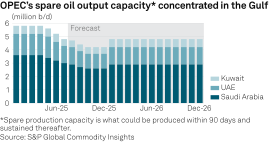
Should the OPEC+ alliance choose not to crimp Russia's market share and keep production hikes limited, other producers of heavy and medium crude grades have limited ability to fill any supply gap, said Saudi-based independent energy consultant and analyst Abdulaziz al-Muqbil.
"With most major [crude] producers operating near maximum capacity, the ability to scale up output meaningfully appears limited," al-Muqbil said, adding the burden may shift to refiners and drive up refined product prices – particularly diesel.
Supply reconfiguration
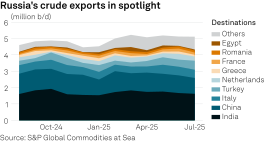
Europe imported 124,000 b/d of gasoil/diesel from India and 94,000 b/d from Turkey in June, representing 7% and 5% of its total imports, respectively, S&P Global Commodities at Sea data showed.
While Middle East OPEC+ producers are a logical replacement supplier for Russian crude, refiners will have to take into account the recent turmoil in the region and the impact any reignition of hostilities could have on supply security.
"Middle Eastern supplies have recently been impacted by geopolitical conflict, so even if diesel supplies are plentiful, relying too much on one source could make Europe vulnerable to price fluctuations or physical shortages," said Eleanor Budds, research and analysis director at S&P Global Energy.
The EU's measures also include a new, lower price cap of $47.60/b on Russian crude, down from $60/b, designed to limit Moscow's war chest.
If Russian crude sells at the new price cap level, refiners may still opt to buy Urals, as it would likely be cheaper than similar unsanctioned grades, such as Iraq's Basrah Medium and Saudi Arabia's Arab Light.
Iraq set its official selling price for August-loading, Asia-bound Basrah Medium at $1.35/b to the average of Platts Oman/Dubai assessment, priced at $70.40/b on July 23. Similarly, Aramco set the OSP for flagship Arab Light crude at $4.70/b to ICE Brent, assessed by Platts at $68.51/b the same day.
"The discounted Russian crude is hard to ignore, so maybe we'll see segregation of supplies," Mills said.
To still serve the European market with fuel made from non-Russian barrels, refineries would need to separate processing streams, which would be operationally complex.
Implementation uncertainty
India imported 1.66 million b/d of Russian seaborne crude in June, predominantly medium sour Urals, according to CAS data. Turkey took 433,000 b/d, while Italy imported 529,000 b/d.
India's Nayara Energy was also targeted in the EU sanctions, due to Russian oil giant Rosneft's 49.13% ownership of its Vadinar refinery. Nayara already sources some crude from Iraq and Saudi Arabia, and Indian refineries could recast their crude slate with other medium sour grades, including Arab Light, Basrah Medium and Arab Heavy.
Most of Iraq's crude is sold on term contracts, though some barrels are available on the spot market, while Saudi Arabia's Aramco sells its crude exclusively through term contracts, so quickly securing additional barrels could be challenging.
The sanctions' effectiveness will hinge on the ability to enforce them, and the measures include a six-month implementation timeline, providing a window for the market to adapt.
From Jan. 21, EU importers must provide evidence of the country of origin of crude used to produce refined products, but some exclusions apply, and the European Commission said further guidance will be published within the six-month window on how to provide such proof.
"In that [six-month] window, much could change, especially given the current climate of global trade friction and escalating tariff exchanges between major economies, which may further reshape the energy trade landscape," al-Muqbil said.

Editor: