Crude Oil
July 16, 2025
Drone strikes shut in nearly three-quarters of Iraqi Kurdistan’s crude production
HIGHLIGHTS
Five oil fields in northern Iraq hit by attacks
Energy projects stalled due to security risks
Some 200,000 b/d offline, companies say
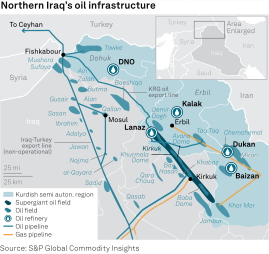
Two days of drone attacks have taken about 200,000 b/d of Iraqi Kurdistan's crude production offline, with operations temporarily suspended at several fields, according to a July 16 statement from APIKUR, a trade group representing international oil companies in northern Iraq.
The semiautonomous region had been producing around 280,000 b/d prior to the attacks, which struck five fields.
"The majority of APIKUR member companies, including those not targeted, have announced suspension of production totaling over 200,000 b/d," the statement said.
The latest strike came late July 16, with the Kurdistan Regional Government's counterterrorism service saying that a drone bomb attack targeted the US-owned Hunt Oil field in Duhok province at 7:10 pm local time (1610 GMT). Apart from material damage, no casualties were reported.
The field's facilities have been shut down while the company assesses the damage, Hunt Oil spokesman Paul Schulze told Platts.
DNO's Tawke field, which produced around 29,300 b/d in the first quarter of 2025, according to the company, and HKN's Sarsang block, which averages 60,000 b/d of output according to the company's website, were offline following drone strikes on July 14 and 15.
At DNO's nearby Peshkabir field, which averages around 52,800 b/d, surface processing equipment was damaged.
Gulf Keystone on July 16 said it had temporarily suspended production at its Shaikan field as a precautionary measure, noting that facilities had not been damaged. Baban said production at the Shaikan field averages around 40,000 b/d.
KAR Group's Khurmala Dome oil field in Erbil was targeted in the July 15 strikes, and one source in the region said production was briefly halted in the strike that damaged a water facility, but resumed shortly after. Various estimates placed output at roughly 90,000-100,000 b/d in 2024.
Planned energy infrastructure projects at one Kurdish company's fields are also likely to be slowed down due to the strikes, one Kurdish industry source said, asking for the company name to be withheld.
The Kurdistan region's current crude production is largely used to serve the domestic market, with some volumes of refined products smuggled to Iran.
Pipeline negotiations
Exports from Kurdistan once hovered at around 400,000 b/d, but production has plummeted since the Iraq-Turkey pipeline was shuttered in 2023, forcing producers to sell discounted barrels into a domestic market, with some volumes of refined products smuggled to Iran, according to industry sources.
Negotiations to reopen the pipeline have been ongoing, but despite recent talks between the Iraqi federal government and the KRG -- and pressure on Baghdad from the US -- to agree on terms to resume exports, both sides remain at loggerheads over financial disbursements to Erbil and the amount of crude the region must sell via federal oil marketer SOMO.
Meanwhile, the international oil companies operating in Kurdistan remain adamant that their contract terms must not be altered, and have asked for assurance of previous debts owed to them, as well as guarantees of payment for any crude handed over to SOMO.
"The drone attacks are linked to the current events and are designed to intimidate the oil companies and remind them that their security can be compromised if no agreement is reached on the exports," Shwan Zulal, managing director at KRG-focused Carduchi Consulting, told Platts.
No group has publicly claimed the attacks, though similar attacks in the past have been carried out by the Popular Mobilization Forces, a group of loosely organized militias that operate primarily in Iraq, many of which are backed by Iran.
Aziz Ahmad, deputy chief of staff to KRG Prime Minister Masrour Barzani, said on X that attacks on five oil fields, including two operated by US companies, were by "criminal militias on the Iraqi government payroll."
"The KRG welcomed US investment and companies. Now, those same investors are being pushed out in a calculated campaign to economically strangle us," he wrote, also calling on the US to provide "more than words" in support.
The US embassy in Iraq condemned the July 15 attacks and, in a statement, called on Baghdad to "exercise its authority to prevent armed actors from launching these attacks against sites within its own territory, including locations where Iraqi and international companies have invested in Iraq's future."
The embassy statement added that these attacks will hurt Iraq's efforts to attract foreign investment and urged the Iraqi government to investigate who was behind the attacks. The US has pushed heavily for private Western investment into Iraq.
On the same day its Sarsang block was hit, US-based HKN signed an agreement with Iraq's federally owned North Oil Co. to develop the Hamrin field in Salah ad Din province.
The deal to raise the Hamrin field's crude production rate to 60,000 b/d is an unusual one for Iraq, with Baghdad having previously blacklisted companies operating in Kurdistan from working on federal oil projects.
As recently as May, HKN itself came under condemnation from Baghdad for signing a deal with the KRG to develop the Miran gas field in Sulaymaniyah without the approval of the federal government, which threatened legal action.

Editor: