LNG, Natural Gas, Crude Oil
July 14, 2025
Senegal frustrated at lack of progress on GTA phase two: official

HIGHLIGHTS
'No visibility' on next phases of key project: Petronsen
GTA output should rise to 5 mil mt/year, then 10 mil mt/year
Eyes 'imminent' FID on phase 2 of Woodside's Sangomar
Senegal is growing frustrated with what it sees as sluggish progress on phase two of its vast BP-operated Greater Tortue Ahmeyim gas development, as well as the lack of visibility around the next step, the head of its state oil firm told Platts.
"GTA is an issue," Alioune Gueye, CEO of Petrosen, said in a brief interview on the sidelines of a major oil industry conference hosted by OPEC in Vienna, at which BP CEO Murray Auchincloss was also present.
"What we want is to go very quickly into phase two and three," Gueye said. "The problem is that at this point in time there is no visibility as to when that will happen. We are waiting for the operator to be able to do an FID."
Asked if the West African country was frustrated at the lack of progress to date on a second phase, Gueye responded: "To say the least."
BP did not respond to requests for comment, nor did Auchincloss speak on Senegal in his remarks to the OPEC International Seminar.
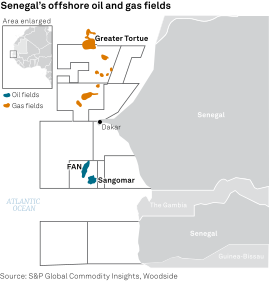
The 2.5 million mt/year offshore natural gas project, which spans the Senegal-Mauritania maritime border, saw its first gas in January and loaded its first cargo -- 174,000 cu m of LNG -- in April.
A second phase is expected to double production to 5 million mt/year, while a third would push it to 10 million mt/year.
Crucially, Senegalese and Mauritanian officials say future phases will provide gas for domestic power generation and industry, rather than converting it into LNG for export.
The project has lifted the fortunes of the two West African countries, making them gas exporters for the first time, but it has also been plagued by delays and cost overruns, Mauritania's energy minister, Mohamed Ould Khaled, told Platts on the sidelines of a Paris conference in May. Khaled declined to provide a total cost for the development.
Mauritanian ministry sources said the second phase should come online in two to three years, with phase three expected in the early 2030s, subject to FIDs by BP and its partner, Dallas-based Kosmos Energy.
A spokesperson for Kosmos directed questions to the operator, BP.
The presidents of Senegal and Mauritania recently travelled to the project's floating production, storage and offloading vessel, far out to sea, to mark the start of the key project.
Senegal's 2024 election was won by Bassirou Diomaye Faye, a former tax collector and anti-establishment presidential candidate.
Claims by Faye's Pastef party that it would look to renegotiate oil and gas and mining contracts spooked some investors, insiders told Platts at the time.
Oil growth
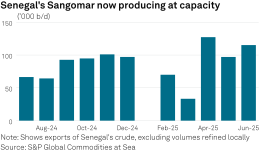
Gueye struck a more optimistic tone on Senegal's oil growth potential, with plans to take FID on phase two of the 100,000 b/d offshore Sangomar oil project -- the country's inaugural crude development -- "in the next six months".
The Woodside-operated project saw first oil in June 2024 and ramped up to its full capacity in August, with its medium sour crude heading to China, the Netherlands, Italy and elsewhere, according to shipping data from S&P Global Commodities at Sea.
The Petrosen boss said phase two would happen in the next two years, allowing for the 100,000 b/d plateau to be maintained, although it would not boost production beyond that threshold.
"That investment is imminent -- with our partners Woodside, we are looking into doing the additional investment to be able to maintain that plateau," Gueye said.
In a statement to Platts, a Woodside spokesperson said: "We continue to work with the Senegal government in evaluating phase two development options at Sangomar and we expect it will take approximately 12–24 months of production data to inform this evaluation."
"Our immediate goal is to optimize production from the Sangomar field while maintaining the highest standards of safety and operational stability," the spokesperson added. "Achieving a steady and reliable production plateau is critical not only for meeting our performance targets but also for ensuring long-term asset integrity."
The West African country also expects to see a 30,000 b/d production increase by 2028 through the South Fan prospect, where Cairn Energy first discovered oil with its FAN-1 spud in 2017. The prospect holds some 600-900 million barrels of oil in place, Gueye said.
"We hope to develop it, Petrosen with a partner," Gueye said. "But Petrosen definitely as the lead."
He added that the subsea infrastructure could be tied back to the Sangomar FPSO, which lies just 50 km from the Fan prospect.
"We are looking for partners, we have been talking to some people. We believe we will get that online in next two to three years," he said, adding that Petrosen had held talks with international oil companies and Chinese companies.
"We think about 30,000 b/d from Fan," Gueye said. "First we need to do some additional evaluation wells to be able to know the exact capacity for Fan."

Editor: