Crude Oil, Refined Products, Maritime & Shipping
July 09, 2025
Baghdad, KRG make another attempt to solve pipeline dispute, as US ratchets pressure
HIGHLIGHTS
Iraqi PM to form committee to review proposals on oil payments
Washington won’t accept ‘indefinite delay’ to export resumption
US oil companies seek pipeline reopening, fair compensation
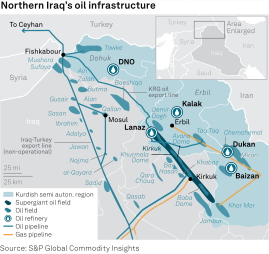
Iraq has formed a committee to resolve the latest spat between Baghdad and the Kurdistan Regional Government over the resumption of oil exports through the country's key pipeline to the Turkish port of Ceyhan, with the US pushing both sides to get a deal done, according to sources close to the talks.
With the federal Iraqi government and the KRG still at loggerheads over Erbil's sovereignty claims and financial matters, the new committee, announced July 8 by Prime Minister Mohammed al-Sudani, will review proposals from both sides to reopen the pipeline.
One source indicated that a potential deal could involve the KRG exporting all of its produced crude volumes through the pipeline, while Baghdad would supply refined products, such as gasoline and diesel, to the semi-autonomous region. A full reopening of the Iraq-Turkey pipeline would allow some 400,000 to 450,000 b/d of mostly Kurdish-produced medium, sour oil to flow into the Mediterranean market.
"Iraq is keen to reach an agreement on opening the pipeline and resume exports in accordance with the budget law and the decision of the federal Supreme Court," an Iraqi government official said, asking not to be named due to the sensitivity of the negotiations.
Ministers from planning, construction, health, justice, higher education and industry are on the committee, an Iraqi government source said.
In May, Iraq's finance ministry halted all budget transfers including public salaries to the KRG, saying it had exceeded its 12.67% share of the 2025 federal budget. That came right after the KRG signed two deals with US-based companies HKN Energy and WesternZagros to develop oil and gas fields in Kurdistan without first getting approval of the federal government.
"The federal government was not pleased with the KRG's independent gas deals, which led to the suspension of budget transfers in May and a pause in negotiations," Yerevan Saeed, director of the Global Kurdish Initiative for Peace at American University told Platts, part of S&P Global Energy. "However, steady pressure from the US embassy and officials in Washington eventually encouraged Baghdad to return to the table."
The pipeline has been closed since March 2023, when a Paris-based arbitration court ruled that Turkey had violated its bilateral pipeline agreement with Iraq by allowing independent Kurdish oil sales.
US pressure
Baghdad has come under increasing pressure from Washington, with the Trump administration siding with the handful of US-based oil companies in Kurdistan, including WesternZagros, HKN Energy and Hunt Oil, which have called for the pipeline to be reopened and for guarantees that they will be compensated fairly for future crude production.
The Trump administration has threatened sanctions on Iraq over the pervasive influence of Iranian-backed militia in Baghdad's economy, including the oil sector, Platts previously reported.
All parties need to "urgently restart the Iraq-Turkey pipeline's operations," a spokesman for the US embassy in Baghdad told Platts. "The business of three American companies is directly harmed by the pipeline's closure. This is unacceptable. We have repeatedly urged all parties to resolve their issues and will not accept an indefinite delay."
One stumbling block is Baghdad's demand that all KRG oil production be handed over to federal marketer SOMO for sale, which Erbil has been reluctant to accept, according to Saeed, who estimated that Kurdish production currently averages around 282,000 b/d, including 236,000 b/d for export and 46,000 b/d for domestic use. Much of the exported volumes are taken by truck across the border to Iran or Turkey.
Another obstacle to a deal is a lack of consensus among the oil companies operating in KRG over the best approach to resolve the payments owed to them by Erbil, said Nabil al-Marsoumi, an energy and economics professor at the University of Basrah.
"These companies, first of all, want guarantees for the payment of both past and future dues," he said. "They want their accumulated debts amounting to around $900 million to be paid. They also want guarantees for future payments, either from Baghdad or Erbil, and they want the original terms of their contracts to remain unchanged. These contracts are subject to international arbitration. So far, no agreement has been reached with the companies."
Election considerations
There are also disagreements over Baghdad's proposal to reimburse the company $16/b for their production, with many of the oil companies seeking higher compensation rates to cover production and transportation costs.
A third-party consultant is to audit the costs and determine a fair rate, under the terms of a deal between Baghdad and Erbil, but the oil companies have said they want the consultant's scope of work to be more clearly defined and for their existing production sharing contracts signed with the KRG to be honored.
Producers are ready to export "once we have payment surety for past and future exports," the Association of the Petroleum Industry of Kurdistan, which represents the majority of the oil companies operating in the region, said.
Iraqi elections in November may be a deciding factor, with Sudani up for reelection and likely needing support from Kurdish factions to achieve a majority vote. Ibrahim al-Sumaidaie, a former adviser to Sudani, told Platts that the elections are not the prime motivation for a pipeline deal with the KRG.
"It is a matter of settlement and bilateral obligations according to the constitution and according to the so-called deal between the two sides to solve this issue of salaries by handling the oil to SOMO," he said.
