Crude Oil, Refined Products, Natural Gas, LNG
July 08, 2025
INTERVIEW: BP improving upstream efficiency ‘every quarter’: upstream head

By Nick Coleman
HIGHLIGHTS
BPX a ‘tremendous growth opportunity' with exportable expertise
Seismic advances ‘lighting up’ opportunities in Trinidad and beyond
BP’s UK output rising, but regulatory clarity needed for new investment
BP is improving its upstream performance with progress in locations from Azerbaijan to the US and Trinidad thanks to improvements in seismic and other technology, its upstream vice president Gordon Birrell said in an interview.
Speaking the same week as Shell denied it was considering buying BP, Birrell said the company's upstream division was on an "exciting mission" with numerous opportunities to stabilize production after a strategic reset in which it formally pulled back from green investments in February. He highlighted plans to start up production at 10 upstream projects from 2025-27 and a further 8-10 by 2030. "The upstream continues to improve every quarter on its operating performance," Birrell told Platts.
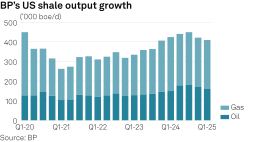
For BP's upstream business, pride of place goes to shale -- it is the only major European producer with a sizable US shale business -- and BP plans to allocate a quarter of its upstream capex to the BPX shale division annually, or $2.5 billion/year. It expects to raise the division's output by 7% annually to 650,000 b/d of oil equivalent by 2030, Birrell said – up from 434,000 boe/d in 2024.
“We’ve now become one of the most efficient operators in the Lower 48. We’ve improved our fracking efficiency massively over the last couple of years. Our costs have come down -- last year they came down by a $1 per barrel -- so we continue to drive the efficiency of that business," Birrell said. "We very much like the Lower 48.”
In the Gulf of Mexico, Birrell underlined BP's role in the push into ultra-high pressure Paleogene oil fields that have been known about but have lain undeveloped for over a decade due to technological barriers. These are expected to account for a third of US deepwater production by the 2030s. Following its decision to go ahead with the Kaskida project in 2024, BP aims to take a second Paleogene investment decision this year, at the Tiber field, with three more Paleogene projects waiting in the wings.
Elsewhere, Birrell said BP was achieving the highest efficiency rates in its portfolio in Azerbaijan, at the ACG and Shah Deniz fields, following the startup of a new ACG platform in 2024. In June, BP signed several agreements including approval for a new gas compression project at Shah Deniz, as well as joining the Karabagh oil project in the Caspian -- a field expected on stream in 2029.
Trinidad 'success story'
BP also plans to boost production at two of its established gas locations, Trinidad and Oman. While it lags its European peers in LNG volumes, its 43% ownership of Trinidad's 12 million mt LNG facilities complements its recent launch of the Greater Tortue Ahmeyim project offshore Mauritania and Senegal -- expected to load 2.4 million mt/year once the first phase is ramped up.
BP has started up two shallow-water gas projects in Trinidad this year, and two more are due on stream in 2027, Birrell said. "It's a bit of a success story, from very limited drilling a couple of years ago to continuous drilling, continuous well work, and we've found many more opportunities," he said, pointing to advances in seismic and the potential for new deepwater activity. "We can light up opportunities in the subsurface in a way that we never could before, and now that we're also applying AI to all the data it makes it even more clear where the opportunities are: acreage that we may have thought was mature, running out of opportunities, you apply new technology and suddenly see a whole lot of new opportunities," he said.
As for Senegal and Mauritania, after lengthy delays at GTA, "we've now been ramping up over six months and the reservoir is doing fine, so we remain optimistic about GTA and there could be more phases to come," he said.
Meanwhile At Oman's Khazzar field, where BP has two gas processing plants, there is also potential for the field to do more, Birrell said, noting BP has been bringing hydraulic fracturing expertise from its BPX shale business and applying it in Oman.
UK in balance
At home in the UK North Sea, Birrell said BP's business was going from "strength to strength," despite the discontent that has surged in the industry over the onerous tax regime and the current ban on issuing new licenses.
BP expects to increase its UK production in 2025 to 120,000 boe/d thanks to efficiency gains at its Schiehallion field in the West of Shetland area, Birrell said, adding the platform had achieved operating efficiency of 95% so far in 2025, up from 78% in 2024. Data from the regulator shows Schiehallion produced over 60,000 b/d of crude in January-April 2025. The Murlach oil field in the North Sea is also due to start up this year, Birrell noted.
BP has sold a large proportion of its UK assets to smaller players over the years and has a UK portfolio weighted toward crude rather than gas, primarily from the West of Shetland Clair and Schiehallion hubs.
The company accounted for 12% of UK oil output in 2024. However, a potential third development phase at Clair hangs on the outcome of current government consultations on the future of the tax regime and the sector more broadly, Birrell said.
The North Sea "continues to be a material part of our current portfolio and our future," Birrell said. "Clair's got a long way to go to be fully redeveloped. It's got huge [oil resources] in it and it's only partly developed, so we'll just wait and understand what the consultation with the government on fiscal rules and environmental rules" yields, he said. "Once we get clarity on that we'll re-engage with our partners."

Editor: