Crude Oil
July 02, 2025
US oil and gas activity slows amid policy uncertainty: Dallas Fed survey

HIGHLIGHTS
Q2 production indexes turn negative as firms plan fewer wells
Producers expect $68/b WTI at end of 2025
Executives continue to vent on Trump price targets, market volatility
Activity in the US oil and gas sector contracted in the second quarter of 2025, according to the latest Dallas Federal Reserve Bank quarterly energy survey, as respondents -- executives from 136 firms -- continued to express widespread angst at uncertainty caused by US federal energy policy.
The survey's business activity index, which the Dallas Fed says is its "broadest measure of the conditions energy firms face" in a wide swath of the southwestern US shale patch, turned negative, declining from 3.8 last quarter to minus 8.1 in Q2. The company outlook index remained negative, at minus 6.4, "suggesting slight pessimism among firms," the Dallas Fed wrote in its report.
That pessimism was hammered home in many of the Dallas Fed's special questions for the survey, which asked respondents how US policies and lowered prices would affect their drilling in the months to come.
"It's hard to imagine how much worse policies and DC rhetoric could have been for US E&P companies," one anonymous executive wrote. "We were promised by the administration a better environment for producers, but were delivered a world that has benefited OPEC to the detriment of our domestic industry."
Fewer wells to come
Barring a change in the broader environment, executives at large E&P companies plan to drill fewer wells than they expected to at the start of 2025, the survey said. Thirty-eight executives from E&P firms were asked how their drilling plans had changed since the beginning of the year; half said they planned to drill less, with 26% reporting their drilling would be "decreased significantly."
Over 60% of 85 respondents said their firms' production would "decrease slightly" if WTI prices remained at $60/b over the next 12 months. If WTI fell to $50/b and stayed there, 46% of those respondents said production would decrease significantly, with an additional 41% pledging slight decreases.
"There is constant noise coming from the administration saying $50-per-barrel oil is the target," one anonymous executive wrote in the survey's comments section. "Everyone should understand that $50 is not a sustainable price for oil. It needs to be mid-$60s."
Those predictions mirrored recent outlooks from both the US Energy Information Administration and S&P Global Energy, which foresaw US crude production stalling and even declining in 2025 and 2026.
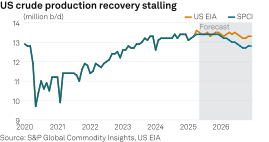
The survey projected an average WTI price of $68/b by the end of 2025, though responses ranged from $50/b to $85/b, the survey noted. Participants said the Israel-Iran conflict had helped increase prices in the short term, but OPEC+ unwinding production cuts would continue to add to the domestic market's unease.
Tariff uncertainty, increased costs
Most respondents said they expected minimal impact from recent steel import tariffs on their businesses, though 27% said they expected to drill slightly fewer wells, and 22% said it's "too soon to know."
According to executives surveyed, oil and gas production decreased slightly in the second quarter, with the oil production index falling from 5.6 in Q1 to minus 8.9 in Q2. The gas production index also went negative, from 4.8 to minus 4.5.
Those decreases in production dovetailed with increased input costs, particularly for oilfield services firms, who saw their costs index rise from 30.9 to 40.0. Growth in finding and development costs for exploration and production companies slowed slightly, however, as did lease operating expenses.
Meanwhile, firms reported lower demand for employees and fewer hours for those on the job.
Projections of increased costs due to tariffs were hardly unanimous. The highest percentage of respondents from 34 E&P firms estimated a 4.01%-6% increase in new well costs, but 24% estimated no change. In recent earnings calls, large firms have reported frontloading tubular and other equipment purchases to build inventory in advance of potential incoming tariffs.
"Tariffs are increasing our product costs," one oilfield services executive wrote in the survey. "Despite efforts to mitigate their impact, the scale and breadth of the tariffs have forced us to pass these costs on to our customers. Our US manufacturing base and operations have been negatively impacted by tariffs. Many of our locally manufactured items contain components, steel and aluminum sourced outside of the United States because they do not have domestically sourced alternatives."
"Despite higher steel prices, domestic mill output hasn't increased much, which is creating inflationary pressures," another executive wrote. "US steel producers should scale up production of steel and other steel products."
Angst continues
In the Dallas Fed's first quarter survey March 26, respondents noted a slight increase in the average WTI price needed to cover operating expenses for existing wells, up from $39/b in Q1 of 2024 to $41/b in 2025. That headline was overshadowed by the deluge of negative comments the Dallas Fed received from sector participants, most of them strongly criticizing US President Donald Trump's policies, from ever-changing trade deals and tariff regimes to the administration's repeated calls for $50/b crude.
Those complaints continued in the Q2 survey, with many lambasting US policy as harmful to the domestic sector and others predicting a continued slowdown.
"The Liberation Day chaos and tariff antics have harmed the domestic energy industry," one executive wrote. "Drill, baby, drill will not happen with this level of volatility. Companies will continue to lay down rigs and frack spreads."
"Increased steel costs and other costs for drilling wells are affecting our business," another said. "The increased costs change the production economics."
"The current political uncertainty is causing apprehension and concern about small, independent oil and gas companies' economic viability," another comment wrote.
One respondent reported dropping their company's rig count 50% while they were spending "way too much time and resources trying to predict the price of oil."
Still, there was at least one positive note in the survey comments: "Thank God the previous administration is gone and so are their anti-energy policies!"

Editor: