Crude Oil, Refined Products, Maritime & Shipping, Fuel Oil, LPG
July 01, 2025
US sanctions relief paves way for Syria to revitalize oil trade links
By Lauren Holtmeier and Max Lin
HIGHLIGHTS
US removed Syria's oil ministry, refineries, maritime authority from sanctions list
Relief aims to facilitate Syria's reconstruction after 14-year war
Lifting sanctions crucial for kickstarting energy reconstruction
The US has removed Syria's oil ministry, its two refineries and maritime authority from its sanctions list, opening the door for the war-torn country's return to the international oil trade and providing some relief to its embattled oil and refining industry.
The Middle Eastern nation is looking to rebuild after 14 years of war, and US President Donald Trump on June 30 announced greater sanctions relief to get the country back on its feet.
The move is a major, and more permanent, step forward that provides clarity on the state of sanctions, said Rachel Ziemba, senior adviser at political risk consultancy Horizon Engage.
Some sanctions were left in place, like those on the former Bashar al-Assad regime, and some individuals linked to the old regime or Iran will remain sanctioned.
While the relief, and plans to lift export controls, are clear signs of a change in motion, there's still a long path ahead.
"The operating environment in Syria is still uncertain, and some banks and other investors could be cautious still," Ziemba said. "Damaged infrastructure is also still a roadblock to further progress."
Additionally, terrorist designations on its leader Ahmad al-Sharaa and his party Hayat Tahrir al-Sham still remain in place, which has kept sanctions-abiding countries and companies at bay, fearing secondary sanctions. The Trump administration has promised to review those designations, as well as far-reaching Caesar Act sanctions.
"It's a mostly green light that the energy sector no longer has sanctions, but it could really quickly change depending on how those investigations go and how Syria's transition develops," Ryan Bohl, a senior Middle East and North Africa analyst at RANE Network, told Platts, part of S&P Global Energy.
Trade implications
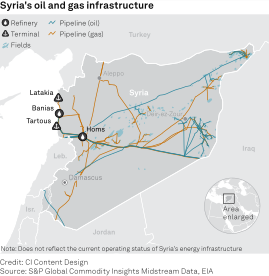
Sanctions on the Homs and Banias refineries have been lifted, as well as the those on the General Petroleum Company, the Syrian Company for Oil Transport, and on the agency responsible for oil refining and distribution of oil derivatives.
Sytrol, or the Syria Trading Oil Company, has also shed its designation. The company had issued various tenders in recent months, including for LPG and gasoil, but many countries that abide by US sanctions were cautious to engage with Syria's oil trading arm.
Also removed from the blacklist were the Syrian General Authority for Maritime Transport, while Turkey's Milenyum Energy and 10 ships -- including six LPG carriers -- that had been allegedly involved in Syrian trades were also cleared.
Sanctions were lifted on a range of companies in Lebanon and Syria linked to the Syrian Company for Oil Transport, as well as multiple trading houses.
The Syrian Central Bank, as well as other banks, are now sanction-free, which could ease transactions with foreign entities.
Previous sanctions relief efforts had been narrow, leaving investors uncertain about re-engagement with the country whose sanctions regime was layered on over years on former dictator Bashar al-Assad.
Assad's ouster in December 2024 has sparked optimism that rebuilding with help from Western nations and companies will soon be a reality.
In May, the US issued a 180-day waiver of the hefty Caesar Act sanctions on Syria in a bid to facilitate investment in the country's energy and utility sectors.
The Caesar Syria Civilian Protection Act, passed in 2019, had imposed some of the toughest sanctions on most aspects of life and business in Syria, including its energy sector, effectively blocking most international investment in the country's oil, gas and electricity infrastructure.
The EU and UK have also taken steps to lift a labyrinth of sanctions imposed on the former Assad regime.
Advocates say that lifting sanctions on Syria is crucial to kickstarting reconstruction and that oil and gas revenues could be a major source of revenue to fund rebuilding efforts that may cost between $250 billion to $400 billion.
Seaborne oil
Before the onset of the civil war in 2011, Syria pumped around 380,000-400,000 b/d of crude -- enough to meet its domestic consumption and supply some barrels to the international market.
However, Syria's oil and gas fields and infrastructure have been badly damaged and neglected, and crude production now stands between 80,000-100,000 b/d, according to various estimates. The loss of output had made Syria highly reliant on supplies from Iran, which had backed the former dictator, but those flows have since halted.
Russia has emerged as its top oil supplier in recent months after Hayat Tahrir al-Sham came into power. Syria imported 9.26 million barrels of crude, fuel oil, clean products and LPG in February-June, of which nearly 90% were from the OPEC+ member, according to S&P Global Commodities at Sea.
With Russia under various Western sanctions schemes itself, ship-tracking data shows 12 of the 19 tankers that have called at Syrian ports this year are blacklisted. But some mainstream shipowners are also returning to the country.
On June 16, the Velos Fortuna, an MR tanker operated by Greece's Velos, lifted the first product shipment from the 120,000 b/d Banias refinery since it was taken offline in end-2024 during the regime change.
"That seems like a good start," S&P Global Energy analyst Fotios Katsoulas said. "We could start seeing some others calling there, most probably Lebanese owners who are familiar with the market."

Editor: