Crude Oil, Maritime & Shipping, Wet Freight
June 23, 2025
FACTBOX: Middle East conflict raises shipping risks, as some tankers avoid Hormuz
By Robert Perkins and Max Lin
HIGHLIGHTS
Reduced tanker traffic through Strait of Hormuz amid heightened security risks
Surging freight rates from Persian Gulf due to conflict, insurance costs
Varied responses from shipping firms on Gulf operations, security measures
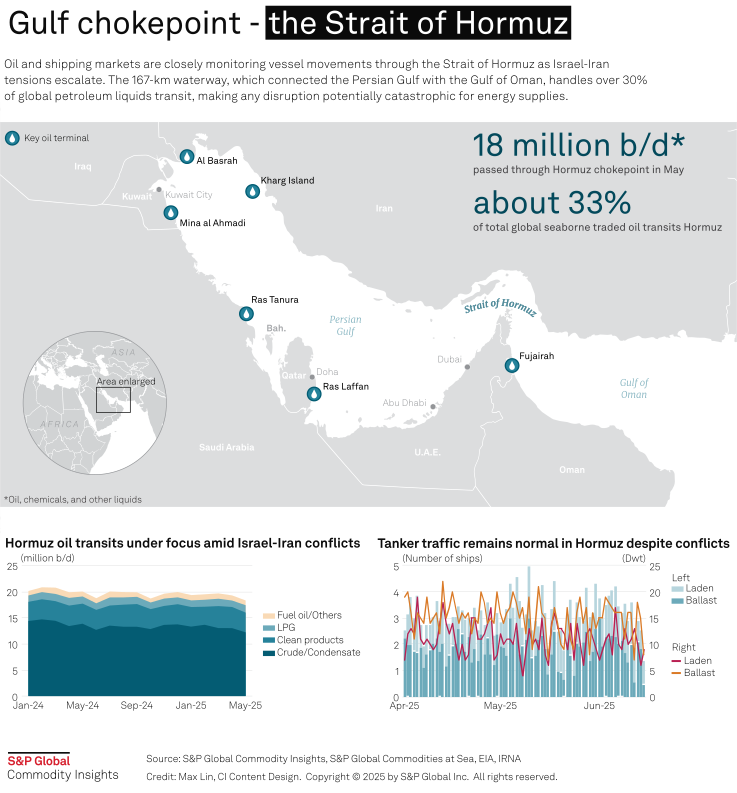
Middle East oil shipping faces heightened security concerns as regional tensions escalate following US airstrikes on Iranian nuclear facilities, pushing some ship operators to avoid the critical Strait of Hormuz chokepoint that handles over 30% of global seaborne oil flows.
"Some shipowners have already paused transits in the Strait of Hormuz due to the deterioration of the security situation," BIMCO Chief Safety Officer Jakob Larsen told Platts, noting that ship transits began reducing after US military involvement.
S&P Global Energy analyst Fotios Katsoulas said insurance costs have more than doubled, driving operators away from the region amid uncertainty and security concerns.
The following are key facts about the impact on tanker markets:
Trade flows
The number of empty tankers heading to Middle Eastern oil producers is declining as security risks increase in the region.
- S&P Global Commodities at Sea data shows 699 unladen crude and product tankers were destined for eight Gulf oil-exporting countries as of June 22, down from daily averages of 730 during June 15-21 and 741 during June 8-14.
- Only 19 oil tankers passed through the Strait of Hormuz by 1112 GMT on June 23, compared with a daily average of 44 during June 16-22, indicating a significant reduction in traffic.
- Five publicly US-affiliated merchant vessels have departed the Persian Gulf since US military operations began, while none have entered, according to security consultancy Ambrey.
- US-listed, Ireland-based product tanker operator Ardmore has canceled a spot charter deal to transport oil from the Gulf for Chinese firm Rongsheng due to security concerns.
- Major operators including Stena Bulk, NYK Line, and Mitsui O.S.K. Line have enhanced security measures but continue trading in the region, evaluating each deal individually.
- Several merchant ships destined for the Persian Gulf have made U-turns or opted to wait, including vessels not linked to the US, reflecting industry-wide concerns.
- Severe congestion has developed near the strait as vessels await instructions or clarity, with GPS jamming increasing collision risks and operations restricted to daylight hours.
Prices
Freight rates from the Persian Gulf have surged as security risks escalate and vessel availability tightens.
- Platts assessed the rate to carry a 270,000 mt crude cargo from the Persian Gulf to China at $19.36/mt on June 23, representing an 82% increase since the conflict began on June 13.
- The rate for carrying a 140,000 mt crude cargo from the Persian Gulf to the Mediterranean was assessed at $20.62/mt on June 23, up 29% over the same period.
- US Gulf Coast to China rates have also strengthened, with Platts assessing the cost to carry a 270,000 mt crude cargo at $29.81/mt on June 20, up 35% since the conflict started.
- Insurance costs for vessels transiting the region have more than doubled, contributing to higher overall shipping expenses and pushing some operators to avoid the area.
Infrastructure
The Strait of Hormuz, a 33-km waterway, supports over 30% of global seaborne oil flows and remains critical to global energy security.
- Iran's parliament is debating whether to close the strait, though any such decision would require higher-level approvals, including from the Supreme National Security Council.
- Most analysts consider a full closure of the strait highly unlikely as it would severely impact Gulf economies, including Iran's, and disrupt supplies to key trading partners like China.
- A more probable scenario involves targeted actions against US and Israeli shipping rather than a complete blockade, according to security analysts.
- GPS jamming in the region has increased navigation hazards and collision risks, forcing vessels to restrict transits to daylight hours only.
- If the situation deteriorates further, Middle Eastern oil exports could continue but with limited vessel availability, driving up freight costs for shipments through the strait.
- Some VLCC owners avoiding the Middle East Gulf are redirecting to cargoes from West Africa, Brazil, or the US, potentially increasing vessel availability in those areas.

Editor: