10 Jun 2020 | 20:11 UTC — New York
ANALYSIS: US commercial crude stocks hit record high amid weak refinery demand, exports
By Chris van Moessner and Jordan Blum
Highlights
US crude stocks up 5.72 million barrels to 538.07 million barrels
Net crude inputs 20% below normal at 13.48 million b/d
Exports fall to seven-month low of 2.44 million b/d
US commercial crude inventories climbed to a record high last week amid moribund refinery demand and falling exports, US Energy Information Administration data showed June 10.
Commercial crude stocks surged 5.72 million barrels to 538.07 million barrels during the week ended June 5, according to EIA data. The build pushed stocks to 13.5% above the five-year average and put commercial inventories at the highest on record dating back to 1982.
However total US inventories, inclusive of the Strategic Petroleum Reserve, were last higher in June 2017.
Click here for full-size image
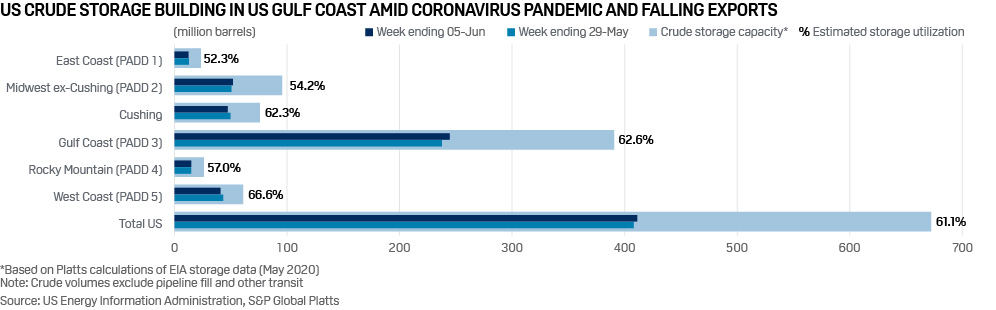
The crude build was concentrated almost entirely on the US Gulf Coast, where stocks climbed 6.87 million barrels to 303.68 million barrels, itself a fresh record high.
Notably, inventories at the NYMEX delivery point of Cushing, Oklahoma, fell for a fifth straight week, declining 2.28 million barrels to 49.44 million barrels. Cushing stocks are now down 16 million barrels below their late-April peak.
Nationwide refinery utilization climbed to 73.1% of capacity, up 1.3 percentage points, pulling net crude inputs up 180,000 b/d to 13.48 million b/d. Refinery crude demand has steadily climbed for four straight weeks and last week was up by 1.1 million b/d from early May. However, much of this increase is in line with a seasonal rebound in refinery runs, and net crude inputs continue to hold at more than 20% below the five-year average.
Weak refinery demand has in large part blunted the impact of a significant reduction in US crude production. Total US crude output averaged at 11.1 million b/d last week; this is down 100,000 b/d from the week prior and 2 million b/d below mid-March levels.
Downward trending crude exports also contributed to last week's build. Exports fell 360,000 b/d last week to 2.44 million b/d -- the weakest since November 2019.
US exports are likely to come under further pressure in coming weeks as the market works through a glut of crude sitting in floating storage.
Roughly 175 million barrels of crude was sitting in floating storage at the end of May, according to Lloyd's List. Most of those volumes are light sweet crude from US shale or offshore barrels from the North Sea that will compete directly with new exports from the US Gulf Coast's top oil ports, especially the ports of Houston and Corpus Christi.
But a sharp pull back in global crude production coupled with resurgent demand has flattened contango structures in the Brent and WTI curves, eroding storage economics and pushing these barrels back into the market.
If US production keeps falling and domestic refinery runs continue to pick back up, then crude exports could bottom out near 1 million b/d in September, according to Sandy Fielden, director of oil research at Morningstar.
US exports were last below 1 million b/d in November 2017.
DISTILLATE DEMAND SHOWS SIGNS OF LIFE
US distillate inventories climbed 1.57 million barrels to 175.83 million barrels last week, putting them nearly 20% above the five-year average. But the build was entirely concentrated on the Central Atlantic coast and New England, regions that have been slow in restarting their economies in the wake of COVID-19 lockdowns.
In contrast, inventories turned lower in all other parts of the country, suggesting that diesel demand is recovering in those areas that are farther along in the reopening process. The regional distillate draws held the nationwide build to the smallest since the week ended April 3.
Total product supplied for diesel, a proxy for demand, was up 590,000 b/d at 3.3 million b/d, EIA said. The jump in distillate demand helped push total product supplied up 2.51 million b/d to 17.57 million b/, the strongest since the week ended March 27, when the first state-wide lockdowns went into effect.
US gasoline inventories were up 870,000 barrels on the week at 258.66 million last week, pushing the nationwide supply overhang to its widest since mid-April at 10.4% above the five-year average.
Stockpiles on the US Atlantic Coast, which encompasses the NYMEX delivery point of New York Harbor, are now more than 15% above the five-year average after climbing nearly 900,000 barrels on the week to 75.11 million barrels.