Crude Oil, NGLs, Refined Products
May 30, 2025
INTERVIEW: Meren, formerly Africa Oil, eyes output hike after rebrand

HIGHLIGHTS
Nigeria consolidation doubles output to 33,400 boe/d
To buy material, producing assets, even beyond Africa
Namibia, South Africa explorations ongoing
Meren Energy is eyeing oil and gas production growth after completing a consolidation of its Nigerian assets, as the rebranded company looks to leverage a $428 million cash position for organic and inorganic growth, its CEO told Platts.
Formerly known as Africa Oil Corp., the company relaunched as Meren on May 15 to remove "Africa" and "oil" from its name and relisted on the Toronto and Stockholm stock exchanges, Roger Tucker said in a wide-ranging interview.
The move follows a portfolio restructuring across assets in Nigeria, Equatorial Guinea, Namibia and South Africa, which more than doubled working interest production to 33,400 b/d of oil equivalent, Tucker said.
"We're still small. Well, small-ish," he added. "We've doubled our production in just over a year. You could consider doubling again, it's that type of growth trajectory we're on."
Growth vehicle
Tucker took over in July 2023 and embarked on "just tons of transactions" to restructure and "clean up" the company, which had layers of investee entities.
In Namibia, where it holds a stake in the huge Venus development through a part-ownership of Impact Oil & Gas, Meren farmed down its stake to TotalEnergies "in return for getting a full carry through all exploration, appraisal and development right to first oil," Tucker said, thereby removing significant capex.
The company also carried out three transactions on 3B/4B offshore South Africa, where it now holds an 18% equity stake alongside TotalEnergies, QatarEnergy and others, with the partners set to embark on a two-well drilling campaign.
Yet the cornerstone of Meren's transformation, Tucker said, was consolidating its Nigerian assets through an "amalgamation agreement" with Brazilian investment bank BTG Pactual, completed in March. BTG now holds a 35% equity in Meren, but the Nigeria assets sit on the Canadian company's balance sheet.
Prior to the deal -- which doubled Meren's output from about 15,000 b/d -- the stakes were held by Prime, a joint venture between Africa Oil and BTG. They cover interests in the Akpo, Egina, Preowei and giant Agbami fields, all of them offshore and operated by either TotalEnergies or Chevron.
"The Prime consolidation was really only going to be of interest if we and BTG held the same strategic view of this space," Tucker said. "There are going to be some very interesting opportunities for us to potentially acquire and grow this business. This is the growth vehicle that we have created."
Tucker said the partnership with BTG opens potential expansion opportunities beyond Africa. "We need to use all of the competitive advantages. Their relationships within Latin America are potentially going to be of interest to us."
He added: "We love Nigeria, the assets and economic terms ... But we have got a single country risk."
The Akpo field will soon see an exploration well drilled near it targeting a "very attractive" prospect that would be immediately tied back if successful, Tucker said.
Accretive acquisitions
Th BTG agreement left Meren with $428 million on its balance sheet, allowing it to pursue "material," production-focused deals that match assets in its existing portfolio, Tucker said.
"We're not big enough to take on big development capex. Hence why we did the deal with TotalEnergies in Namibia," Tucker said. "If you are acquiring producing assets, you're over the peak. We'll become a specialist in managing the back end of field life."
Tucker said that any acquisition must be "accretive" and noted that Meren was "focused on rocks up."
He declined to comment on specific projects or jurisdictions but stressed the need for portfolio diversification. "We love Africa but it's nice to have more opportunity in the hopper."
Several West Africa-focused upstream companies have explored opportunities in Latin America, having noticed similarities in the geology on either side of the Atlantic.
Organic growth
Meren is also eyeing organic growth through its portfolio of "high quality" assets, Tucker said, with Namibia likely to "come on next for us."
Meren holds a 39.5% interest in Impact Oil & Gas, which in turn has a 9.5% interest in Blocks 2912 and 2913B, the latter containing TotalEnergies' Venus discovery that helped trigger an Orange Basin gold rush after 2022.
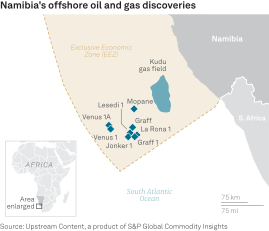
TotalEnergies -- which bought around half of Impact's stake in January 2024 -- is eyeing a final investment decision in 2026, according to Namibian officials, and first oil as soon as 2030.
However, CEO Patrick Pouyanne has raised concerns about a high gas-to-oil ratio and "challenging" 3,000-m water depth, stressing that the company would only proceed with the project if production costs remain below $20/b, amid negotiations with the Namibian government.
"The fact that [Pouyanne] was down there means he's still pretty serious about this as a development," Tucker said of Pouyanne's recent visit to Namibia, adding that "at least one more exploration prospect will be drilled" in the blocks within the next year.
Tucker expects Venus to be Namibia's first producing oil project.
In the South African portion of the Orange Basin, where above-ground risk has dented excitement, Meren and its partners have submitted their environmental impact survey for 3B/4B, Tucker said, and have a rig on hand to drill wells in the next year.
Finally, Meren holds an 80% stake in EG-31 and EG-18 off Equatorial Guinea alongside state-owned GEPetrol and has opened data rooms to farm down its interests.
While it plans to relinquish operatorship of deepwater EG-18, where it has identified a "potentially large and highly prospective basin floor fan prospect," according to its website, the company may retain it for the EG-31, which sits in shallow water close to the Alba gas field, Tucker said.
"We are hopeful to bring another major into EG-18 and someone else into EG-31," he added.
"We're seeing substantial companies in that data room who are not any more in Equatorial Guinea, which gives you an indication of the scale of the feature that we've got in EG18."

Editor: