28 May 2020 | 21:10 UTC — New York
Analysis: US crude builds resume as USGC imports surge

Highlights
Commercial crude stocks add 7.93 million barrels last week
Imports surge 2 million b/d as Saudi barrels flood USGC
Gasoline draw resumes as lockdowns ease
New York — US crude inventories moved higher last week after a surge of imports pushed US Gulf Coast stockpiles to fresh all-time highs, US Energy Information Administration data showed Thursday.
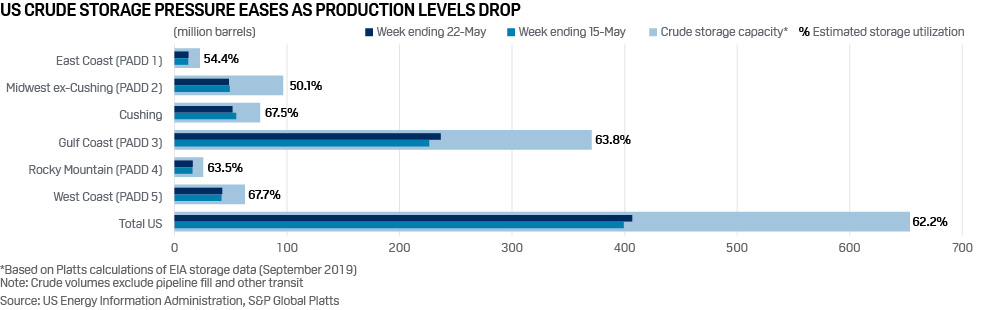
US commercial crude inventories climbed 7.93 million barrels during the week ended May 22 to 534.42 million barrels, EIA reported. The build snapped back-to-back weekly declines and pushed stock levels to the highest since March 2017.
The build was centered on the US Gulf Coast, where stockpiles swelled 10.25 million barrels to 295.15 million barrels. Notably inventories at the NYMEX crude delivery point of Cushing, Oklahoma, declined for a third straight week, falling 3.4 million barrels to 53.46 million barrels.
Click here for full-size image
US crude imports climbed 2 million b/d to 7.2 million b/d - the highest since August 2019.
Imports from Saudi Arabia alone jumped nearly 1 million b/d on the week to 1.59 million b/d, EIA data showed. Crude flows into the US Gulf averaged at 2.92 million b/d last week, up 85% from the week prior and the highest since August 2018. Meanwhile, crude exports edged down 63,000 b/d to a five-week low of 3.18 million b/d, further bolstering USGC inventories.
This flood of Saudi crude into the US is the result of a flurry of fixing activity in April after Saudi Aramco slashed its official selling price for US customers. The arbitrage incentive for Saudi Arab light in the US Gulf Coast versus Platts WTI MEH averaged at $11.34/b in April, Platts Analytics data shows, but to-date in May has dropped to around 71 cents/b.
Still, at least six additional VLCCs carrying approximately 9 million barrels of Saudi crude are slated to discharge into the USGC by mid-June, Kpler vessel tracking software data shows.
Nationwide refinery utilization climbed 1.9 percentage points to 71.3% of total capacity, a seven-week high, but net crude inputs were up just 90,000 b/d on the week at 12.99 million b/d.
Refiner crude demand was around 23% behind than the five-year average last week, and has been more than 20% behind the average since the week ended April 10.
Crude runs cratered in late March as refined product plunged due to states going into lockdown to stem to spread of the coronavirus pandemic. But now as state reopen and demand begins to return, large refined product stockpiles continue to weigh on margins, blunting a recovery in refinery demand. To date in May, USGC refining margins for Platts WTI MEH have averaged at $2.61/b, down from $5.01/b in April, and over the past five days these margins have weakened to an average of $2.34/b, S&P Global Platts Analytics data shows.
GASOLINE DRAW RESUMES AS LOCKDOWNS EASE
Total gasoline stocks fell 720,000 barrels to 255 million barrels, EIA said, leaving stocks still higher than in early May following an unexpected 2.8 million-barrel build the week prior.
At the regional level, gasoline inventories mostly reflected the status of the pandemic in those areas. Stocks drew in regions where states have mostly reopened their economies, including the US West and Gulf coasts where stocks respectively fell by 1.84 million barrels and 1.09 million barrels. But on the US Atlantic Coast many major cities are extending lockdowns into early June even as the exurban portions of the state reopen. As a result, USAC gasoline stocks saw a third week of increases, climbing 1.91 million barrels to 73.78 million barrels.
Total product supplied, a proxy for demand, was 630,000 b/d lower on the week at 15.96 million b/d. Despite accelerating reopenings, last week marked a second weekly decline for product demand, putting it 27% below its early-March peak. Still, gasoline demand was up by 463,000 b/d on the week at 7.25 million b/d, a nine-week high.
Distillate stocks were up 5.5 million barrels on the week at 164.33 million barrels and now stand more than 23% above the five-year average.