Refined Products, Crude Oil, Chemicals, LNG, Maritime & Shipping
May 20, 2025
BRICS criticize sanctions and trade restrictions as threat to energy security

HIGHLIGHTS
Group includes heavily sanctioned Russia and Iran
Uncertainty over future sanctions policy adding to market volatility
BRICS countries said that restrictions on energy trade and investment threaten energy security and efforts to cut emissions, in a communique released following a meeting of energy officials in Brasilia May 19.
"We express concern about unilateral sanctions and arbitrary restrictions on energy trade and investment in the energy sector that disregard international law, as well as selective approaches to developing energy systems which undermine the open and non-discriminatory functioning of energy markets, destabilize global and regional value chains and pose a threat to security of the critical energy infrastructure," the group said.
BRICS founder member Russia is subject to wide-ranging sanctions on its energy sector, imposed in response to its military activity in Ukraine since 2014. The most damaging include EU bans on most seaborne imports of Russian oil, price caps on Russian oil, sanctions on over 200 tankers carrying Russian fuel and some LNG projects.
Fellow-sanctioned oil producer Iran joined BRICS in 2024 and is under sanctions due to its nuclear program that have hit crude production and exports.
US President Donald Trump's return to office has led to uncertainty over the future of these sanctions regimes. His statements indicate that developments in conflicts in Ukraine and the Middle East as well as nuclear talks with Iran could see the easing or escalation of these restrictions.
Geopolitical threats have driven major oil price volatility in recent years. Platts, part of S&P Global Energy, assessed Dated Brent at above $132/b in June 2022 as markets reacted to Russia's invasion of Ukraine. Platts last assessed Dated Brent at $66/b on May 19.
BRICS also includes Brazil, India, China, South Africa, the UAE, Egypt, Ethiopia and Indonesia. It accounts for 40% of global crude production and a similar level of global liquids demand if Saudi Arabia – which has yet to confirm full membership – is included.
BRICS ministers said that they acknowledge shared responsibility as both major producers and consumers of energy to enhance energy security and meet United Nations Sustainable Development Goals.
"We highlight the need to enhance energy security by ensuring market stability and maintaining undisrupted flows of energy from diverse sources, strengthening value chains, ensuring resilience and protection of critical energy infrastructure," the communique said.
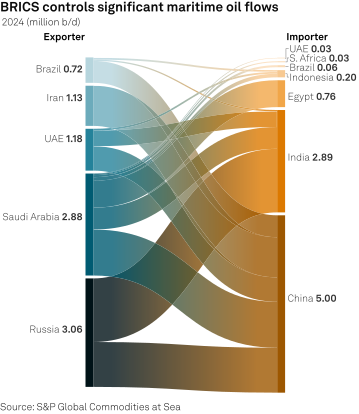
BRICS said that the group acknowledges that fossil fuels will continue to play an important role in the global energy mix and respects countries' right to independently choose their own pace and approaches to energy transition.
"We share the view that improved energy efficiency and the efficient use of all energy sources and technologies, including but not limited to renewable energy, bioenergy, fossil fuels, nuclear energy and hydrogen produced from zero and low emission technologies, carbon abatement and removal technologies are crucial for a just transition towards more flexible, resilient and sustainable energy systems," the communique said.

Editor: