Chemicals, Agriculture, Energy Transition, Crude Oil, Refined Products, Biofuel, Renewables, Jet Fuel
May 19, 2025
BRICS countries agree to broaden energy cooperation

HIGHLIGHTS
Collaboration complicated by members’ different priorities
SAF cooperation among areas of focus for group
The BRICS group of countries agreed to a new road map of energy cooperation up to 2030 at a meeting of energy officials in Brasilia May 19.
"Together we account for nearly 50% of global energy production and consumption," Thiago Barral, national secretary for energy transition and planning at the Brazilian Ministry of Mines and Energy, said in opening remarks at the meeting. "This places on us a shared responsibility to pursue a balance between energy security, sustainable development and the transition towards a low-carbon future."
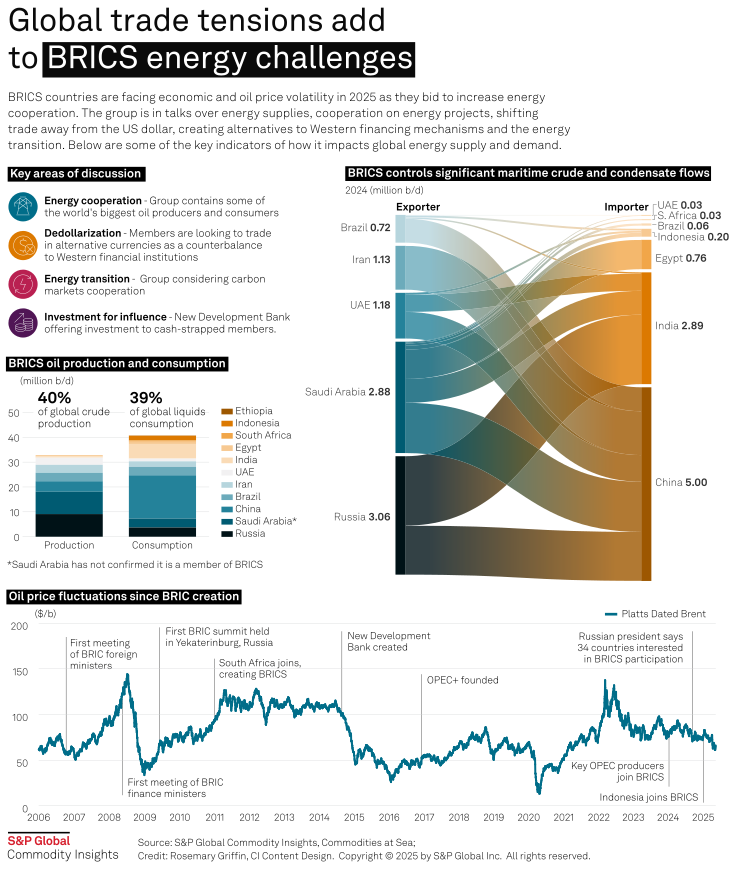
BRICS significantly increased its energy footprint when OPEC members Iran and the UAE joined in 2024. Including Saudi Arabia, which has yet to formally confirm membership in the group, BRICS accounts for 40% of global crude production and a similar level of global liquids demand.
BRICS also includes Brazil, Russia, India, China, South Africa, Iran, the UAE, Egypt, Ethiopia and Indonesia.
New reports in the works
Brazil BRICS sherpa Mauricio Lyrio said at the meeting that BRICS is working on two new reports, one on sustainable fuels and the other on energy access, which are to be finalized before the BRICS leaders' summit in July.
BRICS can play a leading global role in developing sustainable fuels, Barral said.
"We have the resources, the complementary capabilities and the scale to drive a wide range of solutions from biofuels to low-emission hydrogen to synthetic fuels," he said.
Energy officials have also discussed financing the energy transition, creating resilient power systems for climate adaptation, and best practices for decarbonizing the oil and gas industry, with a focus on upstream operations, at recent meetings, he said.
Barriers to cooperation
Securing concrete groupwide cooperation deals has proven difficult, due to differences in economic and geopolitical priorities and alliances.
Analysts see bilateral trade as a more promising way of cooperating within the group. Some aspects of this have increased significantly in recent years, including Russian oil supplies to China and India, which have jumped since Russia invaded Ukraine in 2022.
Another way for BRICS countries to increase their energy clout is by adding members, which some leaders have identified as a priority for the group. In 2024 it added the option to become a partner country. Belarus, Bolivia, Cuba, Kazakhstan, Malaysia, Nigeria, Thailand, Uganda and Uzbekistan have already joined as partners.
The BRICS leaders' summit is scheduled to take place in Rio de Janeiro July 6-7.