Crude Oil, Refined Products
May 15, 2025
IEA sees further 'rebalancing' as oil demand weakens, OPEC+ opens taps

By Nick Coleman
HIGHLIGHTS
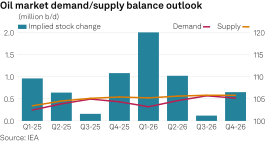
Global oil stocks set to surge in 2025 and 2026
OECD demand decline set to accelerate in 2025-26
Russian oil revenues hit lowest since June 2023
Egypt, Nigeria revisions prompt higher demand estimates
The International Energy Agency on May 15 forecast jumps in global oil inventories in 2025 and 2026 in a "further rebalancing" of the market as trade uncertainty accelerates the decline in OECD oil demand, and Saudi Arabia and its partners ease production cuts.
The IEA left its demand growth estimate for 2025 virtually unchanged at 740,000 b/d, while nudging up its growth estimate for 2026 by 70,000 b/d to 760,000 b/d.
It forecast accelerating oil demand declines in the OECD developed economies collectively, of 120,000 b/d in 2025 and 240,000 b/d in 2026. While emerging market demand continues growing, "latest non-OECD delivery data, especially for China and India, have been weaker than expected," it said.
Global oil stocks, after dropping in 2024 at a rate of 140,000 b/d, are set to rise by 720,000 b/d in 2025 and 930,000 b/d in 2026, setting "the stage for a further rebalancing of supply and demand fundamentals," the IEA said.
Although market sentiment has improved somewhat thanks to a relative easing of trade tensions between the US and China, "increased trade uncertainty is expected to weigh on the world economy and, by extension, oil demand," it said.
Lower oil prices and a weaker dollar are set to provide some encouragement to demand, but the effect in emerging markets is limited by a variety of state controls on prices, it noted.
The report also featured an increase in historical and future oil demand estimates due to revisions to data for Egypt and Nigeria -- amounting to a 350,000 b/d increase in 2024, for example -- due to statistical collection issues.
"Egyptian annual data show a substantially larger uptick of fuel oil, gasoil and LPG consumption than initially reported" under the international Joint Organisations Data Initiative. "These updates coincide with higher use of oil in power generation amid a natural gas shortage," the IEA said. Newly submitted Nigerian data for May-December 2024 showed a sharp acceleration, primarily in consumption of gasoline and gasoil, but also other products, likely relating to the ramp-up of the new Dangote refinery, it said.
OPEC+ easing
On the supply side, the IEA raised its estimate of global oil supply increases in 2025 by 400,000 b/d to 1.6 million b/d on the back of the OPEC+ group's decision to accelerate production increases. Saudi Arabia would implement the lion's share of the increases given several member countries have not been complying with production quotas.
The agency kept unchanged its estimate of the growth in non-OPEC+ oil supply in 2025 at 1.3 million b/d, but warned that lower prices were hurting US shale producers, and lowered its estimate of 2026 non-OPEC+ supply growth by 100,000 b/d to 820,000 b/d.
By contrast, OPEC in its own monthly oil market report on May 14 revised down its estimates of non-OPEC+ supply growth -- already more modest than the estimates of the IEA -- by 100,000 b/d for both 2025 and 2026.
Russia is particularly impacted by recent oil price weakness, the IEA noted.
On the one hand, weaker prices recently have allowed Russia to export its oil more easily as cargoes are free of a price cap imposed by the US and its partners that limits provision of maritime and insurance services to Russian exporters.
However, Russia's opponents have increased sanctions on specific tankers -- dubbed the "shadow fleet" -- and weak prices have taken a toll on Russian revenues overall, the IEA said.
It estimated Russian oil revenues in April were the lowest since June 2023 at $13.2 billion, down $1.13 billion on the month -- despite a 150,000 b/d month-on-month rise in oil exports to 7.6 million b/d.
The Platts Dated Brent crude benchmark averaged $67.79/b in April. Platts is part of S&P Global Energy.

Editor: