Crude Oil, Natural Gas, LNG
April 24, 2026
EU to revisit blocked Russia sanctions, prepare 21st package: EC

Editor:
HIGHLIGHTS
Bloc has 'momentum' to revisit blocked decisions
20th sanctions package passes after Hungary lifts veto
Hungary's new PM says country still needs Russian ties
The EU is preparing to draw up its 21st package of sanctions against Russia and to revisit previous "red lines" after breaking a political deadlock that blocked tougher measures, European Commission Vice President Kaja Kallas said April 24.
"There is now momentum to revisit a range of long-blocked decisions," Kallas said in a statement on X, formerly known as Twitter.
In a press briefing from Cyprus, she said that prime ministers were also pushing to move forward with a new set of measures to intensify pressure on Moscow.
The announcement follows the recent electoral defeat of Hungarian Prime Minister Viktor Orban, who had vetoed the EU's 20th sanctions package and pushed to water down measures to preserve the country's Russian energy links.
The EU finally adopted the 20th package on April 23, two months after it was proposed, targeting a suite of Russian ports, refiners, tankers and service providers.
New measures under the 20th package did not include a full ban on maritime services for Russia's crude oil shipments, as proposed in February and would effectively supersede the current oil "price cap" system. However, it included the basis for a future ban on both crude and petroleum products, which the EU is pursuing in coordination with the G7, it said.
Energy dependence
The EU recently passed legislation to phase out Russian LNG supply by the start of 2027, and has presented plans to end Russian oil imports by the end of the same year, but has yet to make such measures into law. The bloc has already banned seaborne imports of Russian oil but continues to permit pipeline deliveries due to pressure from Hungary and Slovakia.
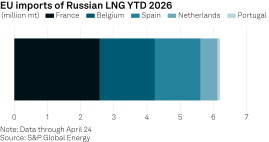
The share of Russian crude in the bloc's imports fell from 27% in 2021 to 3% in 2024, according to the European Parliament. LNG imports have remained high ahead of the 2027 phaseout, with roughly 6.2 million metric tons arriving so far in 2026, according to S&P Global Energy CERA data. Among EU member states, France has taken in the most Russian LNG so far this year, importing about 2.6 million mt. Other EU importers have included Belgium and Spain.
Hungary and Slovakia, two of Russia's largest energy consumers, recently faced a hard stop to their pipeline crude imports, which were shut off from January-April due to a drone attack. During the outage on Russia's Druzhba pipeline system, the two countries were forced to pivot to a second pipeline, Adria, which connects their refineries to the Croatian coastline, but flows were restored on April 23.
Slovakian Prime Minister Robert Fico said in an April 23 press conference that the incident proved the challenges for Central Europe to survive without Russian oil, while Croatia's pipeline operator has maintained it can fully meet the needs of Central Europe's refineries.
Meanwhile, the war in the Middle East has aggravated fears of losing access to Russian oil as a low-cost feedstock and exacerbated inflation risks.
It remains to be seen how Hungary's newly elected Prime Minister Peter Magyar will shape European policy. After his electoral victory on April 12, the Tisza party leader qualified his commitments to diversify from Russian energy, warning that Hungary would not "shoot itself in the foot" with a hard stop on trade ties and that it "cannot override geography." In his party manifesto, Magyar called Hungary's dependence on Russian fossil fuels a "systemic risk," and vowed to cut ties by 2035.
At the EU level, officials have doubled down on plans to advance sanctions and prevent a windfall for Russia amid soaring global energy prices.
"It sends a very clear signal to Russia that they can't outwait us. It also sends a clear signal to Russia that Ukraine is more important to us than it is to them," Kallas said in her press briefing.