Crude Oil, Refined Products, Diesel-Gasoil, Jet Fuel, LPG
April 10, 2026
FACTBOX: Hungarian election potential moment of reckoning for Russian energy ties
By Kelly Norways and Matt Hoisch
Editor:
HIGHLIGHTS
Rival Tisza party vows to cut Russian energy ties by 2035
Government vetoed EU's 20th sanctions package
Orban granted US sanctions relief for oil, nuclear project
As Hungary heads to the polls on April 12, the leadership of Prime Minister Viktor Orban hangs in the balance. A win for his challenger, Tisza politician Peter Magyar, could mark a pivot for the country's energy security strategy and hitherto favorable Russian relations, with sweeping ramifications at the national and EU level.
Here are the key facts about Hungary's energy landscape, diplomacy and the trade flows at stake:
Trade flows
- Under Orban's 16-year leadership, Hungary has been central to keeping Russian oil and gas flowing into the EU. In 2022-23, the EU banned seaborne imports of Russian oil but left inland flows legal, allowing Hungary to continue importing most of its crude by pipeline via Ukraine.
- Hungary also remains one of the few EU states heavily reliant on Russian pipeline flows for most of its natural gas. Orban recently said 60% of its gas consumption comes via the TurkStream system, the only operational pipeline route for Russian gas to Europe. However, Hungary has also pushed to diversify sources, with gas company MVM recently signing several LNG deals running 5-10 years.
- The EU passed legislation in January phasing out Russian gas and LNG imports by late 2027. Orban's government has called for restrictions to be lifted due to the conflict in the Middle East, though EU leaders have maintained they will hold firm on the bans.
- The prime minister has opposed plans for the EU to fully phase out Russian pipeline imports of crude oil by 2027, which has yet to be made into law.
- The close alliance between Orban and US President Donald Trump has won Hungary additional sanctions relief in recent years. After talks between the two leaders in November, Hungary was permitted to keep buying oil from Russian producers Lukoil and Rosneft, and the US lifted sanctions on the country's Paks II nuclear power plant.
- Magyar's manifesto calls Hungary's Russian energy dependence a "systemic risk" and vows to cut ties by 2035. He has not committed to back the earlier 2027 EU phaseout target.
Despite campaigning from the Trump administration to support Orban's re-election, Magyar has promised to retain close trade links with the US. "We are building a bilateral strategic partnership with the USA, based on real energy diversification," his manifesto says.
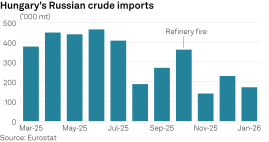
- Hungary imported roughly 100,000 b/d of Russian crude over 2025, according to analysts at S&P Global Energy CERA, making up around 90% of its supply.
- A three-month outage on Russia's Druzhba pipeline system has forced Hungary to pivot to a second connection, Adria, which runs to the Croatian coastline. With Druzhba flows offline, Hungary has pushed to import Russian oil by sea via Croatia, but it has yet to get approval from the pipeline operator.
- Orban has accused Ukraine of using the Druzhba pipeline outage as "political blackmail" responding to his opposition to Kyiv's EU membership bid. As a result, Hungary has halted its diesel exports to Ukraine and banned auctions of natural gas transmission for Q3. Hungary is a major route for gas into Ukraine, transiting roughly 37% of its net pipeline imports across Q1 2026, CERA data showed.
- Hungary has also vetoed the EU's 20th sanctions package against Russia, including a maritime services ban, and said it will block a Eur 90 billion loan for Ukraine while the Druzhba pipeline remains down.
- Without the Russian oil link operating, MOL has imported crude from Libya, Kazakhstan, Saudi Arabia, Norway and Latin America through the Croatian pipeline, and has drawn on state oil reserves.
Prices
- Russian oil prices have rebounded strongly during the conflict in the Middle East after coming under pressure in late 2025. Platts, part of S&P Global Energy, assessed Russia's Urals crude on a FOB Primorsk basis at $94.46/b on April 9, down from an all-time high of $109.68/b on April 2.
- The discount for Russian oil relative to Dated Brent, the European crude benchmark, has also narrowed. On April 9, Urals FOB Primorsk was assessed at $17.75/b below Dated Brent, narrowing from a March 10 discount of $35.5/b.
- The price of diesel, responsible for roughly half of Hungary's oil use, has stayed elevated, heightening fears over fuel affordability. Platts assessed CIF NWE ULSD cargoes at $1415.75/mt on April 9, almost double levels in late February.
- Refiner MOL claims that Croatia's pipeline operator, Janaf, charges "three to four times" the average European transit fee, adding to the cost of switching from Russian oil. Janaf has accused MOL of "selective presentation" of the transport fees, arguing that on a cost per mt basis its fees are more competitive.
European gas prices have likewise rocketed amid the trade disruptions from the Middle East war. Platts assessed the Hungarian MGP month-ahead gas index at Eur47.42/MWh on April 9, some 39% higher than before the war began.
Infrastructure
- Hungary is home to a single 165,000 b/d oil refinery, Danube. Nevertheless, it is still a net importer of most oil products, and relies on Slovakia to supplement its diesel supply.
- A fire at the refinery in late 2025 has capped its recent crude intake, and processing is expected to stay at 55% of its potential until Q3 2026.
- Orban's government has endorsed plans to deepen Russia's regional energy links by building a new crude pipeline from Hungary into Serbia by 2027, which would effectively extend the Druzhba pipeline system.
- MOL operates refineries in Hungary, Slovakia and Croatia. By 2027, it aims to link its Hungarian and Slovakian refineries with a 1.5 million mt/year fuel pipeline.
- The company is pursuing a majority stake in Serbian refining business Naftna Industrija Srbije from Russia's Gazprom Neft, in a deal that remains subject to approval from the US Treasury.
- Hungary has recently accused Ukraine of targeting TurkStream gas infrastructure amid a series of attacks that Russia says have all been repelled.
- Orban alleged April 5 that a "sabotage" operation had been prepared near the gas pipeline in Serbia that brings Russian exports to Hungary. He has increased security around the gas link.
- Magyar has pledged to double the share of renewables in Hungary's energy mix by 2040 from a base of 30% to diversify from Russian fossil fuels. Funding would be dedicated to modernizing the grid, promoting geothermal and wind energy, which currently contribute to a fraction of national power production.
- In nuclear, Magyar has said he would review funding for the Paks II nuclear power project and examine the possibility of advancing smaller, lower-cost modular reactors supplied by partners such as France and the US.
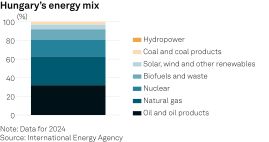
- According to the International Energy Agency, nuclear contributes to 18% of Hungary's energy supply, behind oil with a 32% share and 31% for natural gas.
