Crude Oil, Refined Products, Gasoline
April 22, 2026
Mexico to send crude to Japan to help ease supply constrains caused by Iran war

By Sheky Espejo
Editor:
HIGHLIGHTS
Mexico agrees to send crude to Japan
Help limited to available production
Mexican exports already weak amid refining push
Mexico has agreed to send "some" crude oil to Japan, according to Mexican President Claudia Sheinbaum.
Demand for Mexican barrels comes as Japan faces mounting energy security risks tied to the war in Iran, which has disrupted flows through the Strait of Hormuz, a key artery for global crude shipments.
Sheinbaum and Japanese Prime Minister Takaichi Sanae discussed the matter during a conversation late on April 20, Sheinbaum said April 21, adding that there was an agreement following a previous request from Japan.
Sheinbaum said the topic was discussed as part of broader bilateral cooperation. Sheinbaum did not provide details, but noted that this was not the first time Mexico had sent crude to the island.
Mexico has sent some crude to Japan in the past, but not in the last two years. The last cargo to Japan was in October 2023 for 750,400 barrels, according to S&P Global Commodities at Sea data.
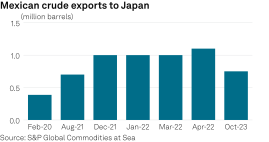
Japan relies heavily on Middle Eastern supply, with the vast majority of its imports transiting the chokepoint, leaving it particularly exposed to ongoing disruptions and price spikes.
For Mexico, any move to supply Japan would be limited by its own available production, as the country is working to increase its domestic refining capacity.
Mexico's crude oil production averaged 1.37 million b/d in February 2026, essentially flat compared with 1.36 million b/d in February 2025, according to the government data. While output has stopped falling on a year-over-year basis, volumes remain below the roughly 1.55 million b/d produced in early 2024 and well below the 3.4 million b/d of 2004.
Condensate production, meanwhile, rose to 278,602 b/d in February from 253,900 b/d a year earlier.
Pemex refinery run rates have remained elevated, averaging 1.19 million b/d in February, close to the peak above 1.2 million b/d in late 2025. That has caused fuel imports to remain low. Gasoline imports were at 273,980 b/d, while diesel imports marked a new low at 34,511 b/d, the data shows.
This combination of weak crude output and higher refining has hurt exports.
Mexico's crude exports rebounded in February to 517,784 b/d after falling to a record low in January of 294,453 b/d.
Between 2018 and 2022, Mexico routinely exported between 900,000 b/d and 1.2 million b/d of crude. By late 2025, exports had fallen below 400,000 b/d, even as total production showed little sustained growth.
