Crude Oil, Refined Products, LPG
April 22, 2026
India's March crude runs remain high; future months to test crude sourcing strategy
HIGHLIGHTS
March crude runs stay strong at 5.5 mil b/d
State-run refiners run above 100% of nameplate capacity
Future feedstock supply faces pressure amid Hormuz disruption
India's crude oil throughput in March remained robust as refiners had largely secured feedstock volumes for the month before the Middle East conflict began, but runs in the coming months will reflect refiners' ability to secure alternative supplies amid disruptions to flows through the Strait of Hormuz, according to government data, sources and analysts April 22.
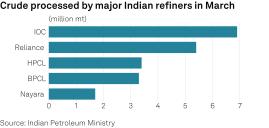
While overall March runs slowed marginally year over year, state-run refiners kept utilization well above 100% of capacity as they rushed to maximize throughput and fill the gap from reduced Middle East cargo arrivals. Private refiners also maintained high utilization levels, although lower than those of state-owned refiners, oil ministry data showed.
"All refineries are operating at high capacity with adequate crude inventories, while sufficient stocks of petrol and diesel are being maintained. Domestic LPG production from refineries has been increased to support domestic consumption," a petroleum ministry statement said April 21.
India's refineries processed 23.5 million metric tons, or 5.5 million barrels/day, of crude in March, down 1.7% from 23.9 million mt in March 2025, the data showed. In February, crude throughput totaled 21.9 million mt, or 5.7 million b/d.
State-run refiners Indian Oil Corp., Bharat Petroleum Corp. Ltd. and Hindustan Petroleum Corp. Ltd. -- which together account for more than 61% of India's total refining capacity -- operated well above normal monthly levels in March, according to the oil ministry's preliminary update on refinery runs. IOC ran at 117% capacity, BPCL at 112% and HPCL at 114%.
In the private refinery segment, Reliance Industries Ltd. operated at about 95% capacity, while Rosneft-led Nayara Energy recorded a 100% run rate, according to the data.
Pushing runs above average
In March, none of India's refiners carried out any planned maintenance work, oil ministry data showed.
India relies on the Gulf region for about 60% of its LPG consumption. The Middle East conflict has prompted urgent government intervention to secure alternative supplies and encourage the use of kerosene and coal in restaurants and other lower-priority sectors to ease supply pressures.
India consumed 33.2 million mt of LPG in fiscal year 2025-26 (April-March), up 6% from 31.3 million mt in the previous fiscal year, according to provisional oil ministry data. Domestic production meets about 40% of the country's LPG demand, with the remaining volumes imported.
Reliance said March 10 that it aims to maximize LPG production at its Jamnagar refining and petrochemical complex to ensure ample domestic fuel supplies. IOC said the same day that it was taking steps to boost LPG output and prioritize its availability for domestic consumers and essential non-domestic sectors, such as hospitals and educational institutions.
India has an average LPG yield of about 7.5%, according to S&P Global Energy CERA. LPG typically accounts for up to 10%-11% of total refining output when advanced processing methods are used.
"LPG supply continues to be affected by the prevailing geopolitical situation. The supply of LPG to domestic households has been prioritized. Total commercial LPG allocation has been increased to about 70% of precrisis levels," the petroleum ministry statement said.
Options ahead
Abhishek Ranjan, South Asia oil research lead at CERA, said India's crude inflows have remained relatively resilient, as most refiners had secured sufficient volumes.
"The disruption has significantly reduced crude flows, and even higher output from less-affected suppliers is unlikely to offset a shortfall of this scale," Ranjan said. "As a result, competition among importing and refining nations should remain intense, keeping the volatility elevated. For India, pressure is therefore likely to persist as the pool of viable supply options has narrowed."
The US Department of the Treasury has authorized the delivery and sale of Russian crude and petroleum products loaded on ships through April 17 for one month, as the Middle East war continues to disrupt oil supplies. The waiver does not apply to transactions involving Iran, North Korea and Cuba, the Treasury said in a general license on April 17. A previous monthlong waiver on some Russian oil sales had been in effect through April 11.
"The temporary extension of Russian sanctions is expected to help boost short-term crude supply by enabling the offtake of on-sea volumes by refiners without falling afoul of regulations. In the short term, this measure can provide for additional supplies of 3 million-4 million b/d," said Tushar Bansal, senior director at consulting agency Alvarez & Marsal.
As of April 20, an estimated 98 million barrels of identified Russian oil were on water, S&P Global Commodities at Sea data showed. Based on ship positions, about 48 million barrels of this volume could be sold to India, while the remainder could be destined for buyers in China or Southeast Asia.
"An extension of the US waiver permitting purchases of Russian crude would be supportive, but rising competition from other Asian buyers will keep the market tight. Other suppliers -- such as Venezuela, Nigeria and Brazil -- may increase export volumes, but production constraints mean these additions are unlikely to fully replace lost Middle Eastern barrels," Ranjan said.
Amid disruptions to flows through the Strait of Hormuz due to the Middle East conflict and the initial sanctions waiver, India's appetite for Russian crude rebounded to an average of 2.1 million b/d in March, nearly double the 1.1 million b/d in February. This marked India's highest level of Russian-origin crude discharges since July 2023, according to CAS data.
CAS data showed April 22 that a total of 10.3 million barrels of Venezuelan-origin crude are scheduled to be discharged at India's ports in April, comprising 5.6 million barrels in transit and 4.7 million barrels already discharged, highlighting a sharp near-term increase in flows.
