05 Apr 2022 | 16:59 UTC
Kashagan oil field headed for major shutdown ahead of output increases

By Nick Coleman
Highlights
Maintenance shutdown follows CPC export disruption
Gas processing capacity key to future oil increases
Consortium consulting on alternative export routes
Kazakhstan's Kashagan oil field is on track for a major maintenance shutdown in June as the operating consortium eyes further output increases at the Caspian Sea development, despite recent disruption.
Production at Kashagan, which is the second-highest contributor to CPC crude exports, has been reduced due to the disruption of loading at the Russian port of Novorosossiisk, operator the North Caspian Operating Company confirmed in emailed comments. NCOC includes Italy's Eni, ExxonMobil, Shell and TotalEnergies.
Loading at Novorosossiisk has dropped since around March 22 when CPC reported storm damage in the Black Sea port. This has compounded market tightness stemming from the Ukraine invasion and sanctions against Moscow.
Landlocked Kazakhstan has few alternative export routes apart from the 1,500 km CPC pipeline to Novorossiisk. It has estimated the impact of the disruption on its output will be around 320,000 b/d in April; CPC loadings in February, by comparison, were over 1.5 million b/d, including small amounts of Russian crude.
Though loaded in Russia, CPC Blend is not subject to US sanctions. Kashagan is typically the second-highest source of Kazakh crude after the Tengiz field, although its reserves are thought to be at least as large, with production able to continue into the next century.
Output had reached around 410,000 b/d before the Novorossiisk outages, with the upcoming shutdown expected to lead to a further small increase following upgrade work.
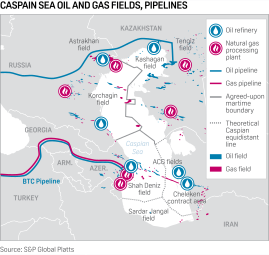
Temporary reduction
The NCOC consortium has long been planning the shutdown at what is one of the world's most complex oil developments. The field is expected to be offline for around two months as facilities are inspected and improvements made to gas injection capacity.
In parallel, state-owned gas company Qazaqgaz is building a 1 Bcm/year gas processing facility expected to enable more gas sales from Kashagan and in the process support an increase in crude output to 450,000 b/d, NCOC confirmed.
"At this stage NCOC is still on track to commence turnaround as per schedule, 1 June," NCOC said of the maintenance shutdown.
On the issues at Novorossiisk, where two out of the three loading systems were shut down around March 22, leading to reduced volumes, NCOC said: "NCOC confirms the temporary reduction of oil production since the 1st of April in line with the allocation from CPC."
NCOC continues to explore alternative "routing scenarios" for Kashagan crude with shareholders and the Kazakh state, the consortium added. Other options potentially available to Kazakhstan include pipeline exports to Russia or China, or sending some volumes across the Caspian Sea to Azerbaijan.
Output expansion
On the longer term outlook, NCOC noted the start of work on an additional 2 Bcm/year gas processing project known as "Phase 2A," for which 'front end' engineering and design began in December 2021. Phase 2A is expected to start up around the middle of the decade, enabling a further increase in Kashagan crude output to 500,000 b/d, NCOC said.
Creating more outlets for the gas that accompanies Kazakhstan's oil production has been highlighted as a priority by Italy's Eni, which oversaw much of the prolonged early development — Kazakh gas prices are far below those in developed markets such as Europe.
In parallel to projects aimed at boosting oil output, NCOC is carrying out dredging to improve access to the Kashagan facilities, which feature 10 artificial islands built to protect against ice floes.
The consortium faces a growing problem of falling sea water levels in the North Caspian; the annual water-level drop in the vicinity of the facilities increased to 60 cm in 2021 from around 20 cm/year previously; the phenomenon has been attributed to climate change and industrial water usage in rivers that feed the North Caspian.
With the Kashagan facilities located in around four meters of water, the consortium faces major logistical challenges, particularly as all waste must be brought ashore under a 'zero-discharge' policy intended to protect the environment. Hovercraft are currently utilized, but may not be sufficient for future needs.
The other partners in the NCOC consortium are China's CNPC, Japan's Inpex, and state-owned KazMunaiGaz. The current production sharing agreement runs to 2041.