Refined Products, Crude Oil, Maritime & Shipping, Chemicals, Fuel Oil, Wet Freight, Gasoline
April 02, 2026
Russian crude deliveries reach three-year high as loadings fall amid Ukrainian attacks
By Max Lin and Thomas Washington
Editor:
HIGHLIGHTS
US sanctions relief removes logistics constraints
Russian oil on water falls as Indian imports rise
Ukrainian drone strikes disrupt port loadings
Russia's monthly seaborne crude deliveries rose to a three-year high in March on US sanctions relief, but exports marginally fell amid loading disruptions at its main Baltic hubs following relentless Ukrainian drone attacks.
Preliminary data from S&P Global Commodities at Sea shows 4.61 million b/d of Russian crude were delivered to importing countries last month, up from 4.38 million b/d in February and the highest since 4.65 million b/d June 2023, also the highest since CAS records began in 2016.
The development came after the US said Russian crude and refined products loaded by tankers before March 5 could be sold to India regardless of the ships' sanctions status, if due to arrive at Indian ports by April 4. The same relief applies to all Russian oil lifted by March 12 and lasts until April 11 for all other countries.
The policy has removed some logistical constraints for Russian cargo movements, with CAS data showing the amount of Russian crude on water falling to 99.3 million barrels from 125.1 million barrels March 4.
"The aim is to get more supply onto the market fast and limit the shock from the Iran war on global energy markets," Vytautas Leškevičius, a senior policy analyst at the Geopolitics and Security Studies Center, said on the Atlantic Council website.
"That matters because in oil markets, signaling is often nearly as important as regulation. Once the US shows flexibility, traders, insurers, and refiners start recalculating risk," Leškevičius said. "Indian refiners have responded quickly."
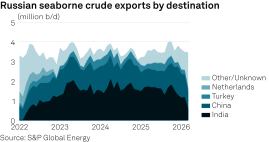
Russian crude deliveries to India jumped to 2.11 million b/d in March from 1.07 million b/d in February, while deliveries to China fell to 1.47 million b/d from 1.78 million b/d, according to CAS.
Meanwhile, despite Moscow's earlier promise to raise oil supplies to fill the gap left by Persian Gulf producers during the Iran war, CAS data show Russian crude exports decreased to 3.46 million b/d last month from 3.49 million b/d in February on a loading basis.
Ukrainian forces have launched several long-range strikes with unmanned aerial vehicles against Primorsk and Ust-Luga energy and port infrastructure since March 23, creating challenges for Russian exporters to maintain operations.
"Loading operations have been intermittently suspended for over a week, disrupting export throughput at a critical node," consultancy Ambrey said in a note.
Crude exports from Primorsk reached 732,000 b/d in the final week of March, having amounted to 1.1 milion-1.2 million b/d earlier in the month, according to CAS. Ust-Luga exports dropped to 105,000 b/d on March 25-31 from 471,000 b/d in the prior week.
Falling product exports
CAS data shows Russia's total oil product exports fell to 2.19 million b/d in March from 2.21 million b/d in February, amid attacks on infrastructure and mounting government concerns over domestic supplies.
Liftings from Primorsk fell to 139,000 b/d on March 25-31 from 359,000 b/d in the prior week when fuel oil was not taken into account, while those from Ust-Luga halted in the final week of last month. Exports have recovered this month.
Aside from targeting the two ports, Ukrainian drones attacked Russia's second-largest refinery, Kirishi, as part of new overnight strikes on the country's Leningrad region, local media reported March 26.
Citing eyewitness accounts, Russia's Astra news reported attacks on the 420,000 b/d refining complex owned by Surgutneftegas, which acts as a significant regional outlet for motor fuel and petrochemicals. Surgutneftegas didn't comment on the matter.
On April 2, Russia's government approved a full gasoline export ban by extending existing curbs on non-producers to include refiners. The ban will remain in effect until July 31.
