Refined Products, Chemicals, Crude Oil
April 02, 2025
Aramco's interest to invest in Indian refineries alive despite dual setback
HIGHLIGHTS
Saudia Arabia supplied 625,000 b/d crude to India in 2024: CAS
New Indian refineries can provide steady outlet for Saudi crude
Aramco will move cautiously after Ratnagiri, Reliance setback
India's plan to set up new refineries has revived Saudi Aramco's interest in investing in at least one of them and expanding its footprint in a growing oil and petrochemicals market despite facing multiple setbacks in recent years, industry and government sources told Platts.
Although Aramco's earlier plans to buy stakes in the planned Ratnagiri Refinery as well in Reliance fell apart in quick succession, the strategic move by two state-run firms -- Bharat Petroleum Corp. and Oil and Natural Gas Corp. -- to build new refineries will open another window of opportunity for Middle East's biggest oil producer, they added.
"It's early days, but the new Indian refineries will offer an opportunity for Aramco. It's logical to look at those opportunities, but I am sure Aramco will not count on anything until any agreement is completely sealed and signed on the dotted line. We have seen how close Aramco was to two previous opportunities," said a senior industry source.
According to government sources, while BPCL is finalizing plans to build a new refinery in the southern state of Andhra Pradesh, ONGC is planning to build one in the western state of Gujarat, with details of the refineries still being worked out.
India a key priority for Aramco
Aramco has declined to comment on any specific investment plans but has said that India remains a key investment priority for the company.
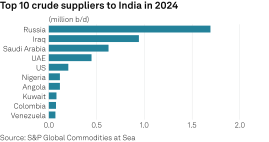
If a deal works out, the move will allow Saudi Arabia to raise its crude oil market share in India where it was the third-largest supplier in 2024 -- behind Russia and Iraq -- supplying 625,000 b/d, according to data from S&P Global Commodities at Sea.
Abhishek Ranjan, South Asia oil research lead at Energy, said that with Far East refineries facing pressure from lower margins and the threat of rationalization, India's expanding refining capacity would present an opportunity for Aramco.
"Any interest from Aramco in BPCL and ONGC refineries will align with this strategic direction. If they get to obtain a successful partnership in any of these new refineries, Aramco cannot only ensure a steady supply of its crude but will gain a substantial share of refinery output for sale in the Indian retail market," he added.
India aims to boost refining capacity from 258.1 million mt to 309.5 million mt by 2028. S&P Global Energy estimates that beyond current plans for distillation capacity expansion, India will require an additional 400,000 b/d of hypothetical capacity by the early 2030s, indicating ample room for investment in one of the world's major demand centers and fastest-growing economies.
Previous setbacks
India announced a few years ago plans to set up a mega refinery-cum-petrochemicals complex—called the Ratnagiri Refinery—with an annual capacity of 60 million mt. It was planned to be jointly built by three state-run refiners—IOC, HPCL and BPCL—while Aramco and ADNOC signed initial agreements to take stakes in the project. However, the project has faced numerous delays, raising questions about when it can take off.
A proposed $15 billion sale of a 20% stake in Reliance's oil to chemicals business to Aramco was also called off, with both companies agreeing to "reevaluate their agreement."
"Despite India's almost failed attempt to establish a world-scale refinery in Ratnagiri, where Aramco had planned to acquire a significant stake, the country remains committed to increasing its refining capacity. Aramco has been actively pursuing stable partnerships for its crude oil as part of its broader strategic goals, investing heavily in China and eyeing India as a pivotal market due to its burgeoning oil demand," Ranjan added.
In addition to the new refineries planned by India, IOC is expanding its Panipat, Paradip, Gujarat, and Barauni refineries to increase their capacities and integrate petrochemical production units. BPCL is also expanding its Bina refinery in terms of crude processing capacity and increasingly integrating petrochemical production capacity.
HPCL Mittal Energy has also expanded its refinery capacity and integrated petrochemicals, increasing the petrochemical intensity to around 20%. HPCL Rajasthan Refinery is developing a 9 million mt/year refinery and petrochemical project in Rajasthan, which would have a petrochemical intensity of around 26%, one of the highest in India.
"It's very unlikely Aramco would look at operating refineries for taking a part of the stake. Rather, they would look at a new refinery, which could provide an incremental outlet for their crude. But 5-6 years down the line when those new refineries become operational, to what extent oil demand outlook might have changed is a key question for them to evaluate," said one senior industry source.