Crude Oil, Maritime & Shipping
March 23, 2026
FACTBOX: Oil prices tumble as Trump announces five-day ceasefire
HIGHLIGHTS
US halts strikes on Iran's energy facilities for five days
Strait of Hormuz remains effectively closed
ICE May Brent falls to lowest since March 11
The US will postpone strikes against Iranian power plants and energy infrastructure for five days following "productive conversations" over a potential cessation of hostilities, President Donald Trump announced March 23, sending crude prices falling on hopes that oil flows from the Middle East could be unlocked.
But counterclaims from Iran that no such talks had taken place have left some doubts in the market that the attacks were over.
"I am please[d] to report that the United States of America, and the country of Iran, have had, over the last two days, very good and productive conversations regarding a complete and total resolution of our hostilities in the Middle East," Trump wrote on his social media platform Truth Social.
His comments came after the head of the International Energy Agency said in Australia that its members were mulling another release of strategic oil reserves to tamp down prices, while speakers at CERAWeek by S&P Global in Houston said the war has heightened conversations among the industry and policymakers about the need for energy security.
"No country should be allowed to hold Hormuz hostage," Abu Dhabi National Oil Co. CEO Sultan al-Jaber said in a televised address to the conference.
The following are the latest key facts about the global oil supply crisis and response measures:
Trade flows
The Strait of Hormuz remains effectively closed to most commercial traffic after grinding to a virtual standstill following the Feb. 28 launch of the war, disrupting critical energy arteries.
- An estimated 69.28 million barrels of Iranian crude oil and condensate were on water as of March 20, according to S&P Global Commodities at Sea.
- Iranian crude flows to China have remained steady or increased during the conflict, reaching about 70 million barrels over five weeks through mid-March, compared with under 40 million barrels in the prior five weeks, according to analysts at S&P Global Energy CERA.
- The US issued a 30-day sanctions waiver on March 20, allowing purchases of Iranian crude already loaded on vessels until April 19.
- Traffic through the Strait of Hormuz remained extremely constrained over the weekend, with only two vessels crossing on March 22, and no vessel transits on March 21, CAS data showed.
- 22 countries said they would take steps to stabilize energy markets, including working with some producers to increase oil output, according to a March 21 joint statement on the website of the UAE's Ministry of Foreign Affairs.
Prices
Trump's post -- the first major sign of a potential easing of the monthlong conflict -- caused an immediate drop in front-month ICE Brent futures.
- ICE May Brent settled down $12.25/barrel at $99.94/b, the lowest settlement level since March 11.
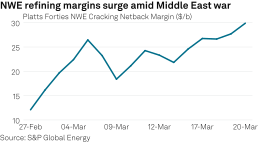
- Platts, part of S&P Global Energy, assessed Dated Brent at $110.05/b on March 23, down 5.9% day over day, but up 55.1% from Feb. 27, before the war.
- The discount for Russian oil delivered into India has flipped to a premium after partial sanctions relief from the US for supplies already at sea. Platts assessed Urals DAP West Coast India versus Forward Dated Brent at a record high premium of $7.20/b on March 23.
- Platts assessed the front-month Brent-Dubai EFS spread at Singapore Market on Close assessment process at $8.46/b March 23, up from $1.22/b on Feb. 27.
Infrastructure
The International Energy Agency is poised to release more strategic oil reserves to the global market if needed, Executive Director Fatih Birol said at an event held by Australia's National Press Club in Canberra on March 23.
- The IEA is already managing a 400 million barrel stock release, which represents the largest collective action in its 51-year history.
- The US' release of 172 million barrels from its Strategic Petroleum Reserve will flow at a rate of 1 million-1.5 million b/d, Energy Secretary Chris Wright said March 23.
- IEA member states say announced stock releases should reach the market within a maximum of 90 days, with 72% crude oil and 28% oil products.
- The first US SPR auction covered only 52% of the initially offered 86 million barrels, signaling supply gaps and highlighting that emergency releases cannot fully offset disruptions.
- Recent Iranian strikes on major Gulf oil and gas sites have damaged facilities and increased the risk of lasting production outages beyond the strait closure.
- The IEA published a March 20 special report recommending demand-side controls, including encouraging remote work and lowering speed limits to curb oil consumption.
