Crude Oil
March 18, 2026
Urals DAP India crude soars to record premium over Dated Brent
HIGHLIGHTS
Urals delivered to India hits $5/b premium to Dated Brent
Refiners scramble for prompt supply amid sanctions waivers
India could be among most exposed buyers due to low stocks
The price of delivering Russia's Urals crude into Indian ports has soared to its highest level on record relative to Dated Brent, as disrupted Middle East shipping and US sanctions relief have transformed established market fundamentals.
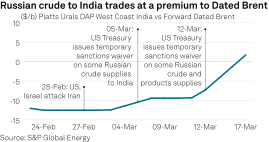
On March 17, Platts assessed Urals DAP India above forward Dated Brent for the first time since records began in 2023, as the Russian grade strengthened to a $1.7/b premium against the international oil benchmark. On March 19, the spread widened to $6/b, setting a new all-time high.
The strengthening price differentials reflect a major shift from the significant discounts offered for Russian fuel before the US launched its first strikes against Iran. On Feb. 27, Urals DAP India was assessed $11.99/b below Brent, and had historically traded at least $1.8/b beneath the benchmark even when the spread was at its narrowest in July 2025.
The jump in relative value has been underpinned by a surge in the Indian delivered value for the Russian grade, which breached $100/b for the first time on March 16 and is up by 101% since the conflict began. In contrast, Dated Brent rose by 59% between Feb 27 and March 18.
Higher prices in India have been propelled by fierce competition with China for available Russian supply, viewed as an alternative to the heavy and medium sour grades produced in the Middle East that are staple feedstocks for Asian refiners.
Recent US sanctions relief has encouraged short-term buying. On March 5, a 30-day sanctions waiver from the White House specifically allowed the sale and delivery of sanctioned Russian oil already at sea into the Indian market, while a March 12 rollback broadened the measure to a global audience.
According to a report from the International Energy Agency, some 30 million barrels of Russian oil was sitting offshore India at the beginning of the month, representing a bubble of spare capacity now coveted by the country's refiners.
In March to date, Indian imports of Russian oil have edged higher, rising to 1.4 million b/d from 1.1 million b/d the previous month, and 1.2 million b/d in January, S&P Global Commodities at Sea data shows. In the first week of the month, India's Nayara Energy, part-owned by Russia's Rosneft, was a lead importer, while the Jamnagar terminal, owned by private refiner Reliance, tripled its imports.
"It is too early to comment on the exact impact, but economics have changed dramatically," said B. Anand, former CEO of Nayara Energy. "India will have the sweet spot of scaling up the Urals since they are used to refining them in the recent past," he said.
Alternative suppliers
The Persian Gulf has typically acted as the largest source of crude for India, now a global refining heavyweight. However, since the war with Ukraine began, the country has emerged as an opportunistic buyer for discounted Russian crudes.
According to CAS data, crude from the Gulf accounted for 47% of oil supplied to India in 2025, followed by Russia at 29%. The country also imports significant volumes of oil from West Africa and the US. In 2026, some refiners appeared to be pivoting from Russian oil in response to new US and EU sanctions.
Ben Hoff, head of commodity research at French bank Societe Generale, estimates that the country has sufficient stocks to withstand around 70 days of disruption to the Strait of Hormuz. "In terms of days' cover, India and South Korea are the most vulnerable," Hoff said in a March 17 report. In contrast, China has spent the past year amassing significant crude reserves, which the IEA estimates built by 111 million barrels in 2025.
Sustained premiums for Russian oil in India could produce a growing call on alternative crudes such as West African and US grades, which have been increasingly sought after worldwide as a result of the crisis. Rachel Ziemba a senior adviser at consultancy Horizon Engage, said stronger Urals prices could have a short term "dampening" effect on other oil benchmarks as markets rebalance, but only temporarily. "Given that there is still a volume loss I think it may be short-lived" she said.
After talks between Iran and New Delhi, India's navy escorted two LPG carriers through the Strait of Hormuz on March 13-14. However, markets await signs of further normalization, and crude flows remain at a virtual standstill for a third consecutive week.
In Europe, Russian oil has continued to price below Brent, but values have strengthened. On March 19, Platts assessed Urals FOB Primorsk at $28.75/b below the benchmark, significantly narrower than a recent $35.5/b discount on March 10, but still a way off from its narrowest spread of minus $11.2/b in September 2025.

Editor: