Refined Products, Jet Fuel
March 10, 2026
Nigeria's Dangote takes spotlight as Gulf distillate exports plunge: Refinery CEO
By Claudia Carpenter and Kelly Norways
HIGHLIGHTS
Refinery running at full capacity, CEO says
Dangote exports hit two-year low in Feb: CAS
Middle East supply disruption boosts margins
Nigeria's Dangote refinery is prepared for a growing call on its middle distillates during disruptions to Middle East trade as it has scaled its operations to full capacity, its CEO and Managing Director David Bird told Platts, part of S&P Global Energy.
The Dangote plant, which first came onstream in 2024, reached its initial nameplate capacity of 650,000 b/d for the first time in February 2026 and now aims to increase throughput to 700,000 b/d.
In written comments to Platts, Bird, who leads Dangote's refining and petrochemicals division, said the company was yet to see a leap in demand for its product as a result of the conflict, though prices have quickly reflected fears of a supply crunch.
"It's not necessarily more demand. It's just showing up in the margins. Refining margins for jet and diesel are extremely strong," he said.
Since starting operations, the Dangote facility has already emerged as a significant producer on the global stage, transforming Nigeria into a net exporter of jet fuel and diesel and demonstrating a capacity to supply most global markets.
In a previous interview with Platts, Aliko Dangote, founder of the conglomerate, embraced the facility's growing role on the global stage. "Our refinery is an export-oriented refinery," he said in February, commenting on its growing presence in the global jet fuel market.
A recent turnaround at the facility pushed its jet fuel and diesel exports to two-year lows in February, when volumes dropped to just 34,000 b/d, S&P Global Commodities at Sea data showed.
According to Bird, the refinery is now consistently running at a throughput of 650,000 b/d, increasing its capacity to produce surplus fuel. Three West African trade sources, who requested anonymity, said the plant is expected to scale its exports in the coming weeks.
When operating at full capacity, Dangote can produce the equivalent of up to 157,000 b/d of diesel and 125,800 b/d of jet fuel, according to company figures shared in January. The refiner estimates that Nigerian diesel consumption accounts for just 56% of its production potential, and that local jet fuel demand is a fifth of its capacity.
Trade reshuffle
As global distillate cracks have risen higher on the back of the war in Iran, the Nigerian refinery has taken on new prominence as an alternative supply outlet.
To date, the US has been a leading export destination for Dangote's jet fuel, accounting for 14% of its exports in 2025. Europe was the end destination for 23% of its supply, while large volumes change hands in the offshore Lome transshipment hub, CAS data shows. In the diesel market, most products stay within West Africa.
"In the current situation, excess output is likely to flow to the highest bidder, with markets in Europe and Asia scrambling for middle distillate supplies," said Tanya Stepanova, associate director for fuels and refining at S&P Global Energy CERA.
Bird declined to comment on the facility's export capacity, but stressed that the product would not necessarily be rerouted to Asia and Europe. "There is equal import dependency closer to home that was previously served by Middle East such as South Africa, Kenya, Tanzania, Angola," the CEO said.
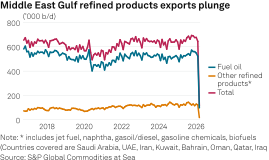
The Persian Gulf is a major supplier for sub-Saharan Africa, particularly in the distillates market. In 2025, East Africa imported over 100,000 b/d, or roughly 80%, of its gasoil and jet fuel from Gulf states, while West Africa sourced 12% of its supply from the region, according to CAS data.
Without a rebound in Dangote exports beyond West Africa, other distillate markets could be left in a pinch. Asian markets have relied heavily on the Middle Eastern fuel trade, while analysts have cast doubt on the ability of the US to fill a European supply vacuum.
"Generally, most of the world gets a lot of distillate supplies from the Middle East. And if that route is choked as it is right now, it has a severe impact on distillate supplies," said Udayan Bhattacharya, chief trader, energy and options at Global Risk Management, said on a March 9 webinar.
"The US cannot make up for distillate supplies to that scale. There's Nigeria, but all of these take time," Bhattacharya said.

Editor: