03 Mar 2022 | 12:50 UTC
Weather-related port closures, Sharara pipeline shutdown impair Libyan oil supply

Highlights
Armed group closes pipeline valve connecting Sharara field
Brega, Es Sider, Ras Lanuf, Zawiya, Zueitina ports closed
Lack of storage could force NOC to cut oil output
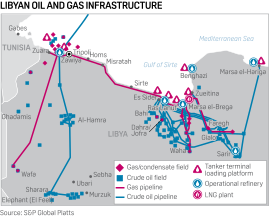
Libya's crude production is poised to fall as operations at its largest oil field Sharara were disrupted after an unknown armed group shut down a pipeline valve, sources close to the matter said March 3.
This comes the same day that Libya's crude exports from six of its oil terminals were temporarily suspended because of rough weather, according to state-owned National Oil Corp.
An armed group turned off a key pipeline valve that connects the 300,000 b/d Sharara field with the Zawiya terminal, sources said. These incidents have become quite common in Libya as the country's oil industry has been at the mercy of groups vying for the control of valuable assets since the 2011 civil war, with armed attacks on key pipelines and production facilities.
Sources also said the country's main oil worker union, the General Union of Oil and Gas Workers, was mobilizing to start a protest at the Zueitina port to demand a salary increase and more bonuses.
The bad weather had affected crude loadings from the 300,000 b/d Es Sider, 250,000 b/d Zawiya, 200,000 b/d Ras Lanuf, 90,000 b/d Brega, 90,000 b/d Zueitina, and the 70,000 b/d Mellitah terminals, according to NOC.
The outages will add pressures to a tightened oil market already scrambling to adjust to western sanctions on Russia due to its invasion of Ukraine.
Dated Brent, on which most of Libya's crude grades are priced against, surged again on March 3 to $119.81/b, according to the Platts assessment by S&P Global Commodity Insights. Two of Libya's grades are priced against Russian Urals crude, which was assessed at a record low $22.23/b discount to Dated Brent for cargoes in Rotterdam.
Libyan port closures because of rough weather have become quite common in recent months. A lack of storage at some of Libya's key oil terminals means that NOC sometimes resorts to turning off the taps at its key oil fields if the ports are closed for a long time.
Many of these terminals, along with the country's key pipelines and production facilities, have regularly come under armed attacks since the 2011 civil war.
Libya relies on nine oil terminals for its crude exports. Exports from the 250,000 b/d Marsa el-Hariga, 30,000 b/d Bouri, and the 30,000 b/d Farwah terminals are still running.
Libyan crude production rose steadily in February, ranging from 1.15 million to 1.20 million b/d after it fell sharply in December and January, Libya-based sources told S&P Global.
Exports in February averaged 1.11 million b/d, up from 920,000 b/d in January, according to provisional data from commodity intelligence firm Kpler.
Libya holds Africa's largest proven reserves of oil, and its main light sweet Es Sider and Sharara export crudes are sought after by refineries in the Mediterranean and Northwest Europe for their gasoline and middle distillate yields.